The short answer
Saudi plants should specify industrial vacuums from the material, duty cycle and hazard, not from a catalogue. Define dust properties, volumes and hose routes, choose an L, M or H dust class, and wherever dust is combustible, require a model whose certificate matches the site's zone drawing and references GSO IEC 62784:2021, the GCC adoption of IEC 62784.
Key takeaways
- USGS reports 22 Saudi cement plants with 85 Mt/yr of cement capacity, and Vision 2030 targets mining as a third economic pillar.
- GSO IEC 62784:2021 is the GCC adoption of the international standard for vacuums collecting combustible dust.
- ATEX suitability belongs to a specific model and marking; the site classifies its own zones.
- Specify cement dust control as capture, vacuum housekeeping and spillage recovery together.
- Freeze the specification, check documents and order spares with the machine when supplying from Aqaba.
Saudi Arabia is adding mining and cement capacity at a pace few markets match, and every new mine, mill and packing line brings its own dust. Engineering and HSE managers are asked to specify housekeeping, spillage recovery and dust extraction equipment early, often before the plant has a cleaning routine or a final area classification.
Choosing an industrial vacuum in Saudi Arabia therefore means more than picking a size. It means matching the machine to the material, the duty cycle and, where dust is combustible, to the site’s hazardous zones and to GSO IEC 62784, the GCC adoption of the international standard for combustible-dust vacuums. This guide explains what to specify, in which order, and what documents to ask for.
Why is demand for industrial vacuum equipment in Saudi Arabia growing?
Demand is growing because Vision 2030 has made mining a strategic sector and construction is keeping cement plants busy. USGS notes that Vision 2030 identified the mineral industry as the potential third pillar of the economy, and that estimates of the Kingdom’s mineral potential rose by 90%, to $2.5 trillion by the end of 2023.
The numbers behind that are substantial. USGS reports about 9.9 million tonnes of phosphate rock in 2023 from the Al Jalamid and Al Khabra mines in the Northern Borders, and describes joint ventures in aluminium, phosphate and copper. For cement, it counted 22 Portland and white cement plants with a combined cement capacity of 85 million tonnes a year, producing 49.2 million tonnes in 2023, and expected demand to rise with NEOM, Qiddiya, the Red Sea projects and the Riyadh Metro. Its 2026 summary estimates cement output of 54 million tonnes for 2025.
Each of these operations moves fine, often abrasive material through crushers, conveyors, mills, silos and packing lines. That is where spillage, settled dust and, in some areas, combustible dust need a planned answer rather than a broom.
What does GSO IEC 62784 mean for an industrial vacuum in Saudi Arabia?
GSO IEC 62784 is the standard to ask about whenever a vacuum will collect combustible dust in a Saudi or wider GCC plant. The GCC Standardization Organization lists GSO IEC 62784:2021 as the current edition, approved on 1 July 2021 and based on IEC 62784:2017.
IEC 62784 covers vacuum cleaners and dust extractors at Equipment Protection Level Dc intended for collecting combustible dust, and it applies in addition to IEC 60335-2-69, the general standard for commercial and industrial vacuum cleaners. DUPUY cites EN IEC 62784:2018 on its ATEX page, alongside EU Directives 2014/34/EU and 1999/92/EC, and states that its ATEX models use antistatic filters and conductive accessories for ground discharge.
Three practical consequences follow for a buyer:
- A standard industrial vacuum is not automatically suitable for combustible dust, even if the motor is outside the dust stream.
- Suitability is a property of a specific model and its marking, not of a brand. DUPUY, for example, sells ATEX-certified models alongside ACD models that it describes as not ATEX and intended for non-classified areas.
- The certificate, the nameplate and the site’s zone drawing have to agree before the machine is used.
Where do combustible dust zones appear in Saudi mining and cement sites?
Combustible dust zones typically appear where coal, petroleum coke, alternative fuels, metal powders or food-grade powders are handled, and the site, not the supplier, decides where they are. DUPUY’s cement-industry page offers “ATEX-certified solutions” specifically for the alternative-fuel and coal zone. As a US reference, OSHA’s combustible dust enforcement programme lists metal dusts such as aluminum, coal and carbon dusts, and organic dusts such as sugar and flour among the materials it covers.
EU Directive 1999/92/EC, a widely used international reference, makes the employer responsible for classifying zones and links each zone to the equipment category allowed in it:
| Dust zone | Definition (1999/92/EC, Annex I) | Equipment category allowed (Annex II) | What to ask the supplier |
|---|---|---|---|
| Zone 20 | Combustible dust cloud present continuously, for long periods or frequently | Category 1 | Is any part of the machine, such as the container interior, rated for Zone 20, and where is that stated? |
| Zone 21 | Dust cloud likely to occur occasionally in normal operation | Category 1 or 2 | Which model is certified for Zone 21, and do hoses and tools come with it? |
| Zone 22 | Dust cloud not likely in normal operation, and short-lived if it occurs | Category 1, 2 or 3 | Does the marking show a dust category valid for Zone 22, and is IEC 62784 referenced? |
| Non-classified | No zone assigned by the site’s assessment | No ATEX category required | Is a non-ATEX model acceptable, and how is static managed if the dust is still combustible? |
Settled combustible dust at height adds another layer of complexity. SpaceVac states that its ATEX pole systems must be paired with a certified industrial vacuum suitable for the site’s zone classification; how to assess an overhead combustible dust cleaning system explains the checks, and the ATEX vacuum questions to ask before you buy applies the same logic to powders such as flour and sugar.
How should Saudi mining operations specify vacuum equipment?
Mining sites should specify vacuum equipment from the spillage they actually produce: material, volume per shift, hose route and discharge point. For conveyor transfer points, how to select spillage vacuum equipment for transfer points sets out the measurements. Decide early which collected material returns to the process and which leaves as waste, because the discharge arrangement follows from that split.
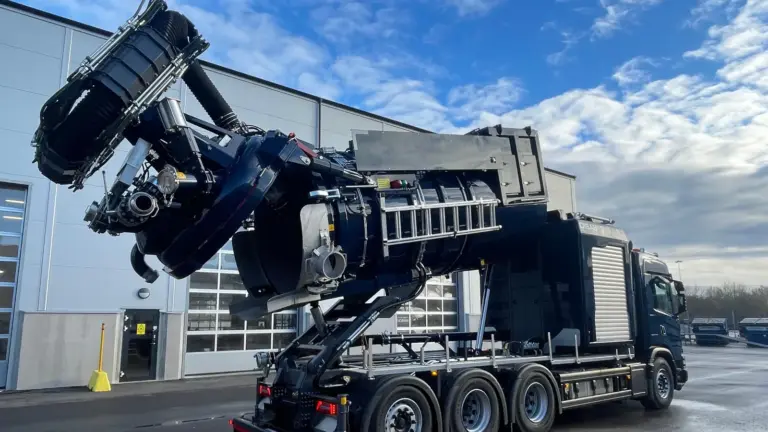
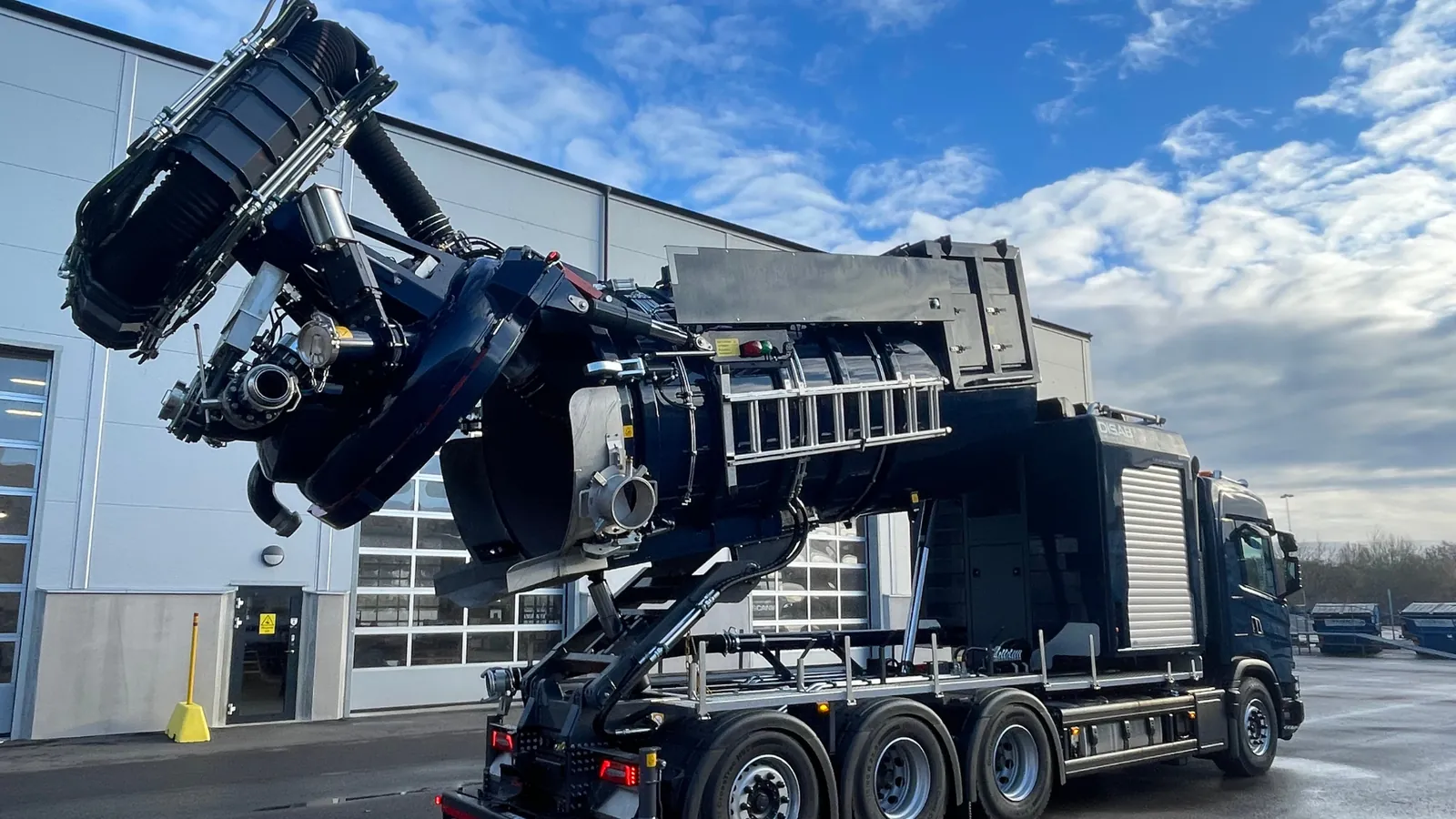
DISAB, whose vacuum trucks, portable units and centralized systems AFE supplies, describes its Futurion as a multi-purpose vacloader for suction, blowing and excavation. It also states that its centralized systems are available with ATEX-approved options and can handle hot materials up to 600°C. DISAB does not publish generic suction-distance figures, so ask for application-based confirmation on your material and route. For degreasing conveyors and machinery during maintenance stops, AFE also supplies TECNOVAP dry steam generators.

Watch how one vacloader switches between suction, blowing and excavation; it shows the technology, not a Saudi site.
What should Saudi cement plants specify for dust control?
Cement plants should specify capture at the source, vacuum housekeeping and spillage recovery as one package, each sized for its own job. A dust collector at a packing machine reduces escape, a vacuum removes what settles, and a heavy-duty loader handles spillage around mills, elevators and conveyors; see pairing capture with housekeeping in a cement packing plant and choosing between fixed and mobile central vacuum layouts.
Filter class is the second decision. Under the IFA summary of IEC/EN 60335-2-69, class L suits dusts with exposure limits above 1 mg/m³, class M limits of 0.1 mg/m³ or more, and class H lower limits and carcinogenic substances. As US references, OSHA sets Portland cement limits of 15 mg/m³ total dust and 5 mg/m³ respirable, and its silica standard restricts dry sweeping where HEPA vacuuming is feasible. These rules do not bind Saudi sites, but they are common benchmarks in company standards.
What should an industrial vacuum specification for a Saudi plant contain?
A good specification describes the task and the hazard, and leaves the supplier to propose a model that it can document. Include:
- Material data: name, safety data sheet, particle size, moisture, abrasiveness and temperature.
- Combustibility: any dust explosibility test results, and the site’s zone drawing for each area of use.
- Duty: hours per shift, volume collected, number of operators cleaning at once.
- Layout: hose routes, lift, power supply and the point where collected material is discharged.
- Filtration: required dust class (L, M or H) and any HEPA requirement from your standards.
- Documents: declaration of conformity, certificate and nameplate marking for any ATEX model, and the standards referenced, including IEC 62784 where relevant.
- Support: spare parts and consumables for the first year, commissioning and operator familiarization.

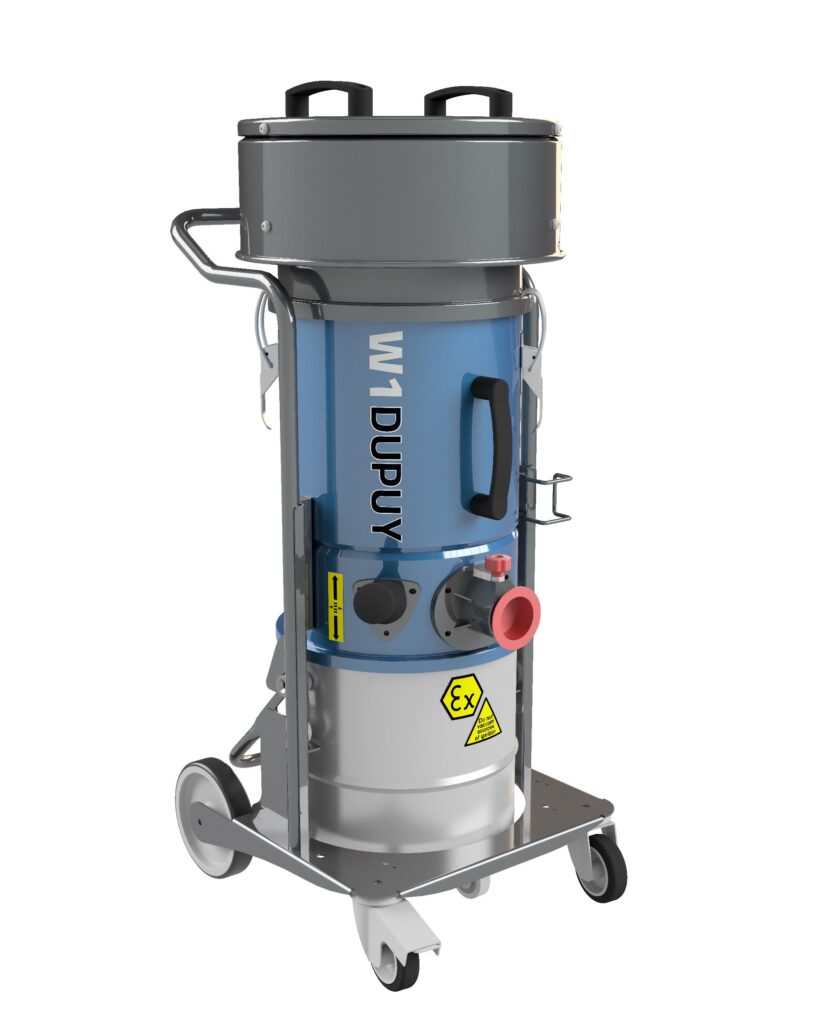
DUPUY presents a compact vacuum in its Atex 3D certified version; check what the marking on any model means for your own zones before relying on it.
How does supply from Aqaba to Saudi Arabia work in practice?
AFE supplies Saudi sites from its hub in Aqaba, which it describes as a strategic connection between Europe, the Levant and the GCC. AD Ports Group describes Aqaba Multipurpose Port as a key transit point for the trade of Jordan’s neighbours, including Saudi Arabia.
AFE states that it sells, rents and executes across Jordan, Saudi Arabia and Iraq, and offers short- and long-term rental for shutdowns and trials. Delivery routes, timings and import documentation for a specific order are confirmed case by case, so plan the sequence below into the project schedule rather than leaving it to the end.
- Freeze the specification. Agree materials, zones, filter class and duty before requesting final offers.
- Confirm the documents. Check certificates and markings against your zone drawing before the order is placed.
- Order spares with the machine. Filters, hoses and wear parts are easier to ship with the unit than later; AFE lists them under MRO and consumables.
- Plan commissioning. Agree who familiarizes operators and who reviews the first months of use.
Specifying a vacuum for a Saudi plant
- Characterize the dust
- Check the zone drawing
- Match model and certificate
- Agree spares and support
For selection support, AFE offers process analysis, system design and ATEX compliance checks, which review proposed equipment against the zones the site has documented; they do not replace the site’s own classification. Equipment ranges are shown under industrial vacuum systems and heavy-duty vacuum trucks, and occasional work can be covered by equipment rental. Plants in neighbouring markets can compare the Jordan guide for phosphate, potash and cement sites and the Iraq buyer guide to supply through Aqaba, or browse the regional insights hub.
Al Faisaliah Enterprises · Aqaba
Get a documented vacuum proposal for your Saudi plant
Send AFE your material data, zone drawing, duty profile and hose routes. You get suitable models with the certificates and markings to check against your zones, plus a first-year spares list.
Frequently asked questions
Is GSO IEC 62784 mandatory for industrial vacuums in Saudi Arabia?
GSO lists GSO IEC 62784:2021 as an approved current standard, but whether it is mandatory for a given purchase depends on Saudi technical regulations, your company standards and your customer's specification. Check with your compliance team or the relevant authority. In practice, asking for IEC 62784 references on any vacuum that will collect combustible dust is a sound requirement either way.
Can one industrial vacuum be used in both classified and normal areas?
A model certified for a zone can usually also work in a non-classified area, but the reverse is not true: a standard machine must stay out of classified zones. Some sites still keep separate fleets to avoid mix-ups, and mark machines clearly. Make sure hoses and tools used in the zone are the conductive ones supplied for that model.
Which filter class does cement dust need?
It depends on the dust's exposure limit and its crystalline silica content, which your hygienist or safety data sheet should state. Under the IEC/EN 60335-2-69 dust classes, M covers exposure limits of 0.1 mg/m³ or more and H covers lower limits and carcinogenic substances. Many sites choose M or H for fine cement and silica-bearing dust; confirm the class against your own exposure data.
Can AFE supply equipment to Saudi sites from Jordan?
AFE is based in Aqaba and states that it serves Jordan, Saudi Arabia and Iraq with equipment sales, rental and services, using Aqaba as its regional gateway. Delivery routing, timing and import documents depend on the equipment and the destination, so they are confirmed for each order. Include the site location and required date in your request.
Does a supplier's ATEX compliance check certify our plant?
No. A compliance check of equipment compares the proposed or existing machines against the zones your site has documented and highlights gaps. Classifying zones and keeping an explosion protection document remain the operator's responsibility, as in EU Directive 1999/92/EC. Any formal certification of equipment comes from the manufacturer's certificate, not from the check.
Sources and references
- 2023 Minerals Yearbook: Saudi Arabia (advance release) · U.S. Geological Survey
- Mineral Commodity Summaries 2026: Cement · U.S. Geological Survey
- GSO IEC 62784:2021 · GCC Standardization Organization
- IEC 62784 preview · VDE Verlag / IEC
- ATEX certified industrial vacuum cleaners · DUPUY
- Directive 1999/92/EC (ATEX workplaces) · EUR-Lex
- Testing of dust filters (dust classes L, M, H) · IFA / DGUV
This article is general technical guidance. Equipment suitability, ATEX conformity and hygiene performance must be confirmed for each site and application.
Written for plant, maintenance, HSE and quality teams in Jordan, Saudi Arabia and Iraq.