The short answer
Source extraction and housekeeping are two halves of one dust-control system. Hoods and a dust collector capture cement dust at packers, spouts, conveyors and loading points before it spreads; industrial vacuums then remove the dust and spillage that escape. Size them together: weak capture multiplies cleaning, and dry sweeping or compressed air puts settled dust back into the air.
Key takeaways
- Source extraction captures dust where it is generated; housekeeping removes what escapes. Neither replaces the other.
- Map every emission point on the packing line before sizing a dust collector or choosing vacuums.
- Size the collector from hood airflows for points running together, plus duct losses, not from available floor space.
- Vacuum instead of dry sweeping or blowing down, and choose the L, M or H dust class from your dust assessment.
- Decide early where collected dust goes: back to the process, into a container, or to waste.
A cement packing plant releases dust at almost every step: when bags are filled at the spouts, when filled bags drop onto conveyors, when a bag bursts, at transfer points and bucket elevators, and when trucks are loaded. Cement packing plant dust extraction captures that dust at the source, but some always escapes and settles on floors, machine frames, beams and cable trays.
Engineering managers are often asked to solve “the dust problem” with one purchase, such as a bigger collector or a new vacuum. In practice, two systems share one dust load. The question applies across the region’s cement sector: the USGS counted 22 portland and white cement plants in Saudi Arabia in 2023, with combined capacity of 85 Mt per year. This guide explains how source capture and housekeeping work together, what to measure before specifying either, and which mistakes keep packing halls dusty.
How do source extraction and housekeeping work together?
They divide the work: source extraction stops dust from leaving the process, and housekeeping removes the dust and spillage that get past it. Hoods at each emission point draw dust-laden air through ducting to a dust collector, which separates the dust and releases cleaned air. Housekeeping deals with what settles, using industrial vacuums or a fixed central vacuum network.
The two are linked. When capture is weak, more dust settles, cleaning takes longer, and every disturbance (a forklift, a draft, a dry brush) puts dust back into the air. When housekeeping is poor, settled dust is re-entrained and adds to the load on the extraction system. Designing both against the same map of emission points is what makes each affordable to run.
Source extraction keeps dust inside the process; housekeeping removes what escapes. A packing plant needs both, sized against the same emission map.
Where does dust escape in a cement packing plant?
Dust escapes wherever cement moves, falls or displaces air, so the first task is a point-by-point map. DUPUY’s cement-industry page lists bagging, loading, conveyor belts and elevator pits among the applications it addresses, alongside centralized dedusting. The table below is a starting framework; your packer type, line layout and product range decide the details.
| Emission point | Why dust escapes | Source control to assess | Housekeeping task |
|---|---|---|---|
| Packer and filling spouts | Air displaced from the bag; leakage at the spout | Hood or enclosure at each spout, ducted to the collector | Spout area and packer frame, often every shift |
| Bag discharge and conveyors | Dust on bag surfaces; impacts at drops | Capture at drop points; enclosed transfers | Conveyor frames and the floor beneath |
| Burst or damaged bags | Sudden release of product | Reject station with local capture | Immediate vacuum pick-up of spillage |
| Transfer points and bucket elevators | Falling material and displaced air | Enclosure, seals and extraction at the transfer | Planned cleaning of the elevator boot and pit |
| Truck and bulk loading | Air displaced from the vehicle; open hatches | Loading spout with extraction | Loading bay floor and walkways |
| Beams, ledges and cable trays | Fine dust carried up and settling | Better capture at the points below | Periodic high-level cleaning |
What should the dust collector at the capture points do?
The collector must deliver the airflow the hoods need while separating cement dust reliably, so hood design comes first and collector sizing follows. Each capture point needs a defined airflow; the total for points that run at the same time, plus duct losses, sets the collector duty.
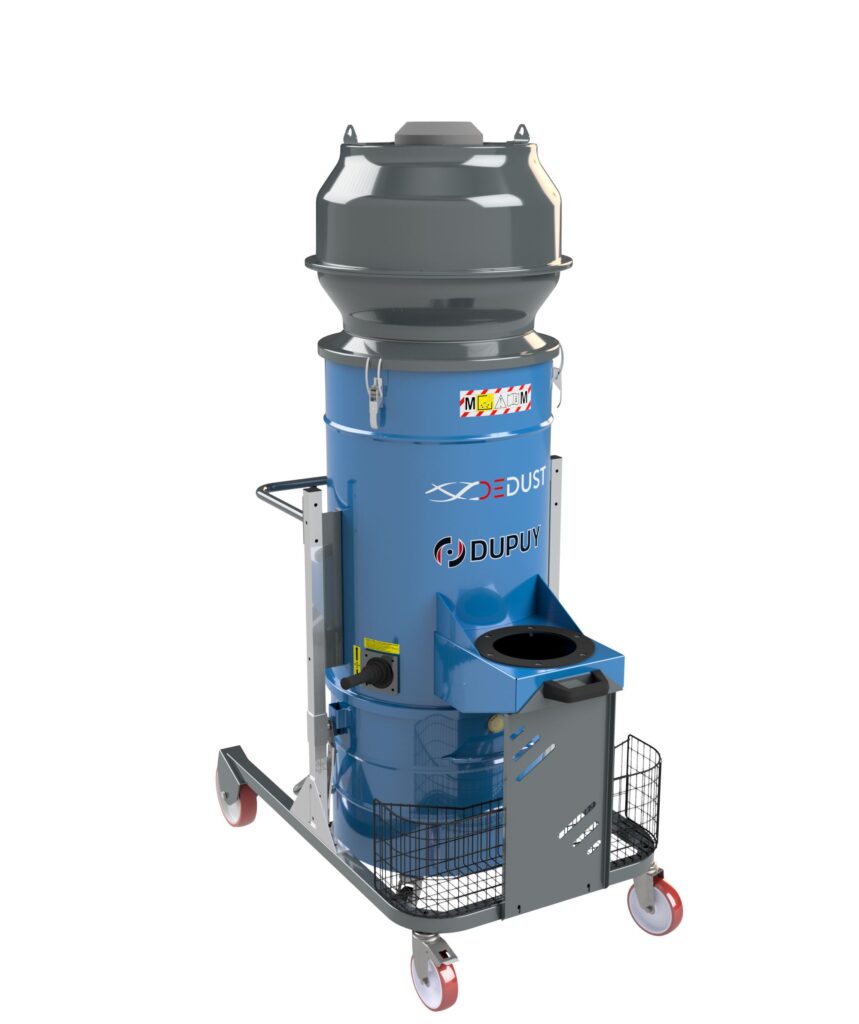
DUPUY describes its DEDUST collectors as using “a stilling chamber in which the principle of gravity is applied”, “ultra-high-efficiency cartridge filters” and “an automatic filter cleaning system using compressed air”. Ask for the filter data of the exact model you are offered and check it against your dust assessment. Agree these points with the supplier:
- Airflow per hood and the duct velocity needed to keep cement dust moving without settling in the ducts.
- Filter area and media suited to fine cement dust, which can cake if moisture reaches the filter.
- Compressed air for automatic filter cleaning: available pressure, dryness and spare capacity.
- Dust discharge to a rotary valve, a container or back to the process.
- Location and access for filter changes, and the summer temperatures the unit must work in.

DUPUY presents the DEDUST ELF range as collectors for centralized extraction systems that capture dry, light and fine dust; treat it as an overview of the technology rather than footage of a packing line.
When the collected dust is clean product from a single cement type, it may be possible to return it to the process. That is a quality decision, not an equipment one; our guide to recovering cement process spillage covers the acceptance questions.
What does good housekeeping look like once extraction is in place?
Good housekeeping removes settled dust and spillage without putting it back into the air, which in practice means vacuuming instead of dry sweeping or blowing down. UK HSE notes that dry sweeping “can produce high levels of dust”, quickly producing peak exposures of around 1–2 mg/m³, and that the dust re-settles; for finer material it recommends vacuum attachments fitted to an H or M class extraction unit.
Choose the vacuum’s dust class from your dust assessment rather than from habit. In the IEC/EN 60335-2-69 classes summarized by Germany’s IFA, class L covers substances with an occupational exposure limit above 1 mg/m³, class M limits of 0.1 mg/m³ or more, and class H carcinogenic substances and limits below 0.1 mg/m³, with maximum filter penetration of 1%, 0.1% and 0.005% respectively. Ask for the documented class of the exact model you are offered.
For packing halls with many cleaning points on several levels, a fixed central vacuum network can replace long hose runs from mobile units. DUPUY states that its central systems move material “through a series of fixed pipes” to a discharge point, with the suction unit “up to hundreds of meters” from the pick-up points, and discharge by rotary valves, removable containers or big bags. Fixed or mobile vacuum systems for cement plants compares the layouts.

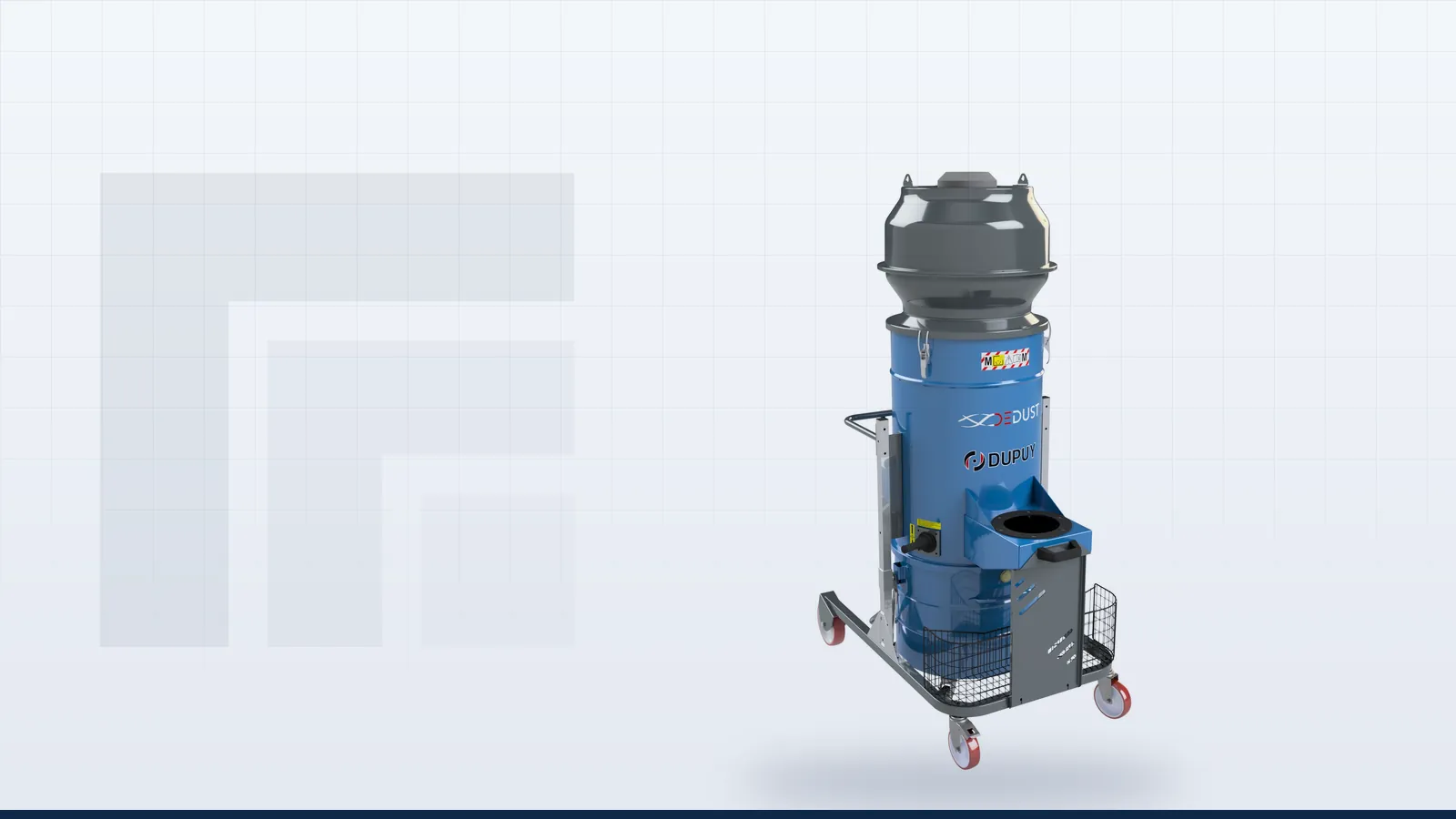
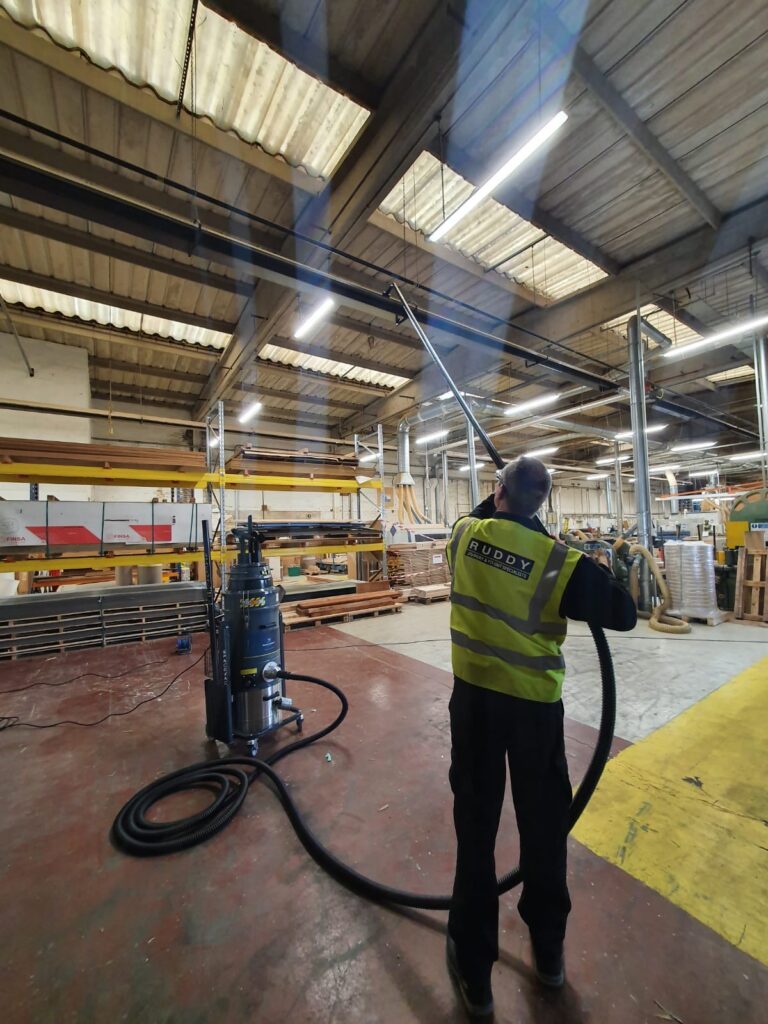
DUPUY names cement factories among the uses of its three-motor W3 mobile vacuum; watch it as an example of a housekeeping vacuum, then confirm its dust class and capacity for your own dust.
What information does a supplier need for cement packing plant dust extraction?
A supplier needs a description of every capture point and of the conditions the equipment will work in; without it, any quotation is a guess. Prepare the following before asking for a proposal:
- Number and type of packers, spouts per packer and typical output per shift
- Products handled (for example grey or white cement, or blended products) and how often they change
- A list of emission points with photos and short videos taken during normal operation
- Existing hoods, ducting and collectors, with their condition and known problems
- Operating hours, shift pattern and planned shutdown windows
- Ambient temperature range, humidity and outdoor dust conditions at the site
- Compressed air (pressure, quality, spare capacity) and electrical supply available
- Space for a collector, and the preferred destination for collected dust
- Areas to be cleaned, current cleaning frequency and method (sweeping, blowing or vacuuming)
- Exposure monitoring results and the site’s dust assessment, if available
- Whether any nearby area is classified for explosive atmospheres, such as coal or alternative-fuel handling
How should you plan a packing plant dust control upgrade?
Plan in a fixed order: capture first, collector second, housekeeping third, then verify. Reversing the order usually means buying a vacuum to compensate for a hood that does not work.
Packing plant dust control sequence
- Map emission points
- Fix source capture
- Size the collector
- Set housekeeping routine
- Verify and adjust
- Map emission points. Walk the line during normal operation and record where dust leaves the process, using the table above.
- Fix source capture. Repair seals and enclosures first, then define hood positions and the airflow each one needs.
- Size the collector. Add the airflows of points that run together, allow for duct losses, and agree filter, cleaning and discharge details.
- Set the housekeeping routine. Define areas, frequency, equipment (mobile vacuum or central network) and the vacuum dust class.
- Verify and adjust. Compare settled dust and exposure results before and after, then adjust hoods, cleaning frequency or equipment.
Which mistakes keep packing plants dusty?
- Using housekeeping to compensate for poor capture. A bigger vacuum cannot fix a leaking spout; it only moves the cost to the cleaning crew.
- Adding points to a collector without rebalancing. New branches connected after commissioning take airflow from the original hoods.
- Dry sweeping and blowing down. Both put settled dust back into the air that the extraction system has just cleaned.
- Neglecting filters. Blinded filters reduce airflow at every hood, so plan spare cartridges and regular checks of the cleaning cycle.
- Leaving overhead dust out of the plan. Dust on beams and cable trays falls back onto the line. AFE’s Internal high clean dust removal service addresses overhead structures from ground level.
How AFE supports packing plant dust control
AFE supplies DUPUY dust collectors, industrial vacuums and central vacuum systems and helps engineering teams match them to measured capture points and cleaning loads. Its consulting and engineering service covers process analysis and system design, and spare filters and consumables can be planned together with the equipment.
Because the equipment is made in Italy and reaches Jordan, Saudi Arabia and Iraq through AFE’s Aqaba regional gateway, agree the spare-filter stock at the time of order rather than after the first filter change. More cement guides are collected in AFE’s cement insights.
Al Faisaliah Enterprises · Aqaba
Specify extraction and housekeeping together
Send AFE your packing-line layout, capture-point photos and current cleaning method. You get advice on matching DUPUY dust collectors and industrial vacuums to each point.
Frequently asked questions
Can an industrial vacuum replace extraction hoods at the packer?
No. A vacuum removes dust after it has escaped and settled; it cannot stop dust leaving a spout while bags are being filled. If the hoods do not capture well, a vacuum only shifts the effort to the cleaning crew, and workers are still exposed while the dust is airborne. Fix capture at the source first, then size housekeeping for the residual dust and spillage.
Can dust from the packing plant collector go back into the cement?
Sometimes, but it is a quality decision, not an equipment one. Returning collected dust is usually only considered when the collector serves a single product and the dust is free of moisture and foreign material. Agree acceptance criteria with your quality team before designing the discharge, and keep collectors on different products separate if their dust is to be reused.
Which vacuum dust class should we use for cement dust?
Base it on your dust assessment. Under the IEC/EN 60335-2-69 classes summarized by Germany's IFA, L, M and H classes are tied to the occupational exposure limits of the substances present, with H reserved for carcinogenic substances and the lowest limits. UK HSE recommends H or M class units for finer material. Ask the supplier for the documented class of the exact model.
How often should a cement packing plant be cleaned?
There is no universal frequency. Record how quickly dust builds up at each area during normal operation and schedule cleaning before it can be re-entrained or spread onto walkways. Spouts and bag discharge areas often need attention every shift, while overhead structures need less frequent but planned cleaning. Review the schedule after any improvement to source capture.
What compressed air does a pulse-cleaned dust collector need?
Pulse-cleaned collectors use bursts of compressed air to clear dust from the filters, so the supply must be reliable, clean and dry. With cement dust, moisture in the air supply can make dust cake on the filter. Tell the supplier your available pressure, air treatment and spare compressor capacity so the cleaning system can be sized and checked.
Sources and references
- Industrial dust collectors for fine suspended dusts — DUPUY
- Cement industry solutions — DUPUY
- Centralized vacuum systems — DUPUY
- Sweeping and cleaning: controlling dust — UK Health and Safety Executive
- 29 CFR 1910.1053 Respirable crystalline silica — US OSHA
- Testing of dust filters (dust classes L, M, H) — IFA / DGUV
- 2023 Minerals Yearbook: Saudi Arabia — US Geological Survey
This article is general technical guidance. Equipment suitability, ATEX conformity and hygiene performance must be confirmed for each site and application.
Written for plant, maintenance, HSE and quality teams in Jordan, Saudi Arabia and Iraq.