The short answer
Silica and cement dust rules push sites toward vacuum cleaning because dry sweeping and compressed air put fine dust back into the air. OSHA restricts both for silica unless HEPA vacuuming or wet methods are not feasible. Choose the vacuum's dust class from the dust's hazard: class H where respirable crystalline silica is present or suspected.
Key takeaways
- Dry sweeping and compressed air re-suspend the finest, most harmful particles; vacuuming captures them.
- OSHA, EU and HSE rules are international references, not law in Jordan, KSA or Iraq.
- Cement dust limits are far higher than silica limits, so identify the dust in each area first.
- Choose class H where silica is present or suspected, and get dust-class documents per model.
- Wetting cement dust can create a caustic slurry; collecting it dry avoids that.
In many cement plants and quarries, housekeeping still means a broom, a shovel and a compressed-air line. Fine dust from raw mills, kiln areas, clinker handling and packing settles on floors, gratings, walkways and machine tops, and it is pushed around rather than removed. Each pass puts a share of it back into the air the crew breathes.
This is why a silica dust vacuum has become the expected housekeeping tool wherever respirable crystalline silica or fine cement dust is present. This explainer for HSE managers sets out what international silica and cement dust rules say about housekeeping, why they push sites away from sweeping and compressed air, and how to choose the right vacuum dust class for the job.
Why are dry sweeping and compressed air the problem?
Dry sweeping and compressed air are the problem because they move fine dust into the air instead of capturing it. The particles that matter most for health are the smallest ones, and they are exactly the ones that a broom lifts and a jet of air disperses.
The UK Health and Safety Executive states that dry sweeping “can produce high levels of dust” and “quickly produces high peak exposures of around 1-2 mg/m3,” after which the dust settles again. For finer material it advises “vacuum attachments fitted to an H or M class extraction unit.” Compressed air is worse: it spreads the deposit over every surface nearby, including those already cleaned, and into the breathing zone of anyone close by.
Vacuuming changes the direction of travel. The dust goes into a filtered container, and the question becomes how good that filter is, which is what the dust classes answer.
What do international silica and cement dust rules say about housekeeping?
The main international references restrict dry sweeping and compressed air for silica and favor filtered vacuuming or wet methods. They are US, EU and UK rules: international references, not law in Jordan, Saudi Arabia or Iraq, where the site’s own national requirements and company standards apply.
| Reference | What it says | Status for sites in the region |
|---|---|---|
| US OSHA 29 CFR 1910.1053, respirable crystalline silica | PEL 50 µg/m³ (8-hour TWA), action level 25 µg/m³. No dry sweeping or brushing that could contribute to exposure unless wet sweeping, HEPA-filtered vacuuming or other low-exposure methods are not feasible. Compressed air only with a capturing ventilation system or where no alternative is feasible. | International reference |
| EU Directive (EU) 2017/2398 | Limit value of 0.1 mg/m³ for respirable crystalline silica dust; work involving exposure to it generated by a work process is added to the directive’s list of carcinogenic processes | International reference |
| US OSHA Table Z-1, Portland cement | 15 mg/m³ total dust, 5 mg/m³ respirable fraction | International reference |
| US NIOSH Pocket Guide, Portland cement | Recommended limit 10 mg/m³ total, 5 mg/m³ respirable | International reference |
| UK HSE construction dust guidance | Avoid dry sweeping; use H or M class extraction for finer material | International reference |
The health reasons behind these limits are well documented. OSHA describes silicosis as “an incurable lung disease that can lead to disability and death” and links silica exposure to lung cancer, COPD and kidney disease; it estimates that about 2.3 million people in the US are exposed to silica at work. For cement dust, the NIOSH Pocket Guide lists eye, skin and nose irritation, cough, wheezing, chronic bronchitis and dermatitis among the symptoms.
Is cement dust treated the same as silica dust?
No. Portland cement dust has its own, much higher exposure limits, but a cement plant also handles materials that can contain crystalline silica, so the dust in a given area has to be identified before the cleaning method and vacuum class are set.
The numbers show the gap. The OSHA respirable limit for Portland cement is 5 mg/m³, while the OSHA silica PEL is 50 µg/m³, one hundredth of that. Quarry materials, raw meal, additives and refractory work can all bring silica into play, and the site’s safety data sheets and occupational hygiene sampling are what tell you whether it is present and at what level. DUPUY, in its cement sector material, also notes that “prolonged exposure to cement dust can lead to serious health problems.”
Wet methods need care in cement areas. OSHA’s Portland cement guidance explains that wet cement is caustic and abrasive and that “wet portland cement can cause caustic burns,” while dry cement is less hazardous to the skin. Wetting settled cement dust to keep it down can therefore create a caustic slurry that is harder to remove and more harmful to skin. Collecting the dust dry, with a filtered vacuum, avoids that problem.
How do you choose the silica dust vacuum class: L, M or H?
Choose the dust class from the hazard of the dust, using its occupational exposure limit and whether it is classified as carcinogenic. The classes come from the vacuum safety standard IEC/EN 60335-2-69, summarized by the German IFA as follows.
| Dust class | For dusts with | Maximum filter penetration | Typical cement plant use |
|---|---|---|---|
| L | OEL above 1 mg/m³ | Less than 1% | Coarse spillage and general dust with no hazardous content, confirmed by hazard data |
| M | OEL of 0.1 mg/m³ or greater | Less than 0.1% | Fine dusts with lower limits; HSE accepts M or H for finer construction dust |
| H | OEL below 0.1 mg/m³ and carcinogenic, mutagenic or reprotoxic (CMR) substances | Less than 0.005% | Dust where respirable crystalline silica is present or suspected |
For silica, the reasoning usually leads to class H. The EU limit sits at 0.1 mg/m³, the boundary of the M band, and the EU lists work that generates respirable crystalline silica dust as a carcinogenic process, which points to the CMR criterion for H. Where the site has confirmed that an area’s dust contains no silica and no other hazardous substance, a lower class may be justified, but that decision should be written into the site’s risk assessment rather than assumed.
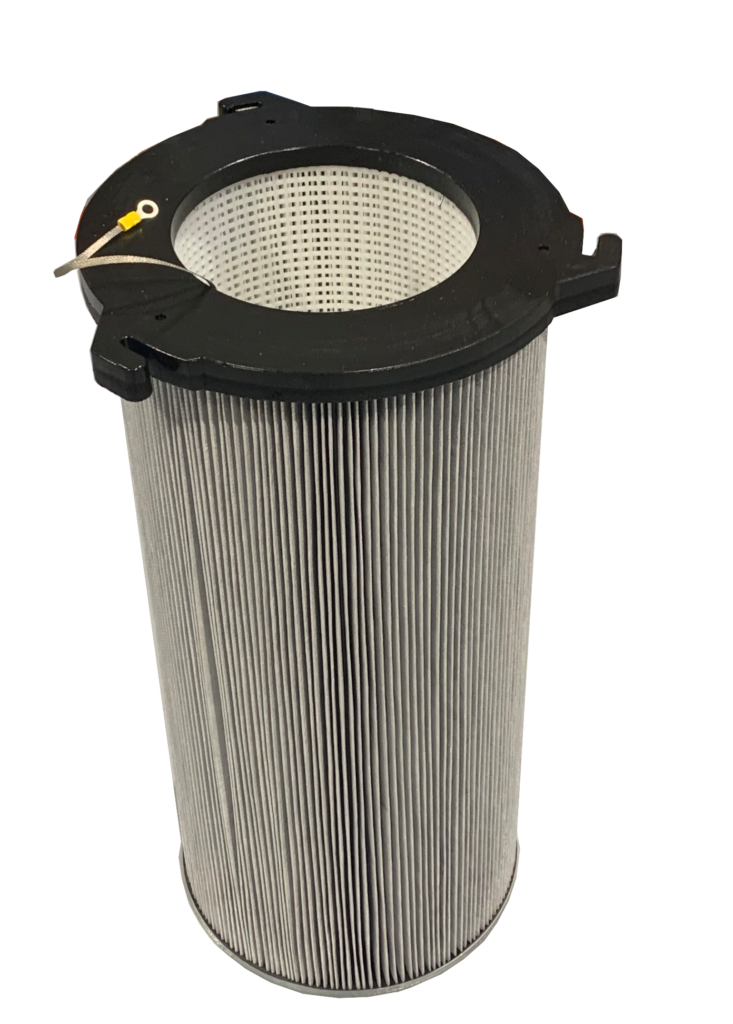
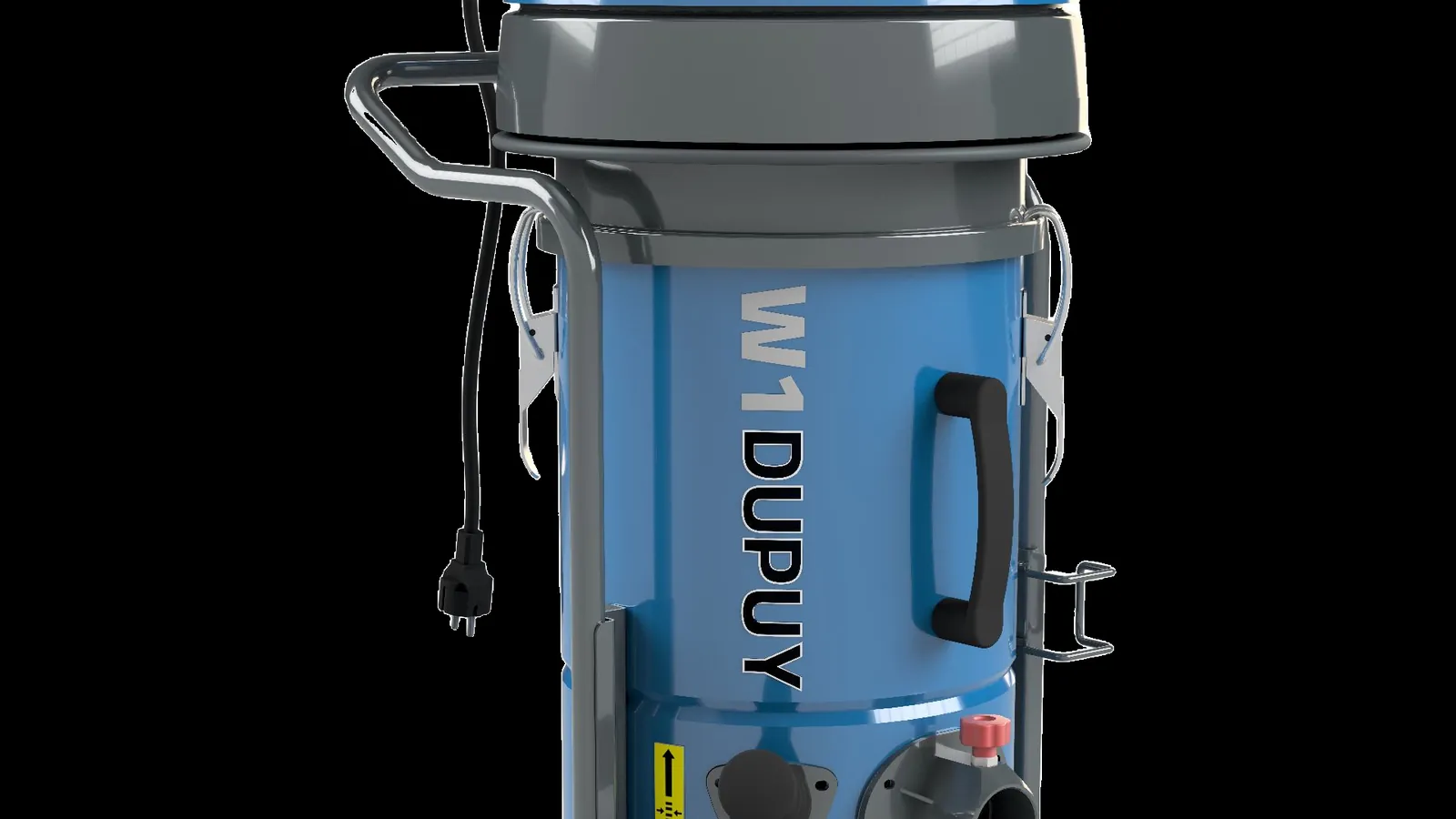
Two details are often missed. First, HEPA and H class are different things: OSHA defines a HEPA filter as “at least 99.97 percent efficient in removing mono-dispersed particles of 0.3 micrometers in diameter,” while the dust class is tested to its own procedure. A good filter in a poorly sealed machine does not make an H-class vacuum, so ask for the dust-class documentation of the specific model. Second, DUPUY’s category pages do not state a dust class for each model, so request it, model by model, before you buy.
What else makes a vacuum suitable for silica and cement dust?
Beyond the dust class, a suitable vacuum is one the crew can empty, clean and maintain without re-exposing themselves, and one that is sized for the quantity and the shift pattern.
- Certified dust class for the complete machine, documented per model.
- Filter cleaning that does not require opening the filter chamber in the work area.
- Closed discharge into bags, containers or big bags, so emptying does not undo the cleaning.
- Duty and capacity to match the area: DUPUY lists three-phase industrial vacuums with turbines “up to 20kW” and silo vacuums for heavier, continuous work.
- Hose and tools for gratings, belts, pits and machine bases, so nobody reaches for a broom.
- Spare filters and wear parts held on site, with a replacement routine taken from the manufacturer’s manual.
- ATEX status only where the site’s zoning requires it. DUPUY lists ATEX-certified solutions for coal and alternative fuel areas; suitability is model-specific and has to match the site’s zone classification.

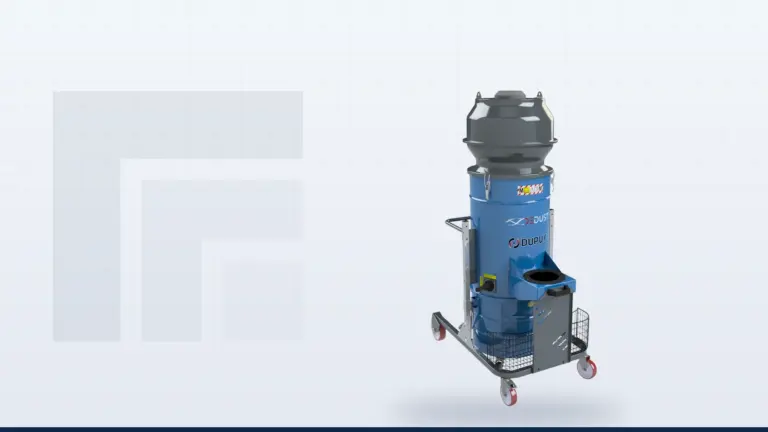
DUPUY’s film shows its three-motor W3 mobile vacuum, which it lists for uses including cement factories. Watch the container and filter arrangement, then ask for the dust-class documentation of the exact configuration you would buy.
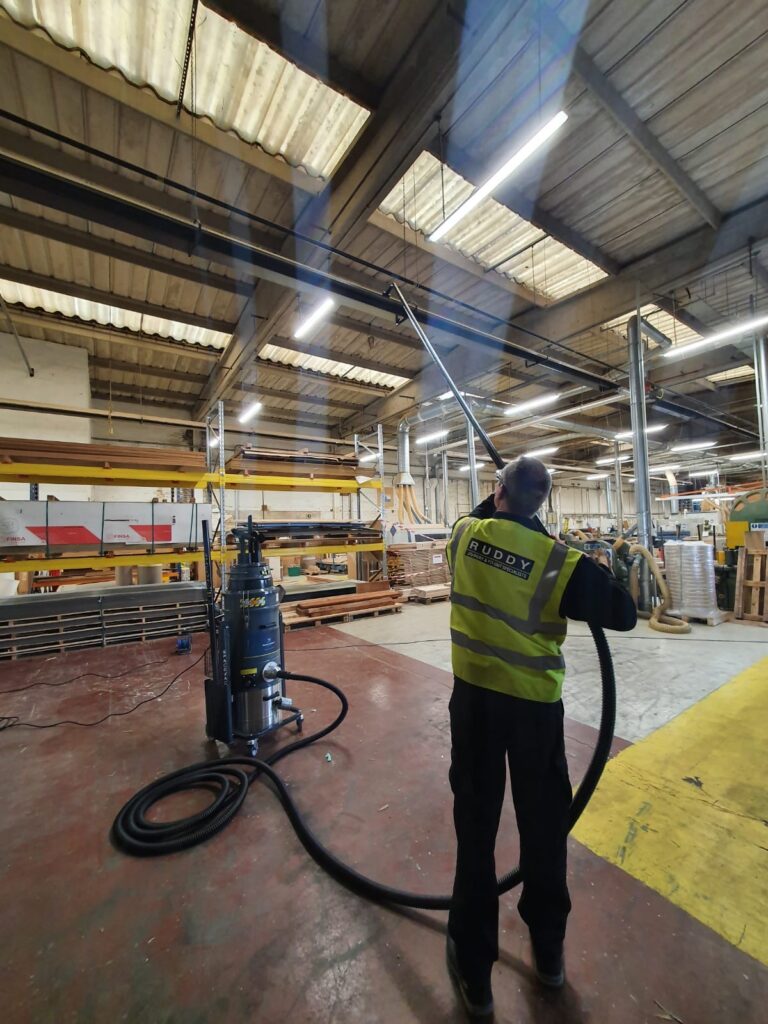
Where the same points need cleaning every shift, such as packing lines or transfer points, a fixed network can be more practical than mobile units; see fixed, mobile or mixed central vacuum systems for cement plants and pairing dust capture with housekeeping in packing plants.
How do you move a site from brooms to vacuums?
Treat it as a change in method, not just a purchase: define the tasks, choose the equipment for each, train the crews and make the old methods the exception that needs approval.
- List the housekeeping tasks. Area, material, quantity, frequency and the method used today.
- Identify the dust. Use safety data sheets and hygiene sampling to mark where silica is present or suspected.
- Set the class per area. H where silica is present or suspected, lower classes only where the risk assessment supports it.
- Select and place equipment. Mobile units sized for each area, or a central system for fixed points, with tools and spares.
- Train and set rules. Filter changes and emptying with the right PPE; dry sweeping and compressed air only by exception.
- Review. Check exposure monitoring, filter condition and housekeeping standards, then adjust.
From broom to filtered vacuum
How AFE supports silica and cement dust housekeeping
AFE supplies DUPUY industrial vacuums, silo vacuums and dust collectors through its industrial vacuum range, and offers process analysis and system design through its consulting team. Filters, hoses and wear parts are available through MRO and consumables, and units can be rented for a trial before a fleet decision. More cement guides are on the cement insights hub, including managing industrial vacuum filters and spare parts.
Al Faisaliah Enterprises · Aqaba
Choose the right vacuum class for each area
Send your housekeeping task list, the materials handled and any hygiene sampling data. AFE proposes DUPUY models, dust classes, tools and spares for each area.
Frequently asked questions
Is a HEPA vacuum the same as an H-class vacuum?
Not necessarily. HEPA describes a filter's efficiency: OSHA defines it as at least 99.97% efficient at 0.3 micrometers. H class is a dust class under the vacuum safety standard, with its own test and a penetration limit below 0.005%. Ask for the dust-class documentation of the specific model rather than relying on a HEPA label alone.
Can we keep using wet sweeping instead of vacuums?
For silica, OSHA treats wet sweeping as one acceptable alternative to dry sweeping. In cement areas, though, wetting dust creates wet cement, which OSHA's guidance describes as caustic and able to cause burns, and the slurry is harder to clear. Many sites therefore collect dry dust with a filtered vacuum and keep wet methods for specific tasks.
Do Jordan, Saudi Arabia or Iraq use the OSHA or EU silica limits?
This article does not cover national law in those countries. The OSHA, EU and HSE rules it cites are international references. Check the national exposure limits and any company or group standard with your HSE function, and apply whichever requirement is stricter.
Does every vacuum in a cement plant need to be ATEX-certified?
Not necessarily. ATEX equipment is needed where the site's own zoning identifies a combustible dust hazard, for example in coal and alternative fuel areas, for which DUPUY lists ATEX-certified solutions. In those zones the vacuum must be a model certified for that zone; elsewhere, the dust class decides. Suitability is model-specific and confirmed against the site's classification.
How often should vacuum filters be changed in silica work?
Follow the manufacturer's manual for the specific model, and use condition signs such as falling suction, filter differential pressure where measured, and visible damage. Change filters with the PPE your risk assessment requires, in a way that does not release collected dust, and keep spare elements on site.
Sources and references
- 29 CFR 1910.1053, Respirable crystalline silica · US Occupational Safety and Health Administration
- Directive (EU) 2017/2398 amending Directive 2004/37/EC (carcinogens or mutagens at work) · European Union (EUR-Lex)
- Table Z-1, Limits for air contaminants · US Occupational Safety and Health Administration
- NIOSH Pocket Guide to Chemical Hazards: Portland cement · US National Institute for Occupational Safety and Health
- Sweeping and cleaning (construction dust) · UK Health and Safety Executive
- Testing of dust filters (dust classes L, M, H) · IFA, German Social Accident Insurance
- Preventing Skin Problems from Working with Portland Cement (OSHA 3351-07) · US Occupational Safety and Health Administration
This article is general technical guidance. Equipment suitability, ATEX conformity and hygiene performance must be confirmed for each site and application.
Written for plant, maintenance, HSE and quality teams in Jordan, Saudi Arabia and Iraq.