The short answer
Olive oil mills should collect oil and paste dry first, then degrease equipment exteriors and floors with dry steam combined with vacuum extraction, during the season and in a fixed season-end sequence. This limits wash water, which matters because olive mill wastewater is a known pollutant. Decanter internals follow the maker's procedure.
Key takeaways
- Jordan had 153 olive mills in 2025, with output swinging sharply between seasons.
- Clean exteriors with steam; clean decanter and separator internals to the maker's procedure.
- Collect oil and paste dry first to cut oily wash water.
- EU research links olive mill wastewater problems to its phenolic compounds.
- Removing oil is cleaning; sanitizing needs its own validated step.
An olive mill runs flat out for a few months and then stands idle for most of the year. During the season, oil, pulp and fine olive paste coat crushers, malaxers, decanters, pumps, pipework and floors. After the season, whatever was left on the equipment oxidizes, hardens and becomes harder to remove, just when the plant is being prepared for maintenance.
This guide explains how dry steam fits olive oil mill cleaning: where residues build up, what to clean during the season and after it, how steam degreasing compares with washing, and why wastewater matters so much for mills in Jordan and the wider region. It is written for mill owners, production managers and maintenance teams.
Why does olive oil mill cleaning need a seasonal plan?
It needs a seasonal plan because the workload, the residues and the risks change sharply between the harvest and the rest of the year. In Jordan, the Department of Statistics counted 153 olive mills in 2025, 149 of them operating, according to the official news agency Petra.
Output also swings from year to year. The Department reported 16,342 tonnes of olive oil in the 2025 season, down 54.4% from 35,828 tonnes the season before, and linked the changes to “alternate bearing and rainfall variability.” A cleaning plan therefore has to cope with very busy seasons and quieter ones, and with long idle periods in between.
- During the season: keep equipment, floors and walkways workable and hygienic without stopping production for long.
- At season end: remove oil and paste from equipment before it hardens, so machines can be inspected and serviced.
- Before restart: clean again after maintenance and long storage, before the first olives arrive.
Where do oil residues build up in an olive mill?
Residues build up wherever paste, oil or water splashes, drips or leaks, and on any surface workers touch with oily gloves. Walk the process in order and list the surfaces at each stage.
| Area | Typical residue | During the season | After the season |
|---|---|---|---|
| Reception, leaf removal and washing | Soil, leaves, wet debris | Clear debris and keep drains open | Clean hoppers, conveyors and frames |
| Crusher and malaxers | Olive paste on covers, frames and surroundings | Clean outside surfaces and spills at shift end | Degrease frames, covers and motor housings |
| Decanter and separators | Oil film, paste and pomace splashes on housings | Wipe and degrease external surfaces | Follow the maker’s procedure for internals; degrease exteriors |
| Pumps, pipework and valves | Oil drips and leaks | Clean leaks as found and record them | Degrease before inspection and repair |
| Floors, drains and walkways | Oily film, paste, pomace | Remove spills promptly to limit slips | Deep clean before storage or works |
| Oil storage and bottling area | Oil drips around tanks and fillers | Clean around outlets and fillers | Clean tank exteriors and bunds |
Oily floors deserve particular attention in season, because they are where residue becomes a safety problem as well as a hygiene one. Clear spills as they happen rather than waiting for the end of the shift.
The table separates external surfaces, where steam is useful, from the internals of decanters and separators, which should be cleaned to the equipment maker’s instructions.
How does dry steam degreasing work on mill equipment?
Dry steam degreasing uses high-temperature steam to soften and lift oil and paste so it can be wiped or vacuumed away with little water. TECNOVAP, whose generators AFE supplies, lists “removal of food residues such as encrustations, oil, grease” among the benefits of its food-industry steam systems, together with savings on detergents and a “considerable reduction in water consumption.”
- Combine with extraction: TECNOVAP states that its generators “can be combined with powerful industrial vacuum cleaners” to extract the dirt the steam has loosened; its Steam Box Vac Industrial is described as “equipped with a wet/dry vacuum cleaner.”
- Choose the tool for the surface: lances and brushes for frames and housings, wider tools for floors and panels.
- Remember the limits: published steam temperatures are generator-side figures; they do not prove a surface temperature or a hygiene result.
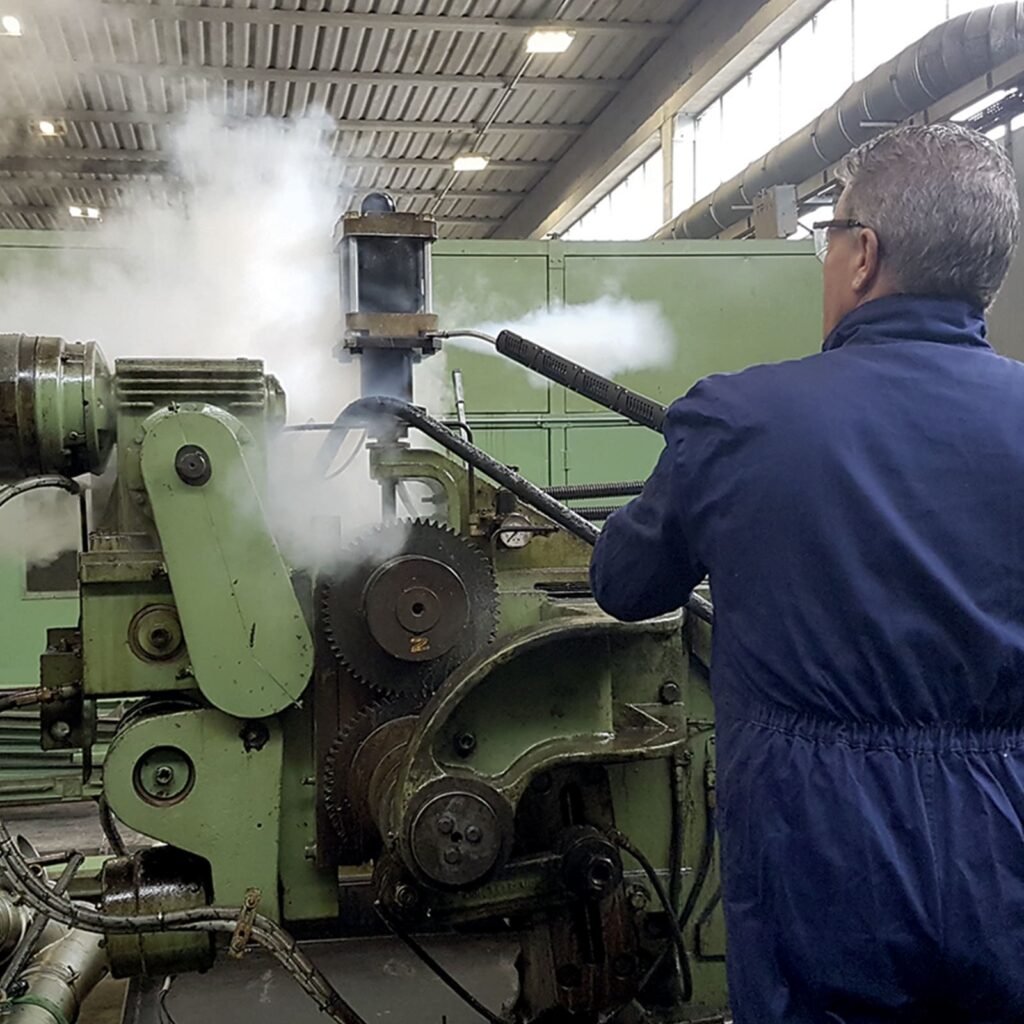
For a wider view of steam degreasing on machinery, see dry steam degreasing for industrial machinery.

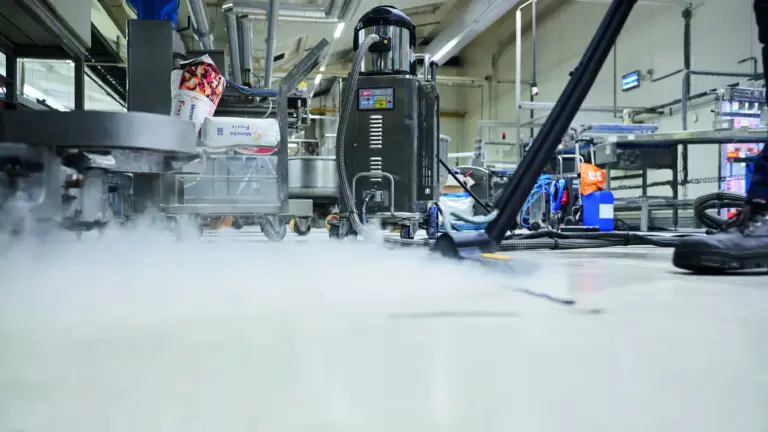
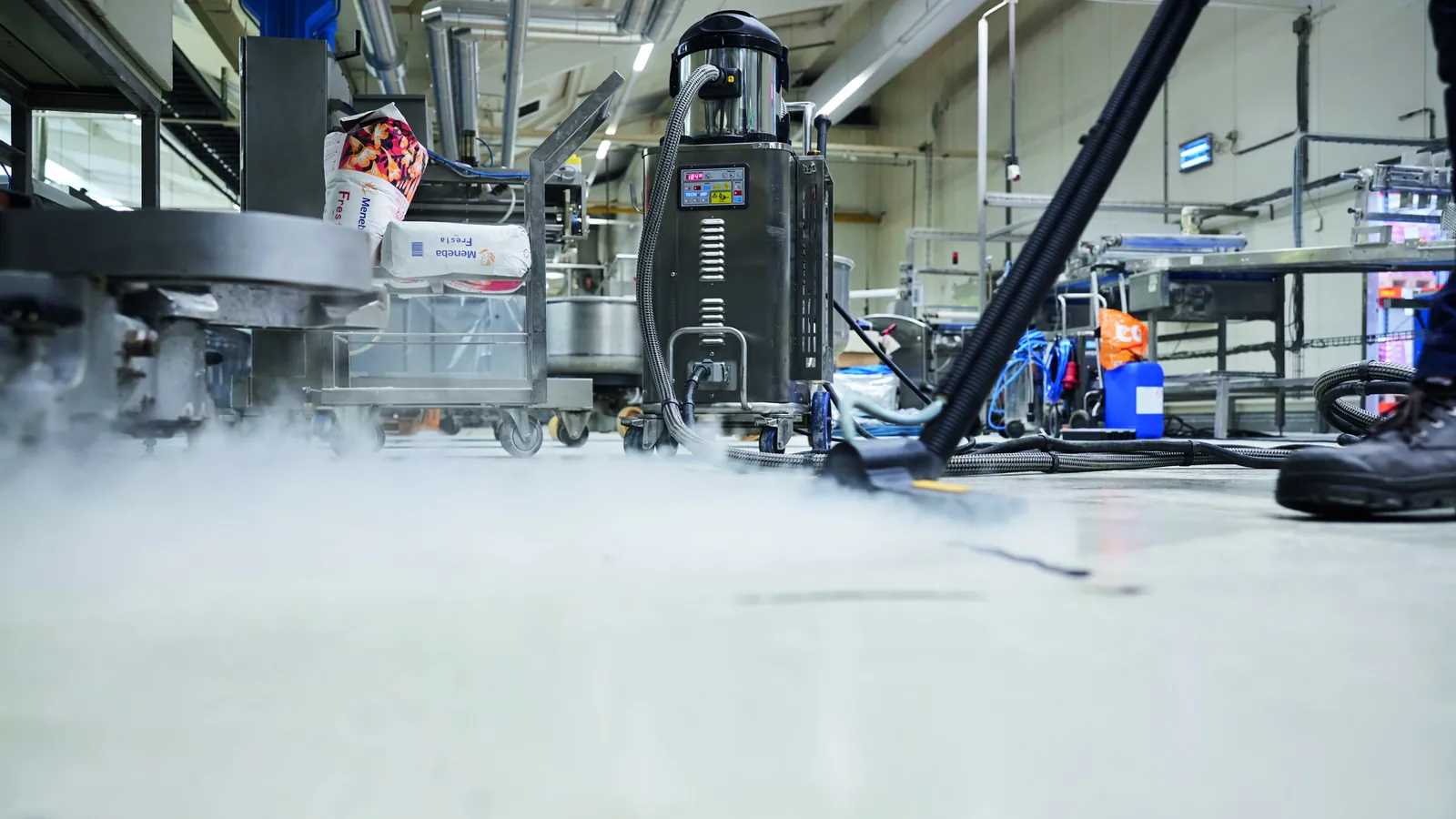
The film shows TECNOVAP steam removing oil, grease and encrustation from machinery in a mechanical plant, not an olive mill; watch how the operator works close to the surface and follows with a cloth or vacuum to carry the loosened oil away.
Why does wastewater matter in olive oil mill cleaning?
Wastewater matters because olive mill effluent is already a known environmental problem, and every litre of oily wash water adds to what the mill must store, treat or dispose of. EU-funded research on CORDIS describes olive mill wastewater as generating “environmental problems especially in the Mediterranean region,” mainly because of “the potential toxicity of the phenolic compounds” it contains.
Water itself is scarce. Jordan’s Ministry of Water and Irrigation describes the country as “one of the world’s most water-scarce nations” and says increasing industrial water use efficiency “is critical.” Cleaning with less water reduces both the volume of oily effluent and the demand on supply.
- Collect oil and paste dry before washing anything, with scrapers, absorbent material or a vacuum.
- Use steam with extraction on equipment exteriors to limit wash water.
- Keep cleaning water out of the mill’s process effluent where your licence requires separation.
- Dispose of collected oily residue through the routes your permits allow.
Rules on mill effluent differ by country and site, so follow your own licence conditions and the authority that issued them. For dry methods in food plants generally, see dry cleaning in food plants.
What sequence works at season end?
A fixed sequence at season end saves time and protects equipment that will stand idle for months. The EU work-equipment directive (EU law, not law in Jordan, but a useful reference) lists “prolonged periods of inactivity” among the exceptional circumstances that call for a special inspection of equipment, and clean equipment makes that restart inspection easier.
- Isolate and lock out. Stop the line and isolate each machine from its energy sources before anyone cleans it.
- Remove bulk material. Scrape and collect paste, pomace and oil dry; empty sumps and trays.
- Steam degrease exteriors. Work from top to bottom on frames, covers, housings, pumps and pipework, extracting loosened oil as you go.
- Clean floors and drains. Degrease floors last so dirt from equipment is not carried back.
- Dry, inspect and record. Let surfaces dry, check for leaks, wear and corrosion, and record findings for the maintenance plan.
Season-end mill cleaning
What should a mill ask before buying steam equipment?
A steam generator should be chosen for your surfaces, duty and site, not from a catalogue. Prepare these answers before asking for a proposal:
- How many lines, decanters and malaxers, and their approximate size.
- Which surfaces you want to steam: frames, housings, floors, tank exteriors.
- How many hours of cleaning per day in season and in the season-end campaign.
- Available power supply and water quality at the cleaning points.
- Whether you need built-in vacuum extraction or a separate vacuum.
- Your effluent and disposal arrangements, so cleaning fits within them.
- Who will operate the unit, and what training they need.
AFE supplies TECNOVAP dry steam generators through its dry steam range, and offers industrial steam cleaning and degreasing as a service where a season-end campaign needs extra hands. A trial on your own equipment can be arranged through equipment rental.
How do you know the cleaning plan is working?
You know it works when equipment comes out of storage clean, wash water falls and spills stop causing problems in season. Check:
- Restart condition: hardened residues found at restart inspection.
- Water use: cleaning water per day of operation, compared season to season.
- Slips and spills: incidents and near misses on oily floors.
- Hygiene records: cleaning logs that match your food safety plan.
For other food-sector guides, browse food and beverage insights.
Al Faisaliah Enterprises · Aqaba
Choose steam equipment for your mill
Tell AFE how many lines you run, which surfaces you clean and your power supply. You get advice on TECNOVAP generators, tools and extraction that fit.
Frequently asked questions
Can dry steam clean the inside of a decanter?
Decanter and separator internals should be cleaned following the equipment maker's procedure, which may involve specific flushing and dismantling steps. Dry steam is most useful on the exteriors: housings, frames, covers, pumps and the floor around them. Ask the decanter supplier before using steam on seals, bearings or electrical parts.
Does steam cleaning remove the need for detergents?
TECNOVAP states that steam gives savings on the purchase of detergents and a considerable reduction in water consumption. On heavy, oxidized residues some mills may still need a suitable cleaning agent. Trial steam on your own equipment and residues before deciding how far it replaces chemical cleaning.
When is the best time to deep clean an olive mill?
Straight after the last pressing, before oil and paste dry and harden on idle equipment. A second, lighter clean before restart removes dust and residues from storage and maintenance work. Cleaning during the season should focus on spills, floors and external surfaces so production is not stopped for long.
What happens to the oil removed during steam cleaning?
It still has to be collected and disposed of. Steam with extraction gathers loosened oil in a vacuum tank or on cloths, rather than washing it into drains with large volumes of water. Dispose of that residue through the routes your site permits allow, and keep it out of the drains.
Sources and references
- Olive oil output falls 54.4% in 2025 season, DoS survey shows · Petra (Jordan News Agency)
- Cost-effective technology for treating olive oil wastewater · European Commission, CORDIS
- National Water Conservation Roadmap · Jordan Ministry of Water and Irrigation
- Food industry · TECNOVAP
- Regulation (EC) No 852/2004 on the hygiene of foodstuffs · European Union
- Directive 2009/104/EC (use of work equipment), Article 5 · European Union (via legislation.gov.uk)
This article is general technical guidance. Equipment suitability, ATEX conformity and hygiene performance must be confirmed for each site and application.
Written for plant, maintenance, HSE and quality teams in Jordan, Saudi Arabia and Iraq.