The short answer
Large public buildings should plan high-level dust removal zone by zone: map the quiet windows, size each zone to fit one window, keep the public out with a barrier-controlled exclusion zone, capture dust at the cleaning head with a filtered vacuum, work from the ground where reach allows, and hand back each zone with photo evidence.
Key takeaways
- Size each zone so it can be prepared, cleaned and handed back inside one quiet window.
- Nobody stands under the work: keep a barrier-controlled exclusion zone and a spotter in place.
- Capture dust at the cleaning head; brushing it down moves it onto seats, counters and people.
- Work from the ground where measured heights allow, and plan access equipment for the rest.
- List exclusions such as fire detection, sprinklers and internal ducts in the method statement.
Schools, shopping malls, stadiums and airport terminals collect dust where nobody looks: on roof steel, skylight frames, lighting rigs, signage, ductwork exteriors, speaker clusters and high ledges. It builds up quietly until a beam of sunlight shows it, a visitor complains or it starts to fall on the people, seats and shopfronts below.
Buying high-level cleaning services for a public building is mostly a planning problem. The work has to fit around visitors, opening hours, events and security rules, and the public must never be underneath it. This guide explains how facilities managers can scope, schedule and control overhead dust removal in large public buildings, and what AFE needs to plan its Internal high clean dust removal service around them.
Why do public buildings need a different high-level cleaning plan?
Public buildings need a different plan because the people below the work are visitors, pupils, shoppers and passengers rather than trained staff, and many of these buildings never fully close. An industrial site can isolate an area and issue permits; a mall or terminal has to keep routes, shops and gates open while one zone is cleaned.
The method matters as much as the timing. In its construction dust guidance, the UK Health and Safety Executive notes that dry sweeping “can produce high levels of dust” and that the dust settles again afterwards. Brushing dust off a beam with a long-handled duster simply moves it onto seats, counters and people below. Capturing it at the cleaning head, in a vacuum with suitable filtration, removes it from the building.
Finishes add another constraint. Public interiors combine fragile and expensive items, such as decorative ceilings, glazing, display screens and hanging signs, with building services such as smoke detectors, sprinkler heads and lighting. The plan has to say what is cleaned, what is only inspected and what nobody touches.
Which high-level surfaces matter in schools, malls, stadiums and airports?
The surfaces that matter are the horizontal and near-horizontal ones above head height, because that is where dust settles and from where it falls back. Each building type has its own typical list and its own natural cleaning window.
| Building | Typical high-level surfaces | Usual work window | Main planning constraint |
|---|---|---|---|
| Schools and universities | Assembly and sports hall roof steel, lighting, projector mounts, high windowsills, library shelving tops | School holidays, weekends, after hours | Safeguarding rules and keeping work away from pupils |
| Shopping malls | Atrium steel, skylight frames, hanging signage, decorative features, food court canopies | Before opening or after closing | Tenant shopfronts, stock and short overnight windows |
| Stadiums and arenas | Roof steelwork, lighting and sound rigs, concourse ceilings, hospitality areas | Between events and fixtures | Large areas, event calendar, preparation crews on site |
| Airport terminals | Terminal hall structure, check-in canopies, signage and screens, baggage hall services | Low-traffic hours, often at night | Continuous operation and airport security and access rules |
| Cinemas and leisure venues | Foyer ceilings, auditorium lighting bars, high ledges, fittings | Before the first screening or after the last | Dark spaces, fixed seating below the work |
Record each surface by zone, with its height, what sits underneath it and whether it is fragile. Internal duct cleaning, electrical work and work on fire detection or sprinkler systems are separate specialist tasks; list them as exclusions so that nobody assumes they are included.
How do you plan high-level cleaning services around visitors and opening hours?
Plan the work zone by zone, sizing each zone so that it can be prepared, cleaned and handed back inside one quiet window. A zone that is half-finished when the doors open is the most common way a good plan fails.
- Map the windows. List opening hours, school terms, event days and low-traffic periods for every area, and mark which areas never close.
- Split into zones. Group surfaces by height and by what sits below, and size each zone to fit one window with time to spare.
- Agree routes. Keep visitor, staff and emergency routes open, and plan any diversions with the security and operations teams.
- Prepare the zone. Set barriers and signage, cover or clear items below and confirm any arrangements for detection and ventilation.
- Clean top-down. Start with the highest surfaces and work downward, so cleaned areas are not dirtied again.
- Hand back. Walk the zone with the area owner, record the result and remove barriers only after sign-off.
Planning overhead cleaning in public buildings
- Map quiet windows
- Split into zones
- Secure the area
- Clean top-down
- Verify and hand back
Large buildings rarely fit into one visit. A realistic programme spreads the zones over several nights, weekends or holiday weeks and puts the most visible areas, such as entrances and atria, into the windows with the most time.
How is the public kept safe under the work?
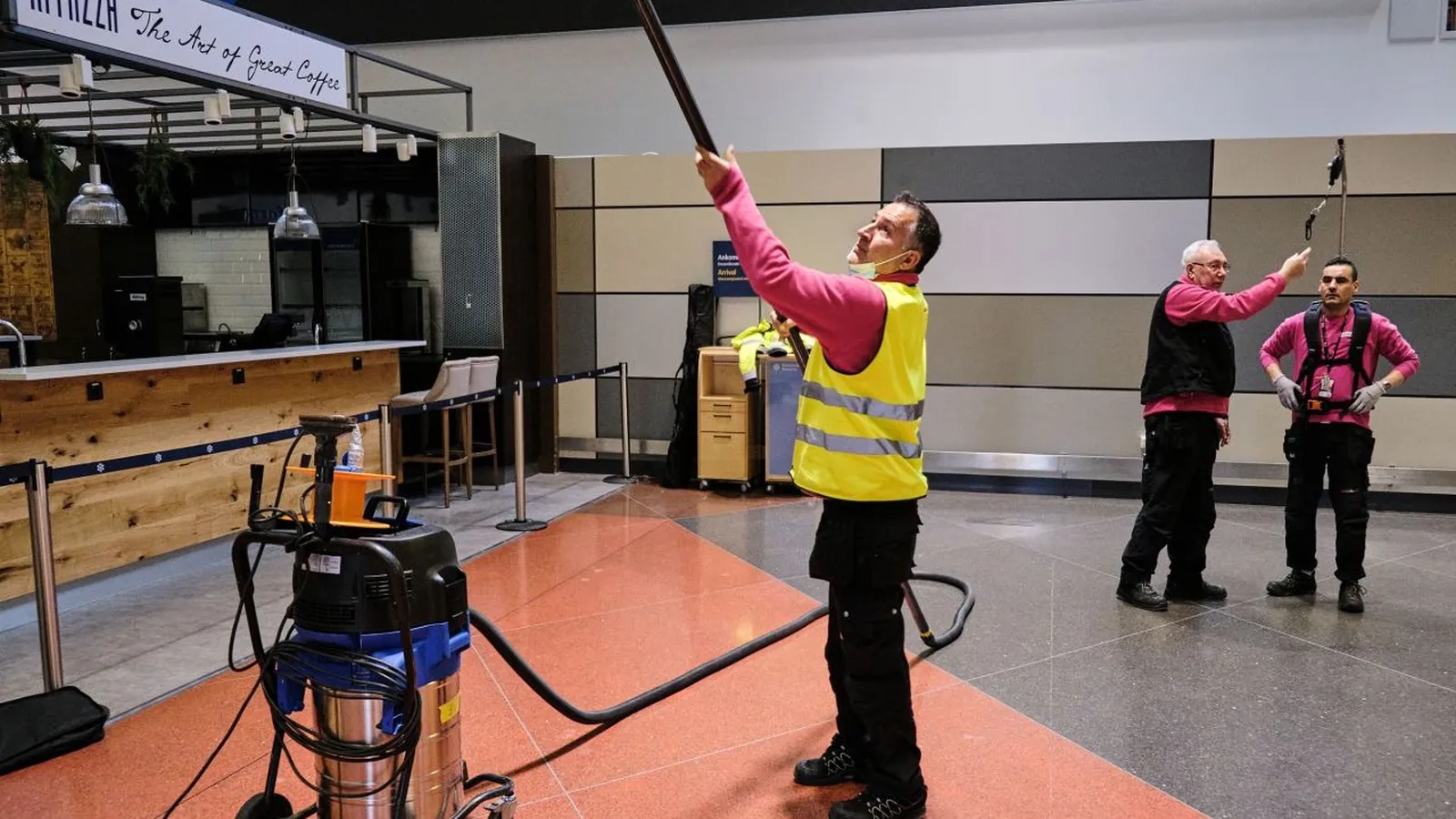
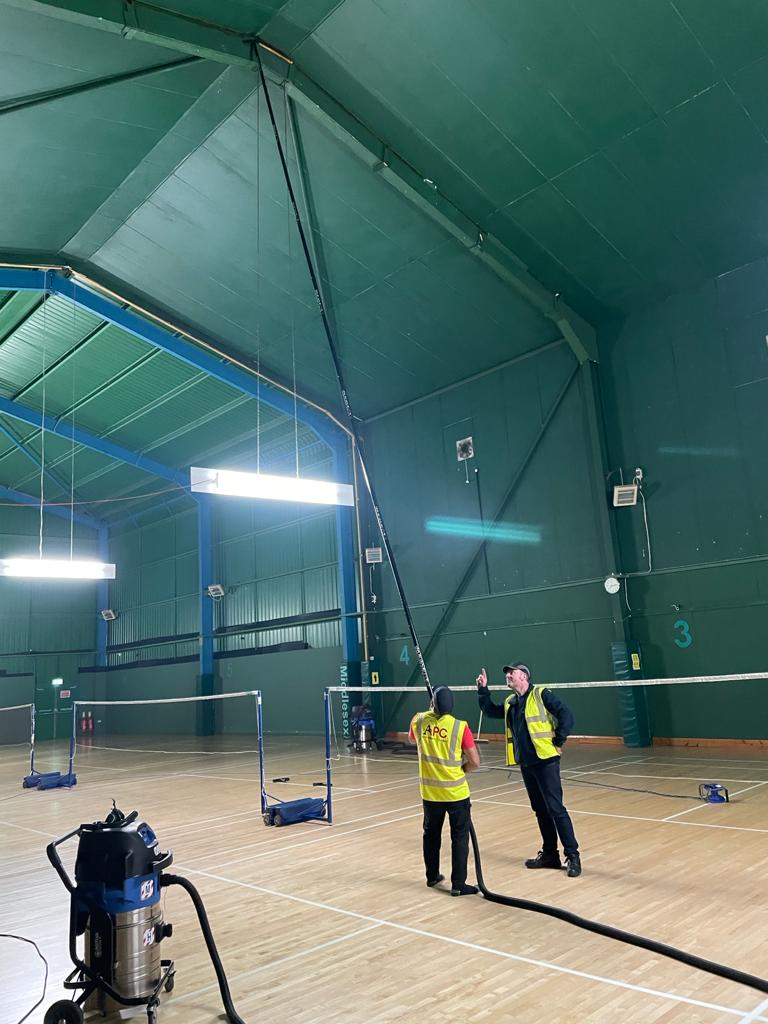
The public is kept safe by never letting anyone stand under the work: a barrier-controlled exclusion zone, sized to the working height, stays in place for the whole time the cleaning head is in the air.
- Exclusion zone. Physical barriers and clear signage around the working area, not just cones.
- Spotter. A second person watching the boundary where visitors or staff pass close by.
- Capture at the head. Vacuum heads and brushes that draw dust straight into the hose, so little falls below.
- Filtration. A vacuum whose filter standard has been agreed with the building owner; where HEPA is required, the US OSHA definition is a filter “at least 99.97 percent efficient in removing mono-dispersed particles of 0.3 micrometers in diameter.”
- Protection below. Covers over seating, counters, displays and equipment that cannot be moved.
- Detection and alarms. Ask the building’s fire safety team whether smoke detection in the zone needs managing while dust is disturbed. That decision, and any change to the system, stays with the building.
Why work from the ground instead of scaffolding or lifts?
Working from the ground keeps the footprint small and avoids bringing scaffolding or powered access into spaces that have to reopen within hours. It also follows a recognized safety hierarchy: the UK Work at Height Regulations 2005 require employers to ensure that work “is not carried out at height where it is reasonably practicable to carry out the work safely otherwise than at height.” That is UK law and does not bind buildings in Jordan, Saudi Arabia or Iraq, but it is a widely used benchmark and the logic behind AFE’s ground-based high-reach cleaning.
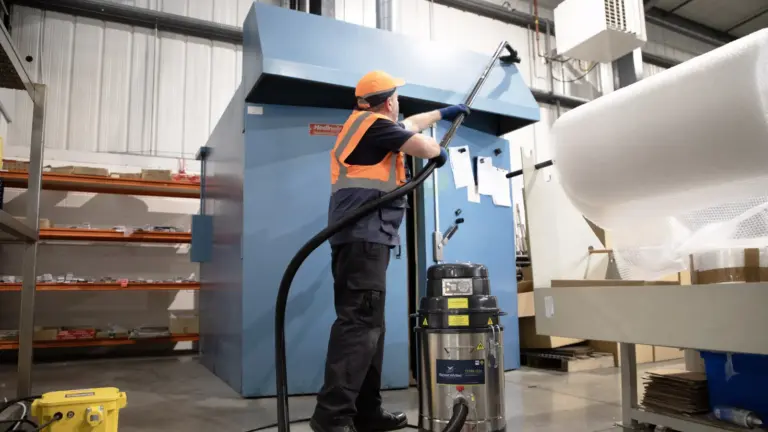
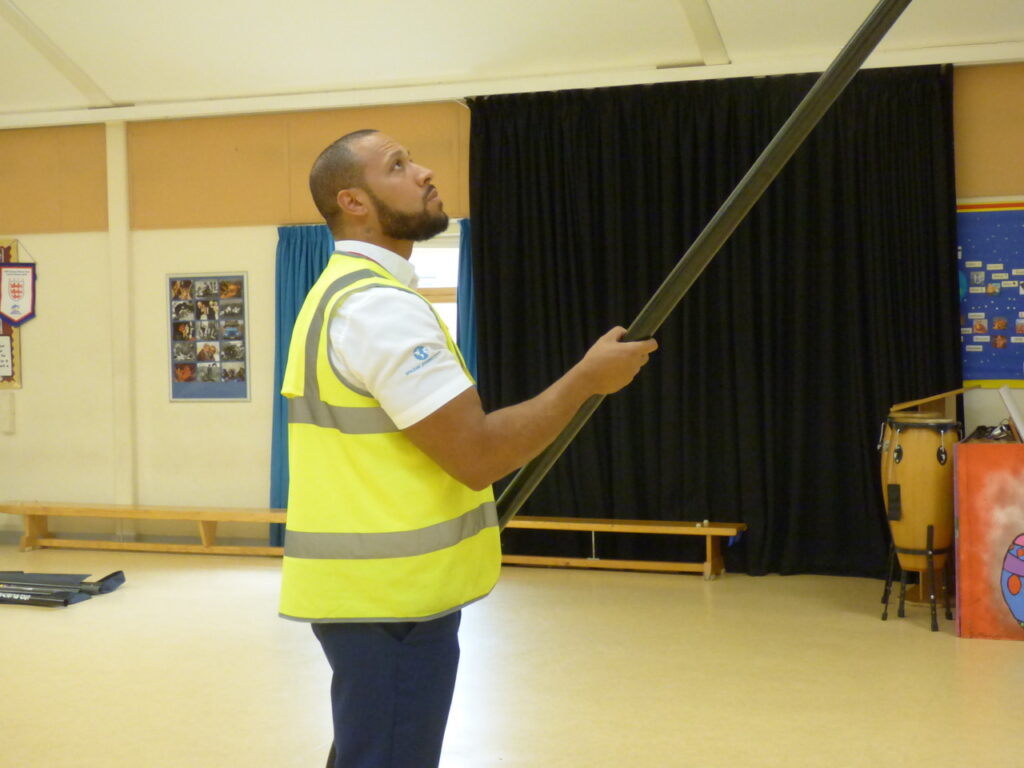
SpaceVac systems use interlocking, mostly carbon-fiber poles connected to a vacuum, so the operator stays on the floor while the head reaches the surface. SpaceVac publishes working heights for each system, but the figures differ between its regional pages, so the survey should check the specific configuration against measured heights. SpaceVac also lists camera and monitor systems, sold separately from the standard kits, that show the operator the surface being cleaned.

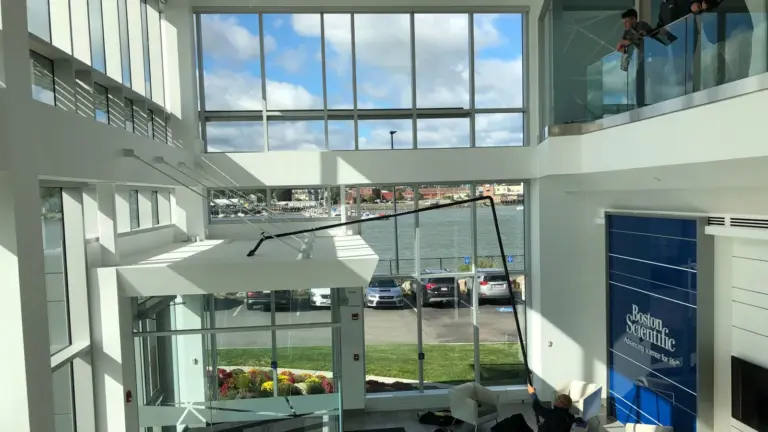
Watch how the round brush works around mounted equipment in a school’s high-level areas while the operator stays on the floor; that is the situation most public buildings present.
Ground-based work is not always possible. Very high roofs, obstructed areas or surfaces with poor line of sight may still need access equipment, and a good survey identifies those spots in advance rather than on the night.
When does dry steam belong in the plan?
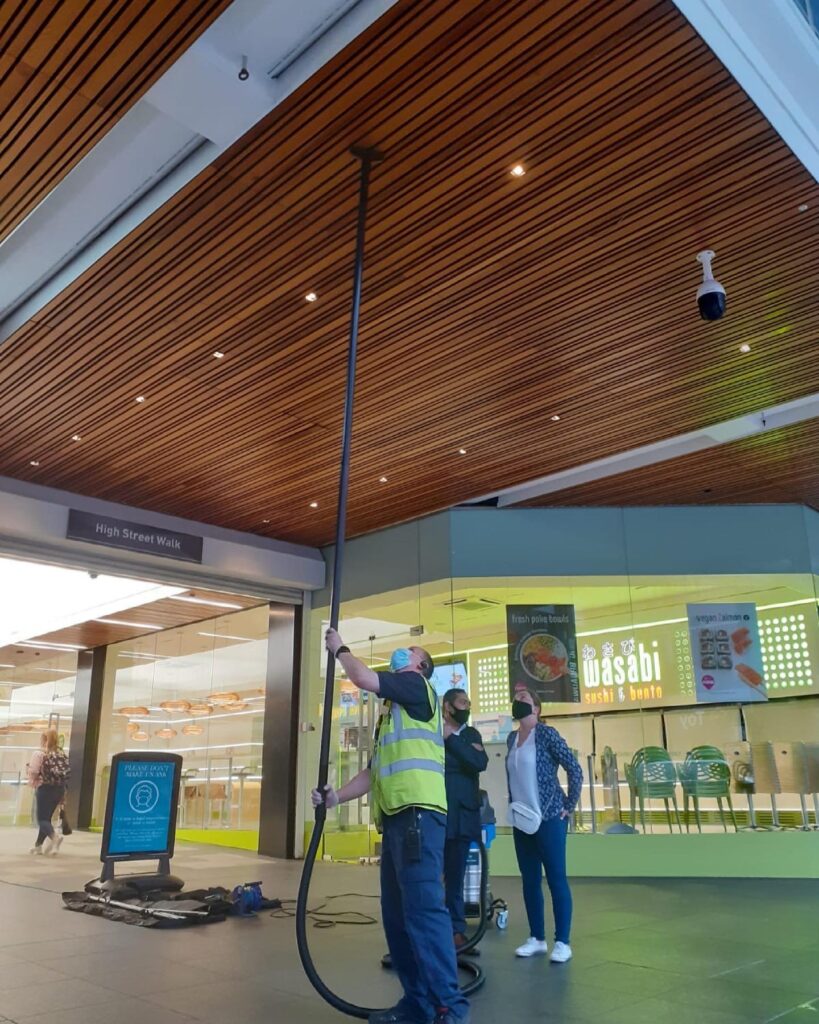
Dry steam belongs in the plan where the deposit is not loose dust but a grease or residue film that a vacuum will not lift, for example on canopies and fittings around mall food courts, stadium hospitality kitchens or terminal catering areas.
TECNOVAP builds dry saturated steam generators, and AFE’s industrial steam cleaning service combines professional steam systems with high-reach solutions to remove grease, oils and residues from overhead structures and surfaces. Sequence matters: remove loose dust first, then steam the surfaces that need it, then clean below. Steam cleaning removes soil; it should not be described as disinfection unless the claim is backed by validated evidence for that specific model and method. For catering areas, see how to prepare a commercial kitchen steam cleaning visit.
What should a facilities manager send before a survey?
A short pre-survey pack lets AFE judge feasibility remotely and keeps the site visit focused on the zones that matter.
- A list of areas with photos of the overhead surfaces and a close-up of the dust.
- Approximate heights, or drawings showing roof and ceiling levels.
- Opening hours, term dates, event calendars and the quiet windows you can offer.
- Items that must not be touched: detectors, sprinklers, artwork, screens, fragile ceilings.
- Site rules: inductions, security clearance, permits and equipment access routes.
- Any greasy or sticky areas where steam may be needed.
- Your definition of “clean” and the evidence you need, such as before-and-after photos.
How AFE supports high-level cleaning in public buildings
AFE lists aviation, education, sports and entertainment among its target sectors and delivers Internal high clean dust removal (often searched as high-level dust removal) as an on-site service: survey, method statement, exclusion zones agreed with your teams, execution from the ground with SpaceVac high-reach poles and a compatible vacuum, and a hand-back record for each zone. Steam cleaning can be added where residues need it.
Buildings that prefer an in-house team can buy SpaceVac pole systems and compatible vacuums through AFE’s industrial vacuum range. Photos by application are in the execution gallery, and related planning guides are collected on the public buildings insights hub. The same occupied-building logic appears in planning overhead dust work in hospital support areas and dust removal from warehouse racking and high bays.
Al Faisaliah Enterprises · Aqaba
Plan overhead cleaning without closing your building
Share your areas, approximate heights and the quiet windows you can offer. AFE proposes a survey, exclusion zones and a zoned schedule your operations and security teams can review.
Frequently asked questions
Can high-level cleaning be done while a mall or terminal stays open?
Often, yes, one zone at a time. Each zone gets a barrier-controlled exclusion zone, dust is captured at the cleaning head and the work is booked into the lowest-traffic window. Areas where the floor below cannot be cleared, even briefly, have to be scheduled for closing hours or a planned closure.
How high can ground-based pole systems reach in an atrium or arena?
It depends on the system and configuration. SpaceVac publishes working heights for each system, and its regional pages give different figures, so AFE checks the proposed kit against heights measured during the survey. Very high roofs or areas with poor line of sight may still need access equipment, and the survey should identify them.
Does the service include cleaning smoke detectors, sprinklers or ducts?
No. The scope covers the outside of overhead structures, services and fittings. Work on fire detection or sprinkler systems, internal duct cleaning and electrical work stay with the building's specialist contractors. Any temporary arrangement for detection while dust is disturbed is decided and carried out by the building's fire safety team.
How often should high-level surfaces in public buildings be cleaned?
There is no universal interval. Set it from what the first survey finds and adjust it with the records from each clean. Entrances, atria and food courts often load faster than quiet halls. Review the interval when the use of an area changes or after unusual events, such as building works nearby.
What evidence do we get that the work was done?
Agree it before work starts. A useful record per zone includes before-and-after photos from fixed positions, the date and window, the method used, items excluded or not reached, defects noticed and the area owner's sign-off. A pole-mounted camera can show surfaces that cannot be seen from the floor.
Sources and references
- The Work at Height Regulations 2005, regulation 6 · UK legislation.gov.uk
- Sweeping and cleaning (construction dust) · UK Health and Safety Executive
- 29 CFR 1910.1053, Respirable crystalline silica (HEPA filter definition) · US Occupational Safety and Health Administration
- Internal high-level cleaning · SpaceVac International
- Resource hub: FAQs · SpaceVac International
- Stainless steel steam generators · TECNOVAP
This article is general technical guidance. Equipment suitability, ATEX conformity and hygiene performance must be confirmed for each site and application.
Written for plant, maintenance, HSE and quality teams in Jordan, Saudi Arabia and Iraq.