The short answer
Toner powder needs a vacuum designed for combustible dust: ATEX-certified for the zone wherever the area is classified, with conductive, grounded hoses and tools, fine filtration and the motor outside the dust-laden air. A standard shop vacuum can build static charge, ignite the powder and blow fine particles back into the room, so it should not be used.
Key takeaways
- Toner makers' safety data sheets, such as Xerox's for a bulk black toner, classify it as combustible dust that can form explosive mixtures with air.
- One maker's data shows a minimum ignition energy below 3 mJ, so static discharge is a credible ignition source.
- Standard shop vacuums usually fail the US OSHA conditions for collecting combustible dust: plastic hoses, motors in the airflow.
- The employer zones the area; the vacuum's ATEX category must match it, model by model.
- Capture at benches, vacuum daily, empty into closed containers and keep toner out of drains.
Cartridge remanufacturing and refilling lines handle toner every minute: empty cartridges are opened, residual powder is removed, parts are cleaned and new toner is filled. A little powder escapes at each step and settles on benches, floors and machines. Choosing a toner vacuum for this work looks like a housekeeping decision, but it is really a safety decision, because toner is a fine, combustible powder and the wrong vacuum can turn a spill into a dust cloud near an ignition source.
This guide is for owners, production managers and HSE staff of remanufacturing and refilling workshops. It explains why toner needs care, why a standard shop vacuum is the wrong tool, how zones and equipment categories work, and what to ask before buying.
Why does toner powder need special handling?
Toner is a fine, combustible powder, and toner makers’ safety data sheets can say so explicitly. One toner maker’s safety data sheet for a black toner sold in bulk (Xerox, SDS A-0600BULK) classifies it as “Combustible dust” under OSHA’s scheme and warns that the dust “can form an explosive mixture with air”.
The same sheet gives test data that explains the concern. It reports a minimum ignition energy below 3 millijoules, a maximum explosion pressure of 7.9 to 9.0 bar and a KSt of 185 to 278 bar·m/s. It also tells users to prevent dust clouds, take precautions against static discharge and to sweep up or vacuum “with electrically protected vacuum cleaner”. These values belong to that product; your toners have their own data sheets, and those sheets are the starting point.
Fineness adds a second problem. Researchers at Germany’s federal materials institute (BAM) note that toner powder particles “usually have diameters above 3 µm”, which places them in the low-micrometre range. For comparison, DUPUY states a filtration efficiency of 3 microns for the standard polyester pocket filter on its W3 general-purpose vacuum. A filter rated at the same scale as the powder can let part of the finer fraction through, so fine filtration and a sealed design matter as much as suction.
Why is a standard vacuum dangerous for toner?
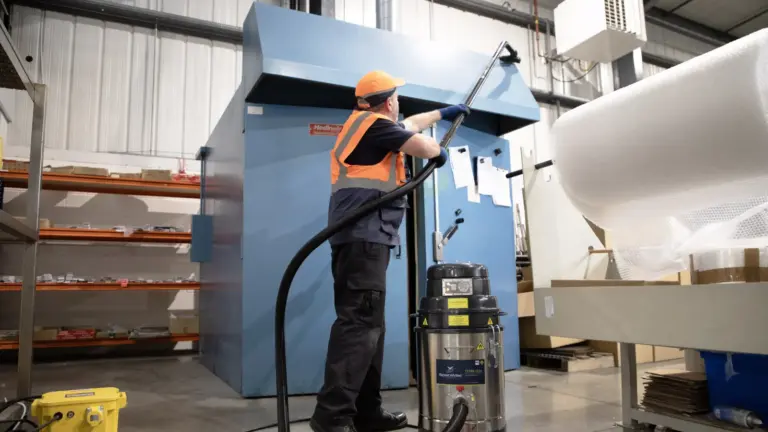
A standard vacuum can charge, ignite and re-release toner at the same time. It moves fine powder at speed through plastic hoses, often past a motor with brushes, and blows what the filter misses back into the room.
As a US reference, OSHA’s combustible dust enforcement programme allows portable vacuum cleaners to collect combustible dust in unclassified areas only when four conditions are met: suitable materials of construction, conductive or static-dissipative hoses, bonded and grounded conductive parts including wands and attachments, and no dust-laden air passing through the fan or over motors unless they are listed for Class II, Division 1 locations. Most shop and office vacuums fail at least one of these. EU Directive 1999/92/EC also treats layers and deposits of combustible dust as a source that can form an explosive atmosphere, so a benchtop covered in toner is part of the hazard, not just untidy.
Which vacuum types fit a toner workshop?
Match the vacuum to the area classification and the dust, not to the brand. The table compares the options a workshop usually considers.
| Option | When it can be considered | Main limits | What to check |
|---|---|---|---|
| Household or shop vacuum | Not recommended for toner | Plastic body and hose, motor in or near the airflow, coarse filter | Remove from the toner area |
| Industrial vacuum for combustible dust in non-classified areas | Where the risk assessment confirms the area is not a hazardous zone | Not for use inside a zone; DUPUY’s ACD models, for example, are stated for combustible dust in non-ATEX zones | Conductive accessories, grounding, filter class, the assessment that supports “non-classified” |
| ATEX-certified vacuum of the right category | Where the site has classified a zone, for example around filling and emptying points | Certification applies to that model and configuration only | Marking, EU-type examination certificate, category versus zone, filter class |
| Fixed extraction at benches | Where powder is released at the same points every day | Needs its own design and explosion-risk assessment | Capture velocity at the bench, filter cleaning, discharge, protection of the collector |
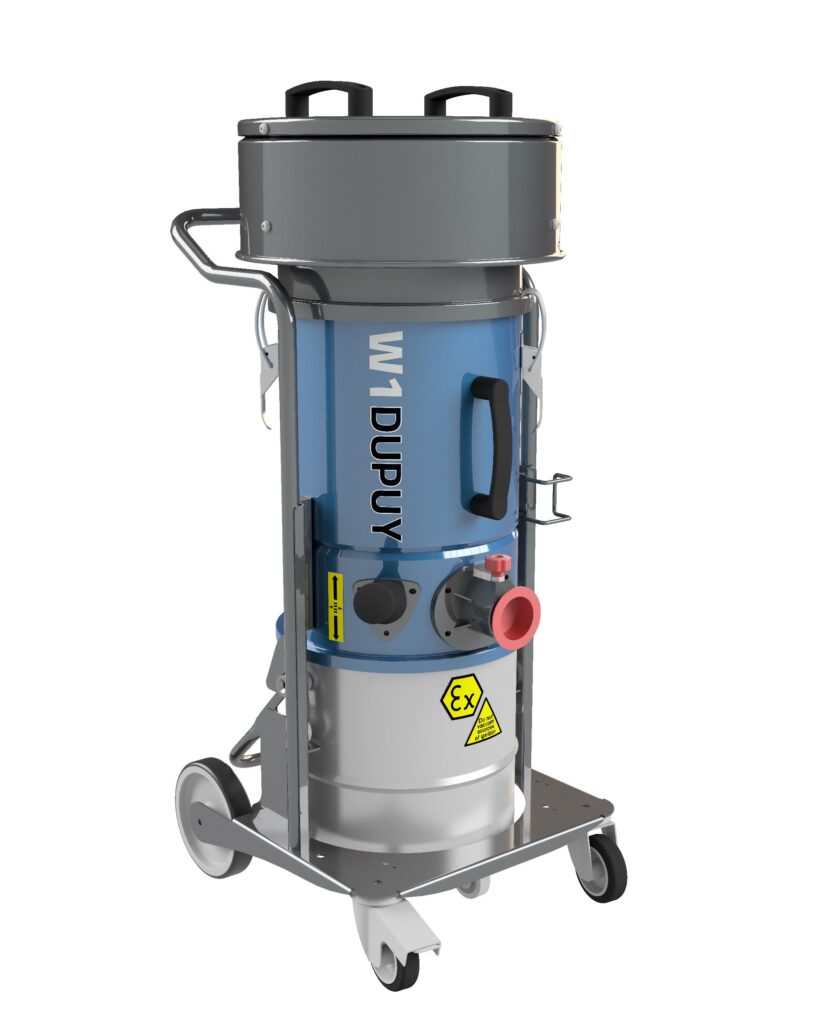
DUPUY offers both ATEX and non-ATEX (ACD) models, so naming the brand says nothing about suitability. For example, DUPUY describes its W2 EX1/3D as ATEX Z22 certified, designed for use in zone 20 indoor and zone 22 outdoor, and states that it complies with EN IEC 62784:2018 for zone 22. That statement applies to that model; DUPUY does not list toner as an application, so the match must be confirmed against your toner data.
How do zones and equipment categories apply to toner?
The employer classifies the zones, and the equipment category must match them. Directive 1999/92/EC, a widely used reference outside the EU, makes the employer responsible for zoning and links each dust zone to equipment categories.
- Zone 20: explosive dust cloud present continuously or for long periods; category 1 equipment. DUPUY, for example, describes some ATEX models as designed for zone 20 inside and zone 22 outside the machine.
- Zone 21: likely to occur occasionally in normal operation; category 1 or 2.
- Zone 22: not likely in normal operation and short-lived if it occurs; category 1, 2 or 3.
Two standards help when reading offers. IEC 62784 covers vacuum cleaners and dust extractors for combustible dust, and the GCC has adopted it as GSO IEC 62784:2021, which is relevant for Saudi buyers. EN 17348:2022 sets design and testing requirements for hand-held and portable vacuum cleaners used in potentially explosive atmospheres; it does not cover battery-operated machines. See what dust zones 20, 21 and 22 mean and how to prepare a combustible dust hazard analysis.

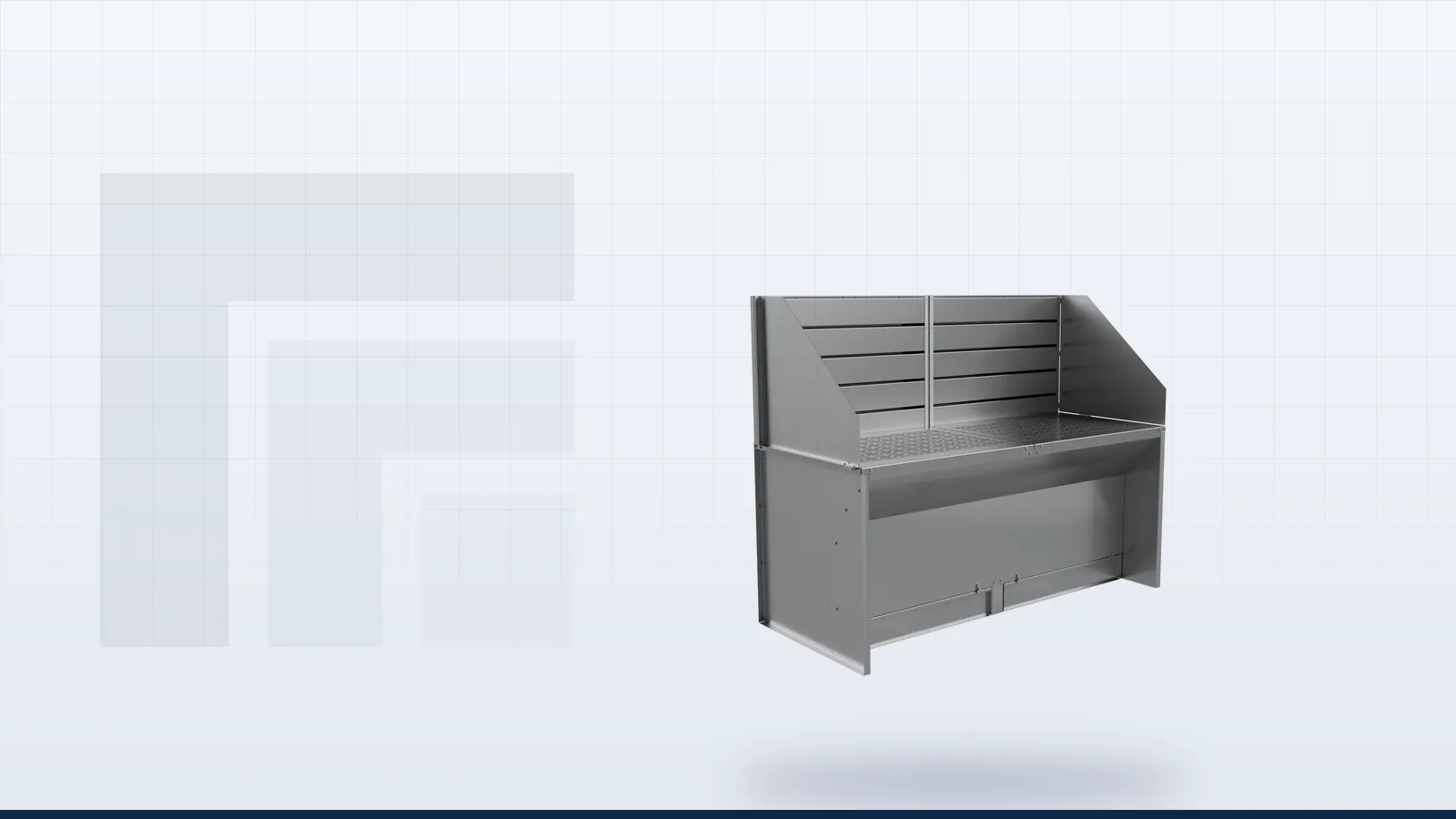
Notice the compact, all-metal build and how DUPUY describes its ATEX 3D certification; it shows the technology, not a toner workshop.
How should a remanufacturing line collect toner safely?
Capture toner where it is released, collect the rest with a certified vacuum, and empty it without making a cloud. The sequence below gives a workable starting point.
- Collect the data sheets. Gather the safety data sheet for every toner on the line, including explosibility and exposure data.
- Assess and zone. Have a competent person assess where dust clouds can form and classify the areas.
- Capture at source. Use extraction at emptying, cleaning and filling benches so less powder reaches the room.
- Select certified equipment. Choose a vacuum whose category matches the zone, with conductive hoses and tools and a defined grounding point.
- Empty without a cloud. Empty into closed containers, keep toner out of drains, and wash remaining residues with cold water without letting the rinse water reach drains; the Xerox sheet notes that hot water fuses toner.
- Clean daily. Vacuum benches and floors before layers build up, and record the routine.
Toner collection set-up
- Read data sheets
- Assess and zone
- Capture at source
- Use certified vacuum
- Empty without cloud
Bonding and grounding are covered in antistatic hose and grounding for combustible dust.
What should you ask a toner vacuum supplier?
Ask for documents, not adjectives. A supplier should be able to answer each point below for the exact model and accessories offered.
- The ATEX marking and EU-type examination certificate, and the zone the machine may stand in and collect from.
- The standard it complies with (for example EN IEC 62784 or EN 17348) and its date.
- The filter type and dust class, and how filters are cleaned and changed without releasing powder.
- Conductive or static-dissipative hoses, wands and tools, and the grounding arrangement.
- Whether the motor sits outside the dust-laden airflow.
- How the container is emptied and what bags or liners are used.
- Spare filters and wear parts held locally.
AFE supplies DUPUY industrial vacuums, including ATEX-certified models, with filters and spare parts and rental for trials. Its consulting team carries out ATEX compliance checks of equipment against a site’s classification; the zoning itself remains the employer’s decision. More guides are on the industrial insights hub.
Al Faisaliah Enterprises · Aqaba
Choose a toner vacuum that fits your zones
Send AFE your toner safety data sheets, area classification and a sketch of the line. You get a proposed vacuum and accessory set, with the certificates to check and the points your assessment must confirm.
Frequently asked questions
Can I use an ordinary vacuum for a small toner spill in the office?
Office spills from a single cartridge are a different scale from a remanufacturing line, but the toner maker's safety data sheet still applies. The Xerox sheet cited above, for example, says to prevent dust clouds and to use an electrically protected vacuum. Follow the sheet for your toner, and on a production line never rely on household or plastic shop vacuums.
Is a HEPA filter enough to make a vacuum suitable for toner?
No. A fine filter reduces the powder released back into the room, but it does not control ignition. Suitability for combustible toner also depends on conductive and grounded hoses and tools, a motor outside the dust-laden airflow and, in a classified zone, ATEX certification of the complete machine for that zone.
Which ATEX zone applies to a toner refilling bench?
Only your own risk assessment can say. Directive 1999/92/EC makes the employer responsible for classifying zones based on how often and how long a dust cloud may be present. Emptying and filling points are where clouds are most likely, so assess them first; the classification and the explosion protection document must be prepared for your own site.
Does every DUPUY vacuum suit toner?
No. DUPUY sells ATEX-certified models and non-ATEX ACD models, and certification applies to a specific model and configuration. DUPUY does not list toner as an application, so the model, filter and accessories must be checked against your toner's data sheet and your zone classification before purchase.
How should collected toner be disposed of?
Empty the vacuum into closed containers or sealed liners without creating a dust cloud, label them and pass them to a licensed waste contractor in line with local rules. One toner maker's sheet warns that toner should not enter drains, sewers or waterways. AFE supplies equipment and does not transport or dispose of waste.
Sources and references
- Safety Data Sheet A-0600BULK, Toner Cartridge - Black · Xerox
- Quantitative Characterization of Nanoparticle Emissions from Office Machines with Printing Function · BAM Federal Institute for Materials Research and Testing
- Revised Combustible Dust National Emphasis Program, CPL 03-00-008 · U.S. Occupational Safety and Health Administration
- Directive 1999/92/EC (ATEX workplaces) · EUR-Lex
- EVS-EN 17348:2022 Requirements for design and testing of vacuum cleaners for use in potentially explosive atmospheres · Estonian Centre for Standardisation and Accreditation
- GSO IEC 62784:2021 · GCC Standardization Organization
- W2 EX1/3D vacuum cleaner with manual filter cleaning ATEX Z22 certified · DUPUY
This article is general technical guidance. Equipment suitability, ATEX conformity and hygiene performance must be confirmed for each site and application.
Written for plant, maintenance, HSE and quality teams in Jordan, Saudi Arabia and Iraq.