The short answer
Plan warehouse dust removal cell by cell: survey heights, fragile items and stored goods, divide the building into aisles and bays that can close one at a time, and clean each in a quiet window from the ground with high-reach vacuum systems, working top-down. Finish with the floor, record before-and-after photos and reopen the aisle.
Key takeaways
- In a warehouse, most dust settles above head height: racking tops, roof steel, fittings, trays and dock door tracks.
- Ground-based high-reach vacuuming avoids work at height and keeps lifts and scaffolds out of busy aisles.
- Divide the building into cells and clean each in a quiet window, top-down, so operations keep running.
- Where stored goods shed combustible dust, overhead layers become a safety issue and equipment must suit any zones.
- Docks need their own frequent routine; floors are finished last with a sweeper and an industrial vacuum.
Dust in a warehouse rarely stays on the floor. It is lifted by forklift traffic, blown in through open dock doors and shed by handled packaging, then settles on racking tops, roof trusses, light fittings, cable trays and door tracks, where nobody sees it until it falls onto stock or appears in a customer audit. Warehouse dust removal at those heights is a planning problem first: how to reach it, when, and without stopping picking and dispatch.
This guide sets out how to survey a warehouse or logistics hub, which method suits each part of the building, how to schedule the work around operations, and when dust becomes a safety question rather than a housekeeping one. It also explains how AFE delivers its Internal high clean dust removal service, often searched for as warehouse high-level cleaning.
Where does dust settle in a warehouse or logistics hub?
It settles wherever surfaces are horizontal and air movement drops, which in a warehouse means mostly above head height. Each area needs its own method.
| Area | What builds up | Why it matters | Usual method |
|---|---|---|---|
| Racking top beams and top-level stock | Fine dust and packaging fibers | Falls onto goods and labels when pallets move | High-reach vacuum from the aisle floor |
| Roof trusses, purlins and bracing | Settled dust and cobwebs | Large hidden area; falls when disturbed | High-reach vacuum, worked top-down |
| Light fittings, cable trays, pipework, duct exteriors | Dust layers on top faces | Visible in audits; some fittings are fragile | Soft brush or vacuum heads, with agreed exclusions |
| Walls, shutters and door tracks at docks | Dust and sand carried in from outside | Doors and tracks collect grit | Vacuum with brush heads, from the ground |
| Dock levellers, floor edges, under the lowest beams | Grit and packaging debris | Hard for a sweeper to reach | Industrial vacuum |
| Aisles and open floors | Loose debris and sand | Re-suspended by traffic | Industrial floor sweeper |
AFE’s own service description makes the same point for industry in general: dust in elevated, hard-to-reach areas can affect product quality, create safety hazards, compromise equipment and become a critical observation during customer audits and inspections.
Why plan high-level dust removal from the ground?
Because it removes the most serious hazard of the job, working at height, and keeps access equipment out of busy aisles. The UK Work at Height Regulations 2005 require employers to ensure that work is not carried out at height “where it is reasonably practicable to carry out the work safely otherwise than at height,” and, where it is, to take suitable measures to prevent falls. That is UK law and does not bind Jordan, Saudi Arabia or Iraq, but it is a widely recognized order of priorities.
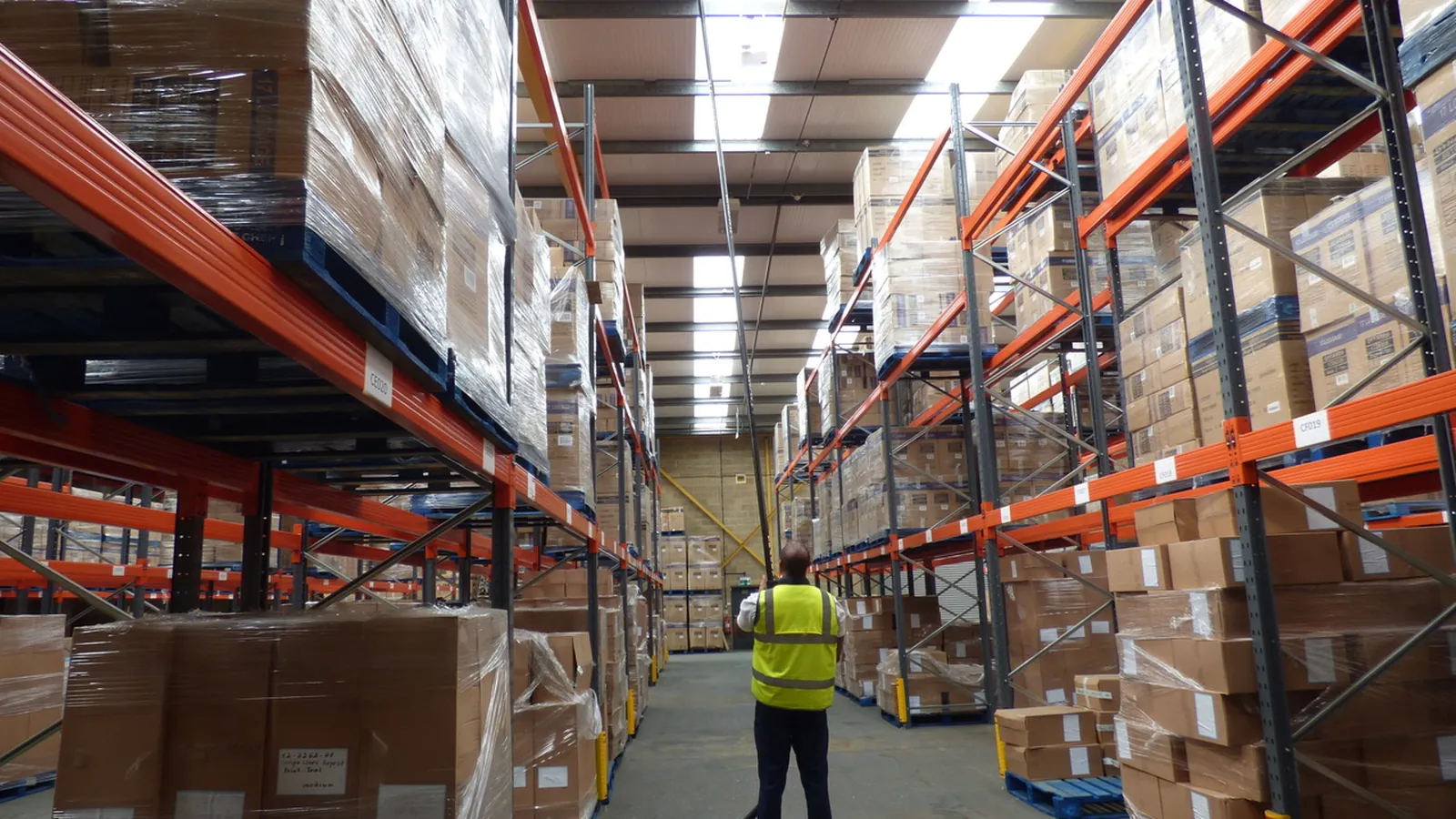
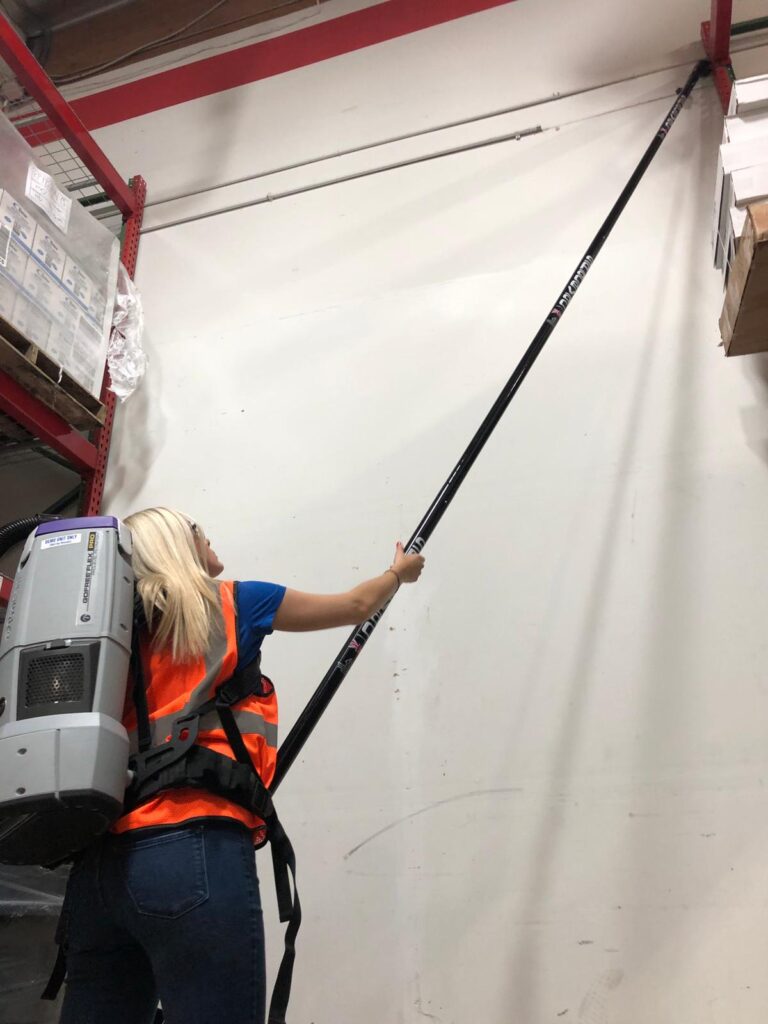
In a warehouse, ground-based cleaning has operational benefits too. Lifts and scaffold towers in narrow aisles block forklift routes and must be repositioned bay by bay. A high-reach pole system connected to an industrial vacuum works from the aisle floor and moves with the operator. SpaceVac’s modular, mostly carbon-fiber pole systems, which AFE supplies, are designed for this: the vacuum stays on the floor while the head reaches beams, cable trays and pipework. Reach still has to be matched to the heights measured in the survey, because pole systems differ.

Compare the access each method needs: the ground-based approach is what lets a warehouse clean one aisle while the next keeps working.
What should a warehouse dust survey record?
It should record enough to plan the work cell by cell and to decide what must not be touched. Walk the building with operations, maintenance and HSE, and note:
- Heights of racking tops, roof steel, lights and other targets, and the clearances around them.
- Fragile or sensitive items, such as sprinkler heads, detectors, light fittings and cabling, that are excluded or handled with soft heads.
- What is stored below: food, pharmaceuticals, electronics or general goods, and whether stock needs covering or moving.
- The type of dust: outdoor dust and sand, cardboard and paper fibers, or spilled product.
- Whether any dust is combustible and whether any area is classified as a hazardous zone.
- Forklift routes, picking waves, shift changes and the quiet windows in each area.
- Power points for vacuum units and the route for collected waste.
- Photos and, where possible, layer depth on representative surfaces.
The same survey logic is used in heavy industry; what a high-level dust removal survey should cover gives the fuller version.
How do you schedule warehouse dust removal without stopping operations?
Split the building into cleaning cells and work each one in a window when it is quiet, so the rest of the warehouse keeps running.
- Divide into cells. Group aisles, dock sections and roof bays into cells that can be closed one at a time.
- Book quiet windows. Agree with operations a low-activity period for each cell: a night shift, a weekend or a gap between picking waves.
- Set an exclusion zone. Close the aisle to forklifts and pedestrians while the pole is in use, with barriers and signs.
- Protect what is below. Cover or move sensitive stock where the survey says so.
- Clean from the top down. Roof steel first, then racking tops and fittings, then walls and shutters, so falling dust lands on surfaces not yet cleaned.
- Finish the floor. Vacuum edges and under the lowest beams, then sweep the aisle before reopening it.
- Record and hand over. Photograph before and after, note exclusions and hand collected dust to the site’s waste route.
Warehouse dust removal by cells
When is warehouse dust a combustible dust question?
When the goods handled or stored shed combustible dust and it builds up in layers. OSHA’s US combustible dust program lists wood, plastics, some metals and organic dusts “such as sugar, flour, paper, soap, and dried blood” among the dusts it covers. The US Chemical Safety Board reports that most of the fatalities and devastating injuries in dust incidents have been caused by secondary explosions, when a first event lifts settled dust into a cloud.
The CSB fact sheet also cites NFPA guidance that a catastrophic explosion can occur from as little as 1/32 inch of dust covering 5% of a room’s surface area. OSHA has clarified that the figure rests on assumptions including bulk density, so it is a US reference point rather than a universal limit. Its archived guidance adds that overhead beams, joists, ducts and equipment tops should be included when estimating the dust coverage area, which are exactly the surfaces in a high bay.
If any area is classified, the vacuum, poles and accessories must be checked against the zones before work starts; see what an ATEX compliance check should cover.
How do loading docks and floors fit into the plan?
Docks are where outdoor dust and sand enter, so they need their own routine rather than an occasional clean. Shutters, door tracks, walls and the area around dock levellers collect grit that is carried further in by every forklift movement. Vacuum them with brush heads from the ground, and clean them more often than the high bays.
Floors close the cycle. An industrial floor sweeper is efficient on open aisles and yards, while an industrial vacuum handles edges, dock pits and the space under the lowest racking beams; choosing between sweepers and vacuums explains the split.
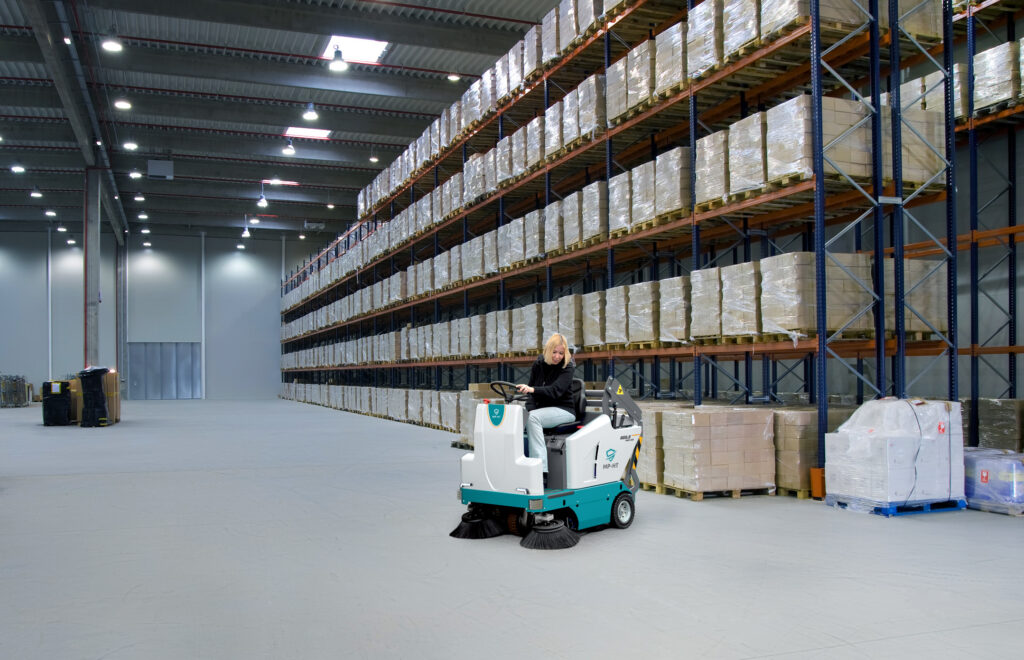

Note that the operator works from the floor throughout, with no lift in the aisle; that is what makes the cell-by-cell schedule possible.
How does AFE deliver internal high clean dust removal in warehouses?
AFE delivers Internal high clean dust removal as a planned service. It combines industrial vacuum technology, high-reach systems and safe access methods so that dust is captured at the source rather than dispersed, fewer people need to access high areas, and operations below are protected from falling debris. Work starts with a survey and a proposed plan of cells, windows, equipment and exclusions.
The scope stays clear: AFE cleans the outside of ducts, trays and fittings, does not clean inside ducts or carry out electrical work, and hands collected dust to the site’s own waste route. Read more about AFE’s ground-based high-reach approach. Sites that prefer to clean in-house can source high-reach systems and industrial vacuums and floor sweepers through AFE, and rental can be discussed for a one-off deep clean. AFE coordinates this work from Aqaba for warehouses and logistics hubs in Jordan, Saudi Arabia and Iraq.
Al Faisaliah Enterprises · Aqaba
Plan high-level dust removal around your operations
Send AFE your layout, racking and roof heights, stored goods and operating hours. You get a survey-based plan of cleaning cells, windows, equipment and exclusions.
Frequently asked questions
How often should high racking and roof steel be cleaned?
There is no single interval. It depends on how fast dust builds up, what is stored below, customer audit expectations and whether the dust is combustible. A practical approach is a first deep clean, then measuring how quickly layers return on representative surfaces, and setting a frequency per area. Docks and areas near open doors usually need attention more often than inner high bays.
Do we have to empty the racking before high-level cleaning?
Usually not. The aisle being cleaned is closed to traffic, and the survey identifies stock that should be covered or moved, such as food, pharmaceuticals or open cartons. Vacuum capture from the ground reduces how much dust falls compared with brushing, and working top-down means any dust that does fall lands on surfaces cleaned later in the sequence.
Can the work be done at night or at weekends?
Yes, and that is the point of the cell-by-cell plan: each aisle or dock section is booked for its quietest window, whether that is a night shift, a weekend or a gap between picking waves. The site needs to confirm lighting, power points, supervision and access for those periods when the plan is agreed.
Could cleaning near ceilings trigger fire detectors?
Disturbed dust near some detector types can cause false alarms, so agree an approach with the site's fire alarm team before work starts. That may mean managing specific detectors during the cleaning window under the site's own procedures, or keeping heads clear of them. Detectors and sprinkler heads should appear on the exclusion list in the method statement.
What happens to the dust that is collected?
It stays the site's material. Collected dust is sealed in the vacuum's containers or bags and handed over to the site's waste procedure. AFE's service covers removing dust from high-level surfaces into the vacuum; transport and disposal remain with the site and its own waste contractors.
Sources and references
- The Work at Height Regulations 2005, regulation 6 · legislation.gov.uk
- Drivers of Critical Chemical Safety Change: Combustible Dust (fact sheet, April 2018) · U.S. Chemical Safety and Hazard Investigation Board
- Evaluating Hazardous Levels of Accumulation Depth for Combustible Dusts (21 April 2015) · U.S. OSHA
- Revised Combustible Dust National Emphasis Program, CPL 03-00-008 · U.S. OSHA
- Combustible Dust National Emphasis Program, 2008 (archived) · U.S. OSHA
- Directive 1999/92/EC (ATEX workplace directive) · EUR-Lex
This article is general technical guidance. Equipment suitability, ATEX conformity and hygiene performance must be confirmed for each site and application.
Written for plant, maintenance, HSE and quality teams in Jordan, Saudi Arabia and Iraq.