The short answer
Hotels can clean chandeliers and high ceilings without disrupting events by booking dark days or the night between strike-down and set-up, keeping a fixture register, and cleaning from the ground with high-reach vacuum poles. The hotel isolates fixtures; dust is captured at the head, the room is zoned, and it is handed back event-ready.
Key takeaways
- Treat chandelier cleaning as a calendar task: reserve dark days and overnight gaps with banqueting weeks ahead.
- Keep a fixture register with height, material, suspension, isolation owner and nearby services.
- Ground-based high-reach poles need little floor space and capture dust at the head.
- Electrical isolation, lowering and rewiring stay with the hotel's electrician or the fitting's supplier.
- Set cleaning frequency from inspection photos, not from a fixed interval.
A hotel ballroom may host a conference in the morning, a wedding at night and a gala the following evening, and its lobby never closes at all. Meanwhile dust settles on chandelier arms, crystal drops and shades, on coffered ceilings, cornices and air-conditioning diffusers. Under event lighting and in guests’ photos, that dust shows.
Chandelier cleaning in a working hotel is therefore a scheduling task before it is a cleaning task: the work has to fit into gaps in the event calendar, leave delicate fixtures undamaged and hand the room back ready for the next set-up. This guide is written for hotel engineering, housekeeping and banqueting managers. It covers which calendar windows work, what to record about each fixture, how ground-based cleaning is done, and how AFE plans its Internal high clean dust removal service around events.
Why is chandelier cleaning in a hotel a scheduling problem first?
Because the rooms with the most valuable fixtures are also the rooms with the least free time. A factory can close an area for a shift; a ballroom offers short windows between strike-down and set-up, and a lobby offers only quieter hours with guests still passing through.
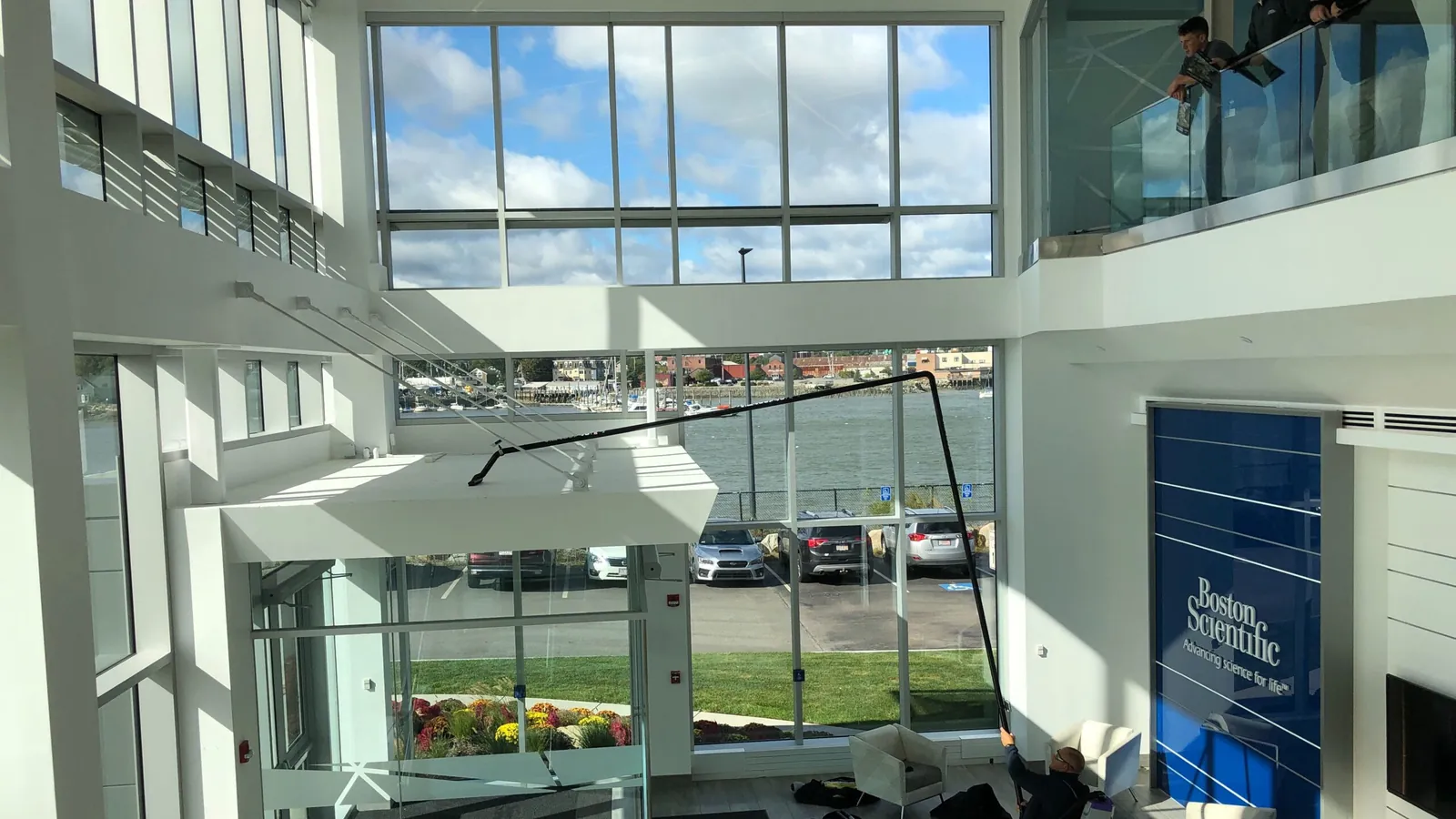
Traditional methods make those windows harder to use. A scaffold tower or lift takes time to bring in, assemble and remove, needs a clear floor, and can mark carpets or dance floors. Working from the ground with high-reach vacuum poles needs less floor space and less set-up time, which is often what makes the job fit at all. The general approach for occupied buildings is described in high-level cleaning in schools, malls, stadiums and airports; a hotel adds the event calendar.
Which windows in the event calendar work best?
The best window is the longest period in which the room is empty of guests, furniture and event set-ups, which usually means a dark day or the night between strike-down and the next set-up. Banqueting and engineering should look at the calendar together and reserve windows weeks ahead.
| Window | What fits | Watch out for |
|---|---|---|
| Dark day with no event booked | Full ballroom: chandeliers, ceilings, cornices and diffusers | Late bookings; agree with sales that the date stays blocked |
| Night between strike-down and next set-up | One or two chandeliers or one ballroom section | Set-up crews arriving early; tables and linen must not be in place yet |
| Divided ballroom with air walls closed | The empty section while the other is in use | Noise and access through the occupied section |
| Lobby during the quietest hours | Lobby chandeliers and high fixtures, zone by zone | Guests and luggage passing; barriers and a guide are needed |
| Low season or planned refurbishment | Deep work on the highest or most complex fixtures | Other contractors working in the same space |
Keep the plan zoned. If an event is booked at short notice, a zoned plan lets the team finish one chandelier or section cleanly and leave the room event-ready, rather than stopping halfway with equipment on the floor.
What should a fixture register record before the first visit?
It should record every fixture and high surface to be cleaned, with its height, material, fragility and the person responsible for isolating it. The register turns one survey into a repeatable plan:
- Location and height. Room, position and measured height to the lowest and highest point of each chandelier.
- Construction. Crystal drops, glass shades, fabric shades or metal arms, and any parts already loose or missing.
- Suspension and lowering. Whether the chandelier hangs on a fixed rod, a chain or a winch that lowers it.
- Electrical isolation. Who switches the fixture off and confirms the lamps have cooled; isolation is the hotel’s or its electrician’s task.
- Surrounding services. Fire detectors, sprinkler heads, speakers, lighting trusses and rigging points that must not be touched.
- Ceiling finishes. Coffers, gilded or painted plaster, fabric panels and diffusers, each marked as clean, inspect only, or do not touch.
- Floor finish. Carpet, timber or dance floor, and the protection each needs.
Photos of each fixture, taken at the survey and after each visit, give the hotel a record of condition. That record matters if a drop is later found missing.
How are chandeliers and high ceilings cleaned from the ground?
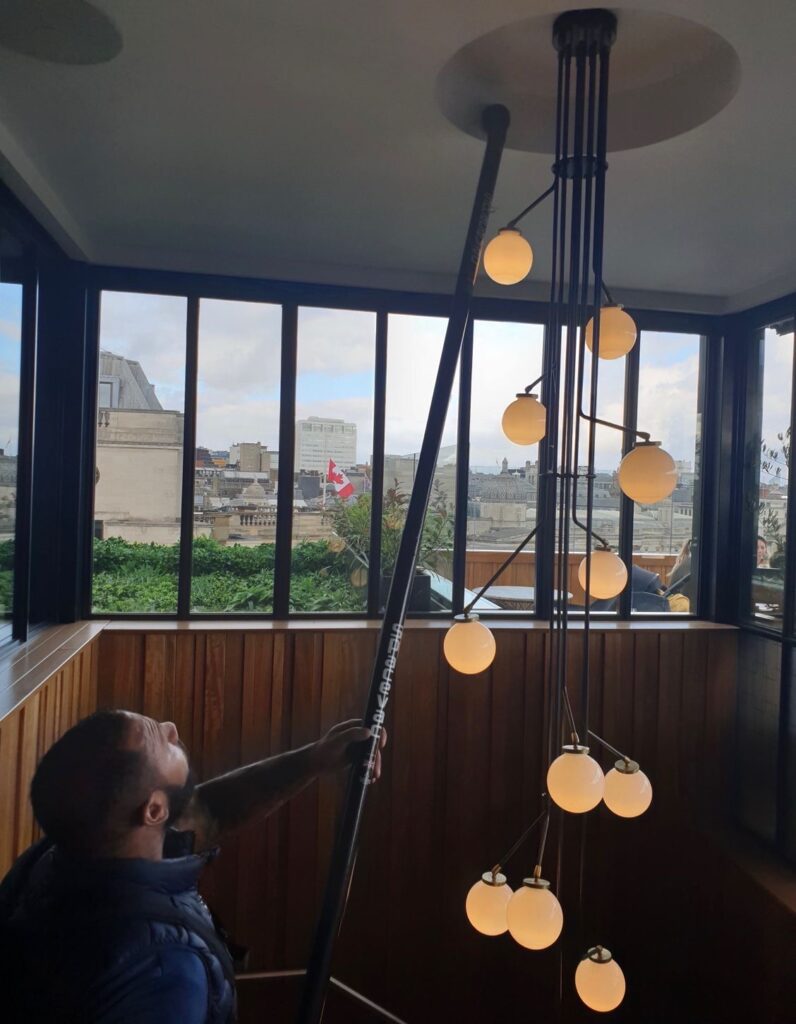
They are cleaned with lightweight high-reach vacuum poles operated from the floor, fitted with soft brush heads and run at a suction suited to the fixture, so dust is captured at the head instead of falling onto the floor below. UK law offers a useful reference: the Work at Height Regulations 2005 require that work is not carried out at height “where it is reasonably practicable to carry out the work safely otherwise than at height.” That rule does not apply in Jordan, Saudi Arabia or Iraq, but the hierarchy is sound practice everywhere.
SpaceVac publishes working heights for each pole system, but the figures differ between its regional pages, so the survey must check the proposed configuration against the measured height of each chandelier and ceiling. The top of a chandelier ring is often invisible from below. SpaceVac lists camera and monitor systems, sold separately from the standard kits, that show the operator the surface being cleaned.
Ground-based vacuuming removes loose dust from arms, drops and shades in place. Washing crystal drops by hand, re-hanging loose drops, or lowering, dismantling or rewiring a chandelier is work for the hotel’s electrician or the fitting’s supplier, and AFE does not take it on. Where a chandelier has a winch, the hotel’s own team decides whether lowering it is needed.

Watch how the operator works around fittings in a tall hotel lobby from the floor while the space stays in use, and note how much floor space the method needs.
How are guests, floors and event set-ups protected?
They are protected by cleaning before set-up, keeping a marked exclusion zone under the work and capturing dust at the head instead of dusting it down. A typical visit runs in this order:
- Confirm the window. Banqueting confirms the room is free and no set-up crew is booked during the visit.
- Isolate and cool. The hotel switches off the fixtures to be cleaned and confirms the lamps have cooled.
- Protect the floor. Lay protection under each work zone and set barriers, with a guide in the lobby.
- Clean high to low. Clean ceilings, cornices and diffusers first, then chandeliers, so no dust falls on cleaned fixtures.
- Inspect and photograph. Check each fixture against the register and record its condition.
- Hand over event-ready. Remove equipment, lift protection, restore power and return the room to banqueting.
Chandelier cleaning between events
How often should hotel chandeliers be cleaned?
Set the frequency from inspection, not from a fixed figure. Dust load depends on the building’s air handling, nearby doors, dust from outside and how often the room is used, so two ballrooms in the same hotel can need different intervals.
A practical approach is to inspect fixtures after each visit and before the busiest event season, compare photos, and adjust the interval accordingly. Lobby fixtures that guests see every day may need shorter intervals than a ballroom used mainly for weekend events. Restaurants have similar constraints in a smaller space, covered in planning a restaurant high-level dust survey.
What does AFE need to plan chandelier cleaning in your hotel?
AFE plans the work as its Internal high clean dust removal service, using ground-based high-reach methods instead of work at height. To propose a survey, it needs the fixture register or photos of each chandelier and ceiling, approximate heights, the floor finishes, the dark days and quiet hours available, and the names of the people who handle isolation and banqueting. AFE also supplies SpaceVac high-reach systems for hotels that prefer their own team to handle routine dusting. Examples of the technique are in the execution gallery, and more hospitality guides are in our HORECA insights.
Al Faisaliah Enterprises · Aqaba
Plan chandelier cleaning around your event calendar
Send photos, approximate heights and the dark days in your calendar. AFE proposes a survey and a zoned plan your banqueting team can review.
Frequently asked questions
Can chandeliers be cleaned without lowering them?
Loose dust on arms, drops and shades can usually be vacuumed in place from the ground with soft brush heads on high-reach poles. Washing crystal drops by hand or repairing loose parts may still need the chandelier lowered, and that is a task for the hotel's electrician or the fitting's supplier. The survey records which fixtures need which approach.
Can the lobby stay open while high fixtures are cleaned?
Often yes, if the work is zoned into quiet hours, each zone has barriers and floor protection, and a guide keeps guests and luggage away from the work area. Ground-based methods need less floor space than towers or lifts. Areas that cannot be closed even briefly may need a night window.
How long does a ballroom chandelier cleaning visit take?
It depends on the number and complexity of the fixtures, their height, the ceiling surfaces included and how much floor protection is needed. AFE estimates the duration after the survey and splits large ballrooms into zones so each window ends with a finished, event-ready section rather than a half-finished room.
Will vacuuming damage crystal or fabric shades?
Suction and brush heads are chosen to suit each fixture, and fragile or loose parts are recorded in the register before work starts. A small trial area on each fixture type is agreed with the hotel. Fixtures that are already damaged, or whose finishes could be harmed, are marked for inspection only.
What should a hotel send AFE to plan the work?
Photos of each chandelier and ceiling, approximate heights, the floor finishes, the dark days and quiet hours available in the event calendar, and the contacts for electrical isolation and banqueting. With that, AFE can propose a survey, a zoned plan and the windows needed.
Sources and references
- The Work at Height Regulations 2005, regulation 6 · legislation.gov.uk (UK National Archives)
- Internal high-level cleaning · SpaceVac International
- Complete SpaceVac Pro system · SpaceVac International
- SpaceVac resource hub: FAQs · SpaceVac International
This article is general technical guidance. Equipment suitability, ATEX conformity and hygiene performance must be confirmed for each site and application.
Written for plant, maintenance, HSE and quality teams in Jordan, Saudi Arabia and Iraq.