The short answer
Before designing a central vacuum system for factories, gather a layout with every pick-up point and distance, the material's properties (density, particle size, moisture, abrasiveness, temperature, combustibility and toxicity), the realistic peak number of simultaneous users, the load per shift and the discharge method. Hazardous-area classification and future expansion complete the brief.
Key takeaways
- A central network suits frequent cleaning at many points with one main material and a single discharge.
- Simultaneous users, measured realistically at the farthest points, drive the power unit, pipe size and price.
- Material data such as density, moisture, abrasiveness and combustibility decide air speed, pipes and filters.
- DUPUY's central-systems page makes no ATEX statement, so combustible-dust projects need project-specific certification.
- Use a rented mobile unit to measure real cleaning loads before the network is fixed.
Mobile vacuums are easy to buy and easy to outgrow. Once several teams clean the same production halls every shift, the hoses, the noise, the exhaust air and the trips to empty containers start to cost more time than the cleaning itself.
A central vacuum system for factories moves that work into a fixed network: a remote power unit, filter and collector connected by pipework to pick-up points across the plant. It performs well only if it is specified from real data. This checklist is for engineering managers in Jordan, Saudi Arabia and Iraq who want a specification that suppliers can design to and that lets their offers be compared fairly.
When does a central vacuum system for factories make sense?
It makes sense when cleaning is frequent, spread across many points and involves one main material that can go to a single discharge. DUPUY, whose central systems AFE supplies, describes the principle as moving material “through a series of fixed pipes” to a discharge point, with the suction unit able to sit “up to hundreds of meters” from the pick-up points.
| Situation | Central network | Mobile vacuums |
|---|---|---|
| Many cleaning points used every shift | Strong fit: the hose plugs into the nearest inlet | Machines must be moved and emptied area by area |
| Few points or changing locations | Fixed pipework is hard to justify | Strong fit |
| Several materials that must not mix | Needs separate networks or collectors | A dedicated machine per material |
| Noise, exhaust air and dust kept out of work areas | Power unit and filter can be remote | The machine works in the area |
| Material returned to the process or sent to one waste point | Single discharge, for example into big bags | Containers emptied by hand at each machine |
| Combustible dust in classified zones | The whole system is engineered and certified for the assessed zones | Only a model certified for the zone |
Many plants end up with both: a network for routine housekeeping and mobile machines for occasional or special tasks. The comparison of fixed or mobile vacuum systems for cement plants works through that choice in a heavy-dust setting.
What material data does the designer need?
The designer needs the properties that decide air speed, pipe material, filter type and safety measures. Take them from process data and safety data sheets, and test samples where the data is missing.
| Property | Why it matters | Where to get it |
|---|---|---|
| Bulk density and particle size range | Heavier, coarser material needs more air speed to stay moving; very fine dust loads the filter | Process data, sieve analysis |
| Moisture and stickiness | Damp or sticky material builds up in pipes and blinds filters | Process data, site observation |
| Abrasiveness | Wears bends and branch fittings, which affects pipe material and wall thickness | Material type, wear seen on existing chutes |
| Temperature | Hot material limits the choice of hoses, pipes and filter media | Process data at each pick-up point |
| Combustibility | Triggers hazardous-area design and certified equipment | Dust test data and your area classification |
| Toxicity and exposure limits | Sets the filtration level and how the collector is emptied | Safety data sheet, occupational hygiene data |
| Recovery value | Decides whether material returns to the process or goes to waste | Production and quality teams |
Filtration is easiest to specify by reference to the hazard. For mobile vacuum cleaners, the dust classes of IEC/EN 60335-2-69 set maximum filter penetration below 1% for class L, below 0.1% for class M and below 0.005% for class H, according to Germany’s IFA. Ask how the central unit’s filter stage performs against the hazard of your dust, and which filter type is proposed: DUPUY lists pocket, cartridge and bag filters for its central systems.
How many simultaneous users should the system be sized for?
Size it for the realistic peak number of operators cleaning at the same time, at the farthest points, with the tools they actually use. This one figure drives the power unit, the main pipe size and the price, and it is the most common cause of disappointment when it is guessed.
- List every point. Number each inlet on the layout and note the task done there: floor, machine, conveyor, bagging line or spillage.
- Describe the tool. Record hose diameter, hose length and tool type at each point, since a long, narrow hose behaves very differently from a short, wide one.
- Map the shift. Note who cleans where, when and for how long. End-of-shift cleaning often puts everyone on the network at once.
- Measure the load. Estimate or weigh the material collected per point per shift. A trial with a rented mobile unit turns guesses into numbers.
- Agree the peak. Fix the number of simultaneous users and write it into the specification with the assumptions behind it.
Two mistakes recur. Sizing for every inlet open at once produces an oversized, expensive unit; sizing for one user leaves suction weak as soon as a second hose is connected. Keeping unused inlets closed and managing cleaning times are part of the design, not afterthoughts.
What should the site layout and pipe routing show?
The layout should show every inlet, the proposed main and branch routes with lengths and height changes, and the positions of the power unit and discharge. Include:
- a scaled plan and elevations, with the walls, roofs and floors the pipe must cross;
- horizontal runs and vertical rises from the farthest inlet to the unit;
- obstructions, crane paths, hot areas and zones where pipes cannot be fixed;
- the preferred power-unit position, with room for maintenance, filter changes and the collector;
- where the exhaust air goes and the noise limits around the unit;
- access points for inspecting and clearing pipe sections;
- future production lines that may need inlets later.
Good routing keeps bends few and gradual and joins branches at an angle rather than at a right angle, which is why fixed networks use swept bends and Y-branch fittings. Long distances are possible, but every extra meter and bend costs airflow, so the layout and the power unit have to be designed together.
How should collection and discharge be specified?
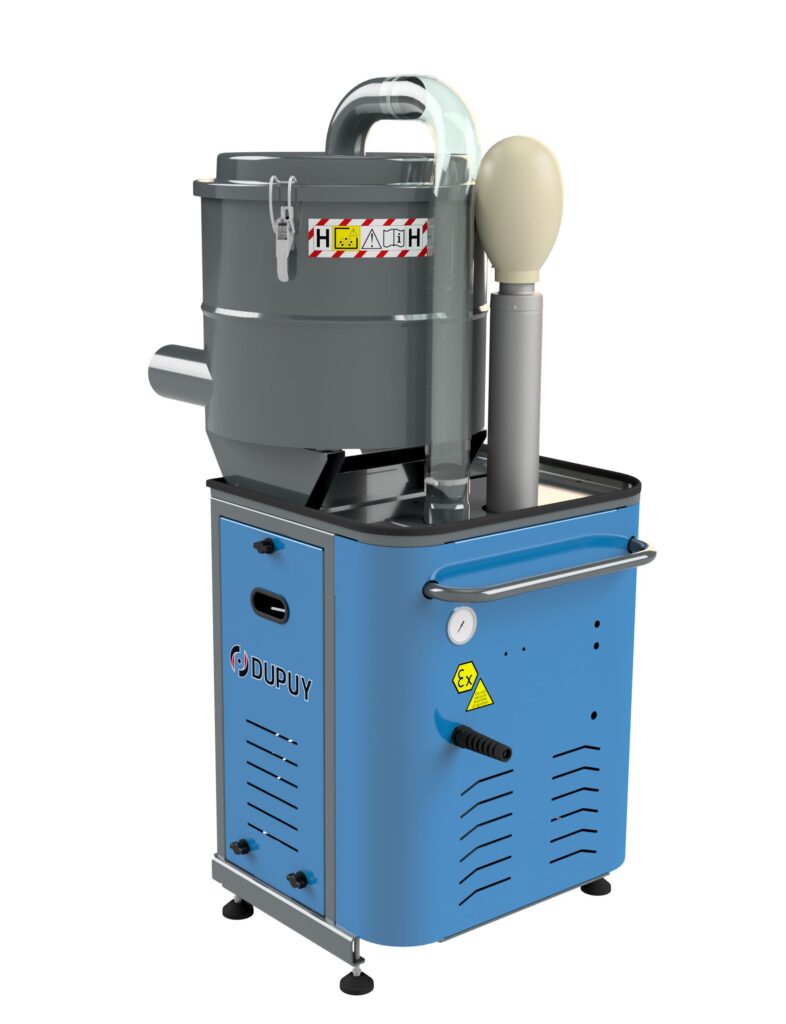
Specify where collected material goes, how often it is emptied and who handles it, because discharge decides daily labor and whether material can be recovered. DUPUY lists discharge “by rotocells for continuous discharge”, into removable containers or into big bags, and offers a filter silo, the BAGFILTER 160, that it describes as being for the food and cement industries.
Match the collector to the daily volume measured during the load study, and state how it will be handled, for example by forklift or pallet truck. If the dust is toxic, ask how the collector is emptied without exposing the operator. If material is to return to the process, the quality team must accept it first; if it is waste, it goes through the site’s own classification and disposal route.

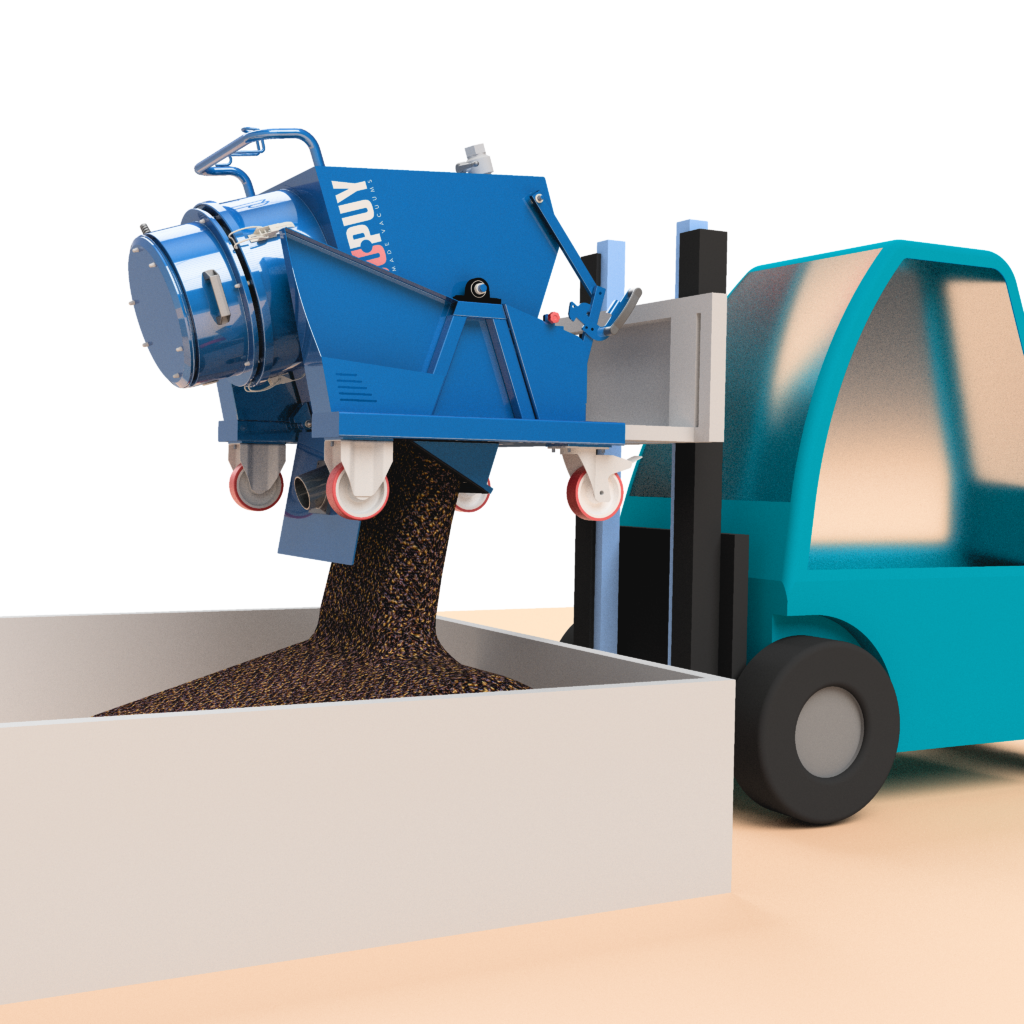
DUPUY’s TANKVAC film shows a high-capacity collection tank built for centralized systems; watch how it is handled by forklift and ask which tank size fits your emptying routine.
What changes if the dust is combustible?
Everything in contact with the dust becomes part of the explosion-protection design, and it must be engineered and certified for your assessed zones as a complete system. DUPUY’s central-systems page makes no general ATEX statement, so ATEX suitability cannot be assumed from the product family; it has to be specified, designed and documented for the project.
Under the EU workplace directive 1999/92/EC, used as a reference in many plants, the employer classifies hazardous areas into zones and equipment categories follow from them. The directive also states that “layers, deposits and heaps of combustible dust must be considered as any other source which can form an explosive atmosphere.” Regular vacuum cleaning removes that fuel, but only if the cleaning system does not add ignition sources of its own.
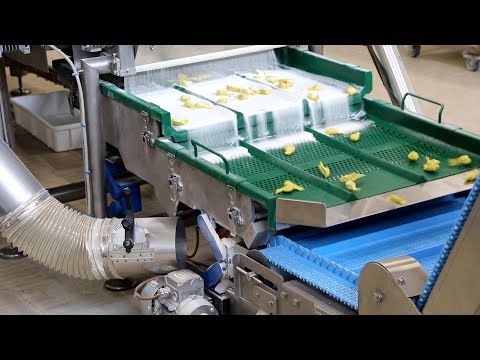
In this DUPUY film of a centralized system at a pasta factory, which DUPUY describes as ATEX 3D, watch how several inlets, the piping and the filter unit work as one system, and remember that its rating applies to that project’s configuration only.
For the questions to put to a supplier about dust and zones, see questions to ask before selecting an ATEX vacuum.
What should a complete central vacuum system specification include?
A complete specification lets two suppliers quote the same system. Use this checklist as the cover sheet of your enquiry:
- Numbered layout with all inlets, distances, rises and the power-unit location.
- Material data: density, particle size, moisture, abrasiveness, temperature, combustibility and toxicity.
- Peak simultaneous users, with tools, hose sizes and the shift pattern.
- Quantity collected per point and per shift, with the method used to estimate it.
- Required filtration performance and how filters are cleaned and changed.
- Discharge method, collector size, emptying frequency and whether material is recovered.
- Hazardous-area classification and the documents expected with the system.
- Utilities available: electrical supply and, if needed, compressed air.
- Ambient conditions, such as summer heat and desert dust around units placed outdoors.
- Spare filters, hoses and parts to hold on site, and the service support expected after handover.
- Future expansion: inlets and capacity to reserve.
Central vacuum specification path
How can AFE support the project?
AFE supplies DUPUY industrial and central vacuum systems and supports the specification through its consulting and engineering service: process analysis, system design and ATEX compliance checks. Where the cleaning load is uncertain, equipment rental for trials lets you measure what each area actually produces before the network is fixed.
After handover, filters, hoses and spare parts are available through AFE’s MRO and consumables service. Because equipment reaches Jordan, Saudi Arabia and Iraq through AFE’s regional gateway in Aqaba, agree the spare-filter stock to hold on site at the time of purchase. If areas need cleaning before the network is commissioned, the guide to industrial dry cleaning services explains how a vacuum-based service scope is defined.
Al Faisaliah Enterprises · Aqaba
Get your central vacuum specification reviewed
Send AFE your layout, material data and shift pattern. AFE reviews the gaps and advises on a DUPUY central vacuum configuration to match your duty.
Frequently asked questions
Can one central vacuum network handle both fine dust and larger debris?
Sometimes, if the design allows for it. Pipe size, air speed and the separator have to suit the full range of material, from fine dust that loads filters to coarse debris that needs more air to stay moving. State the size range in the specification. Where the difference is large, plants often use the network for routine dust and mobile machines for heavy debris or occasional spillage.
How far can the power unit be from the pick-up points?
DUPUY states that the suction unit of its central systems can sit up to hundreds of meters from the pick-up points. Distance is still not free: every meter and bend costs airflow, so a longer network needs more capacity for the same performance at the farthest inlet. Give the designer the real distances and rises from your layout rather than an estimate.
Can we add more inlets to the network later?
Yes, if the original design reserved capacity for them. Adding inlets to a network sized only for today's users reduces suction for everyone once the extra points are in use. List planned production lines and possible future inlets in the specification, and ask the supplier to show how much spare capacity the proposed power unit and main pipe provide.
Is a central vacuum system the same as a dust collector?
No. A dust collector extracts airborne dust at the source, for example at a machine or a transfer point; DUPUY's DEDUST collectors use a stilling chamber and cartridge filters for that task. A central vacuum system cleans settled material from floors, machines and structures through hoses. Most dusty plants need both, and the specification should say which job each system does.
Do food or pharmaceutical areas need a different central vacuum design?
They usually need different materials, cleanability and segregation. DUPUY states that it offers stainless steel solutions for the food, chemical and pharmaceutical sectors. Specify hygiene requirements such as material contact, how pipes and collectors are cleaned, and whether separate networks are needed to keep products or areas from cross-contaminating each other.
Sources and references
- Centralized vacuum systems — DUPUY
- Industrial dust collectors for fine suspended dusts — DUPUY
- Chemical and pharmaceutical industry — DUPUY
- Directive 1999/92/EC on minimum requirements for workers potentially at risk from explosive atmospheres — European Union
- Testing of dust filters (dust classes L, M, H) — IFA / DGUV
This article is general technical guidance. Equipment suitability, ATEX conformity and hygiene performance must be confirmed for each site and application.
Written for plant, maintenance, HSE and quality teams in Jordan, Saudi Arabia and Iraq.