The short answer
Different kitchen residues need different trials because steam acts on them differently. Fresh animal fat re-softens with heat, while vegetable oil heated many times can polymerize into a hard, varnish-like film, and carbonized deposits respond least of all. Residue age, the surface and nearby electrics change the result, so test each residue and surface before choosing a method.
Key takeaways
- Animal fats re-soften with heat; repeatedly heated vegetable oils can polymerize into a hard film that resists steam alone.
- Residue history matters as much as type: record what is cooked, where, how it is cleaned and when it was last deep-cleaned.
- Test each residue and surface combination on a small patch, recording method, time, recovery and surface condition.
- Degreasing is cleaning; it does not sanitize a surface by itself, and generator temperature proves nothing about the surface.
- AFE supplies TECNOVAP steam generators and delivers steam cleaning and degreasing; a site assessment defines the right route.
Every executive chef knows that the grease on a grill station is not the same as the film behind a fryer or the crust inside an oven. Yet cleaning plans often treat all of it as one problem, with one chemical and one method. Commercial kitchen steam degreasing works best when it starts from the opposite assumption: each residue has its own history and needs its own test.
This article explains why animal fats, vegetable oils and aged deposits respond differently to dry steam, what to record about each residue, and how a short, documented trial prevents wasted labor and damaged surfaces. It is written for chefs and kitchen managers in hotels, restaurants and catering operations in Jordan, Saudi Arabia and Iraq.
Why don’t all kitchen grease deposits respond to steam the same way?
Because steam works mainly through heat, with a little moisture and the mechanical action of the tool, and residues differ in how they react to heat. A fat that melts when warmed lifts easily; a film that has already been cooked into a solid layer does not melt again, so heat alone loosens it far less.
Dry saturated steam generators work at high generator temperatures. TECNOVAP, for example, states that its EVO model is “able to deliver dry saturated steam 174°C and detergent injection.” That heat is what softens deposits, but the temperature reaching the surface depends on the accessory, distance and pass speed, and no published figure supports a surface temperature. The residue decides how much the available heat can achieve.
How do animal fats and vegetable oils differ as residues?
They differ mainly in how they age. Animal fats such as lamb, beef or chicken fat and ghee are largely saturated, solid or semi-solid at room temperature, and re-soften when heated. Fresh deposits on grills, rotisseries and shawarma stations are therefore often the easiest to lift, but these fats trap smoke particles, flour and food debris, and they char where they sit close to the heat.
Vegetable oils are richer in unsaturated fats. Each time they are heated and exposed to air, they oxidize and gradually polymerize into a sticky, then hard, varnish-like film: the familiar amber layer around fryers, on canopy exteriors and on walls near the cooking line. Once polymerized, that film no longer melts, so the trial has to test whether detergent, a brush accessory or more passes are needed.
Most real kitchens have mixtures: oil film with dust and lint on top, fat mixed with flour in bakery sections, or layers built up over months of partial cleaning. That is why a residue’s history matters as much as its type.
| Residue | How it typically behaves under heat | What the trial should test |
|---|---|---|
| Fresh animal fat (grills, rotisseries, shawarma stations) | Softens and liquefies; can smear and run if not recovered | Pass speed, how melted fat is captured, run-off to drains |
| Fresh vegetable-oil film (cooking line, splash zones) | Thin, mobile film that lifts with heat and wiping | Whether steam and a cloth alone meet the standard |
| Aged, polymerized oil (fryer surrounds, canopy exteriors) | Hard, varnish-like layer that heat softens only partly | Detergent injection, brush accessory, dwell time, number of passes |
| Carbonized or baked-on deposits (oven cavities, grill plates) | Responds least to heat; largely a mechanical job | Steam as a pre-treatment, then abrasion the surface can tolerate |
| Grease mixed with dust, lint or flour | Turns into a paste that smears when wetted | Dry removal first, then steam, with vacuum or wipe recovery |
| Residue near controls, electrics and seals | Removal may be easy; moisture ingress is the risk | Isolation, protection, low-moisture technique, drying time |
What residue history should a kitchen record before a trial?
Record what is cooked, where, how often each area is cleaned and with what, and when it was last deep-cleaned. Two stations with the same visible grease can behave very differently if one is cleaned daily and the other has not been touched for months.
- The menu and cooking method at each station: frying, grilling, roasting, baking or wok cooking.
- The fats and oils used, including ghee, animal fats and frying oils, and how often fryer oil is changed.
- The current cleaning method, products, frequency and who does the work.
- The date of the last deep clean for each area, if known.
- The surfaces involved: stainless steel, aluminum, painted panels, tiles and grout, glass, plastics and rubber seals.
- Electrical items, controls and sensors near each area, and how they are isolated.
- The problem areas the team already knows: sticky canopy exteriors, splash walls, floor edges and the space behind equipment.
Photos of each area, taken before anything is cleaned, become the baseline for judging the trial.
How should a commercial kitchen steam degreasing trial be run?
Run it as a short, structured test on small patches, one for each residue and surface combination, with the method recorded so the kitchen team or a service provider can repeat the result.
- Pick the test patches. Choose one representative patch per residue and surface, plus a hidden area on any sensitive material.
- Isolate and protect. Have kitchen or maintenance staff isolate the equipment, let it cool, and cover controls, sockets and nearby food-contact items.
- Set the method. Record the generator, accessory, distance, pass speed, whether detergent is injected and how loosened grease is recovered.
- Clean and time it. Treat each patch and note the minutes per patch and the water or chemical used.
- Recover the residue. Capture melted fat with a steam-vacuum tool or absorbent wipes rather than washing it into drains.
- Judge the result. Compare against the baseline photos, check the surface for damage or dulling, and note what remains.
- Decide the method per area. Assign steam alone, steam with detergent or a brush, or another method where steam did not help.
Step 5 matters beyond appearance. In the US, the EPA reports that grease is the most common cause (47%) of reported sewer blockages, because it “solidifies, reduces conveyance capacity, and blocks flow.” Fat that steam melts should be captured, not flushed.
Kitchen degreasing trial

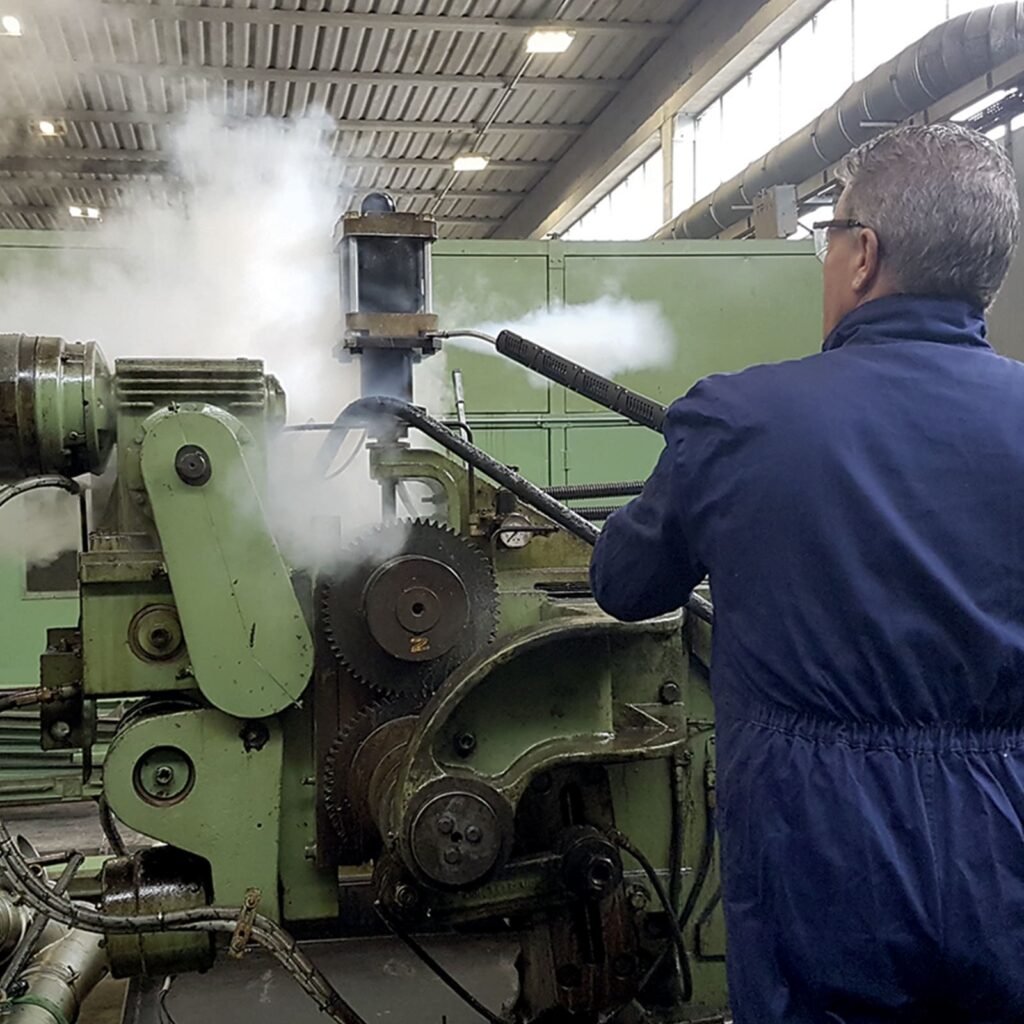
As you watch, note which accessory is used on which surface and how loosened grease is wiped or recovered: those are the variables a trial on your own residues should record.
Which surfaces and areas need extra care?
Electrics, heat-sensitive materials and anything that belongs to the exhaust system need extra care or fall outside the scope. Steam is low in liquid water but still leaves moisture, so control panels, ignition systems, thermostats, motors and sockets must be isolated and protected, and the equipment maker’s cleaning instructions take priority.
Aluminum, painted panels, plastics, rubber door seals and some glass can react to heat or rapid temperature change, so they belong in the hidden-area tests. Tiles are usually robust, but old grout can loosen, and polymerized grease often sits in the grout lines.
Kitchen exhaust ductwork is a separate discipline. Internal duct cleaning is the job of the kitchen’s own exhaust contractor, working to standards such as NFPA 96, and it is not part of a steam degreasing visit. The US Fire Administration reports that cooking caused 64% of fires in US eating and drinking establishments from 2017 to 2019, one reason hood and duct maintenance belongs with qualified specialists.
Does steam degreasing sanitize kitchen surfaces?
No, not by itself. Degreasing is cleaning: the Codex Alimentarius defines cleaning as “the removal of soil, food residues, dirt, grease, or other objectionable matter,” and that is what a degreasing trial measures. Sanitizing is a separate step with its own standard. The US FDA Food Code, for example, defines sanitization of cleaned food-contact surfaces as a treatment that yields a 5-log, or 99.999%, reduction of representative disease microorganisms.
A high generator temperature does not prove that a surface has been sanitized. Keep the kitchen’s existing sanitizing step and HACCP-based procedures in place unless a steam step has been validated for that purpose; building a verified dry steam hygiene procedure explains what that validation involves.
How can AFE help a kitchen choose the right degreasing route?
AFE works on both sides of the decision. It supplies TECNOVAP dry saturated steam generators and accessories to kitchens and facility teams that want to degrease in-house, backed by spare parts and consumables. It also delivers steam cleaning and degreasing as a service where a periodic deep clean suits better than daily in-house work.
Either route starts with a site assessment: AFE reviews the stations, residues, surfaces and electrics, then plans a patch trial that the chef can judge against the baseline. The result is a method for each area rather than one method for the whole kitchen. For institutional kitchens, see dry steam cleaning for hospital central-kitchen equipment; to prepare for the visit itself, see planning a dry steam cleaning visit for kitchen equipment. More hospitality guidance is in the HORECA insights hub.
Al Faisaliah Enterprises · Aqaba
Find the right degreasing method for each station
Send AFE your station list, the fats and oils you cook with and photos of the problem areas. You get a site assessment and a patch-trial plan matched to each residue and surface.
Frequently asked questions
Can steam remove the hard amber film around our fryers?
It depends on how long the film has built up. A polymerized oil film no longer melts, so steam alone may only soften it. A patch trial should compare steam alone with steam plus detergent injection or a brush accessory, and record how many passes were needed. If none reaches the standard, that surface needs a different method, which is better learned on a small patch.
Will steam damage stainless steel kitchen equipment?
Stainless steel is generally tolerant of steam; the risk usually lies in the parts around it, such as control panels, seals, plastics, labels and some coatings. Follow the equipment maker's cleaning instructions, isolate and cool the equipment first, and test any sensitive surface on a hidden area. End the trial with a check for dulling, distortion or moisture where it should not be.
Does steam degreasing reduce the need for chemicals?
It can, depending on the residue. Fresh fats and light oil films may need little detergent, while aged or polymerized deposits may still need it. TECNOVAP states that dry saturated steam offers considerable water and detergent savings, but the reliable answer for your kitchen comes from recording chemical use during the trial and comparing it with your current method.
How often should a commercial kitchen be steam degreased?
There is no fixed interval. Base it on the residue type and how quickly it builds up at each station: a busy grill or fryer area may need far more frequent attention than a pastry section. After the first deep clean, track how long each area takes to return to an unacceptable level, and set the schedule from that evidence.
Are kitchen hoods and exhaust ducts included in a steam degreasing visit?
Accessible external surfaces of hoods and canopies can be included if they pass the surface checks and are agreed in the scope. Internal exhaust ductwork is not: it belongs to the kitchen's own exhaust contractor, working to standards such as NFPA 96. The exact equipment and surfaces covered by an AFE steam degreasing visit are confirmed at the site assessment.
Sources and references
- Controlling Fats, Oils, and Grease Discharges from Food Service Establishments (EPA-833-F-12-003) · U.S. Environmental Protection Agency
- Topical Fire Report Series Vol. 21, Issue 9: Nonresidential Building Fires (2017-2019) · U.S. Fire Administration
- General Principles of Food Hygiene (CXC 1-1969, rev. 2022) · FAO/WHO Codex Alimentarius
- FDA Food Code 2026 · U.S. Food and Drug Administration
- EVO 304 DET · TECNOVAP
- Food industry · TECNOVAP
This article is general technical guidance. Equipment suitability, ATEX conformity and hygiene performance must be confirmed for each site and application.
Written for plant, maintenance, HSE and quality teams in Jordan, Saudi Arabia and Iraq.