
The short answer
Grid frequency matters because an induction motor's speed is set by the supply frequency: on Saudi Arabia's 60 Hz grid a 50 Hz design turns about 20% faster, and a fan or blower it drives needs far more power. Before buying, get the 60 Hz rating at your site voltage in writing, and confirm Jordanian or Iraqi supplies on site.
Key takeaways
- Saudi Arabia's grid runs at 60 Hz; the GCC interconnection needs an HVDC converter to link it with the 50 Hz Gulf grid.
- Induction motor speed follows frequency: a two-pole motor's field turns at 3,600 rpm at 60 Hz and 3,000 rpm at 50 Hz.
- By the fan laws, blower power rises with the cube of speed, so a 50 Hz rating cannot simply be reused at 60 Hz.
- Voltage matters as much as frequency: confirm the nominal voltage at each point of use, not only the country standard.
- Ask for a 60 Hz rating, nameplate and performance data for the exact model before the order is placed.
A plant manager in Dammam and a plant manager in Zarqa can order the same industrial vacuum from the same European catalogue, yet the two machines may need different electrical ratings. The reason is the supply. Saudi Arabia’s grid runs at 60 Hz, while much of the equipment made in Europe is designed and catalogued for 50 Hz, and the supply at a Jordanian site still has to be read on site. A change of frequency changes how every AC induction motor on the machine behaves.
This guide explains why a 60 Hz motor in Saudi plants is a specification item, not a detail for the electrician on commissioning day. It covers the motor speed principle, what is known about the grids in Saudi Arabia, Jordan and Iraq, which equipment types are most sensitive, and the questions to put to a supplier before an order is signed.
Why does a 60 Hz motor in Saudi Arabia behave differently?
An AC induction motor runs at a speed set by the frequency of the supply and the number of poles in its winding. The US Department of Energy’s motor and drive sourcebook gives the relationship as synchronous speed = 120 × frequency ÷ number of poles, and notes that most induction motors run within 1% to 3% of that speed.
Applied to the two common frequencies, the arithmetic is simple:
- A two-pole motor has a synchronous speed of 3,600 rpm at 60 Hz and 3,000 rpm at 50 Hz.
- A four-pole motor has 1,800 rpm at 60 Hz and 1,500 rpm at 50 Hz.
- In both cases the 60 Hz speed is 20% higher, because 60 ÷ 50 = 1.2.
A 20% speed difference sounds modest, but the machines on a cleaning equipment list are mostly fans, blowers and pumps, and their load does not rise in step with speed. That is where the real risk sits.
What do we know about the grids in Saudi Arabia, Jordan and Iraq?
Saudi Arabia is clearly documented as a 60 Hz system; Jordan and Iraq should be confirmed at the site. The GCC Interconnection Authority describes its own grid as 50 Hz and states that it links to “the 60Hz Saudi grid” through a back-to-back HVDC station, because two grids at different frequencies cannot simply be tied together. On voltage, SASO’s plug and socket standard records Council of Ministers decree No. 324 to change the Kingdom’s system voltage “from 220/127 V in the kingdom to 400/230 V”, and covers sockets operating at 60 Hz.
| Country | Frequency | Voltage note | What to do |
|---|---|---|---|
| Saudi Arabia | 60 Hz (GCCIA, SASO) | System voltage changed to 400/230 V by decree; older installations may still have earlier voltages | Specify 60 Hz equipment; confirm voltage at each point of use |
| Jordan | Not confirmed on a regulator page in our research | Not confirmed | Check the distribution board and existing motor nameplates; ask the site electrical engineer |
| Iraq | Not confirmed on a regulator page in our research | Not confirmed | As for Jordan; also ask about generator supply if the site uses one |
Jordan’s grid operator reports that the second phase of the Jordanian-Iraqi interconnection will be a synchronous link between the two grids, and that Jordan has joined the Gulf Interconnection Authority. Those are network facts, not a substitute for checking the supply at your own plant. Many charts list both countries at 50 Hz, but a reading at the switchboard is the evidence that counts.
What happens when a 50 Hz machine runs on a 60 Hz supply?
A machine designed for 50 Hz runs faster on 60 Hz, and for fans and blowers the extra speed asks for disproportionately more power. The US DOE fan sourcebook sets out the fan laws: airflow rises in proportion to speed, pressure with the square of speed and power with the cube of speed. It also notes that direct-drive fans run within a few percent of the motor’s synchronous speed, so they cannot absorb the change.
As an illustration only, a fan running 20% faster would by the cube law ask for about 1.2 × 1.2 × 1.2, roughly 1.7 times the shaft power. Real blowers do not follow the idealised law exactly, which is why the maker must rate them, but the direction is clear. The same sourcebook warns that an overloaded motor “will typically shut itself down with thermal or current safety switches”, so the first symptom on site is often nuisance tripping, not a dramatic failure.
Speed also affects things that are not electrical: bearing life, impeller stress, noise and the vacuum a side-channel blower develops. A machine that works on a 60 Hz supply is not necessarily working within its design limits.
Is voltage just as important as frequency?
Yes, and it is checked separately. The DOE motor sourcebook states that motors are designed to operate within ±10% of their rated voltage and that, ideally, deviations should stay below ±2%. It adds that a 10% drop in voltage on a Design B induction motor cuts its torque by almost 20%, and that when voltage unbalance between phases reaches 5%, phase currents can differ by as much as 40%.
In practice that gives three checks: the nominal voltage at the point of use, the measured voltage under load, and the balance between phases. A plant with long cable runs to a remote silo or loading area can see a lower voltage at the socket than at the main switchboard, which matters for a heavy three-phase vacuum started at the far end of the site.
Which equipment types are most sensitive to frequency?
Equipment that moves air or liquid with an AC motor is the most sensitive; equipment that only heats is mainly a voltage question. The table below is a starting point for the conversation with the supplier, not a rating of any model:
| Equipment | What the motor drives | Why frequency matters | What to ask |
|---|---|---|---|
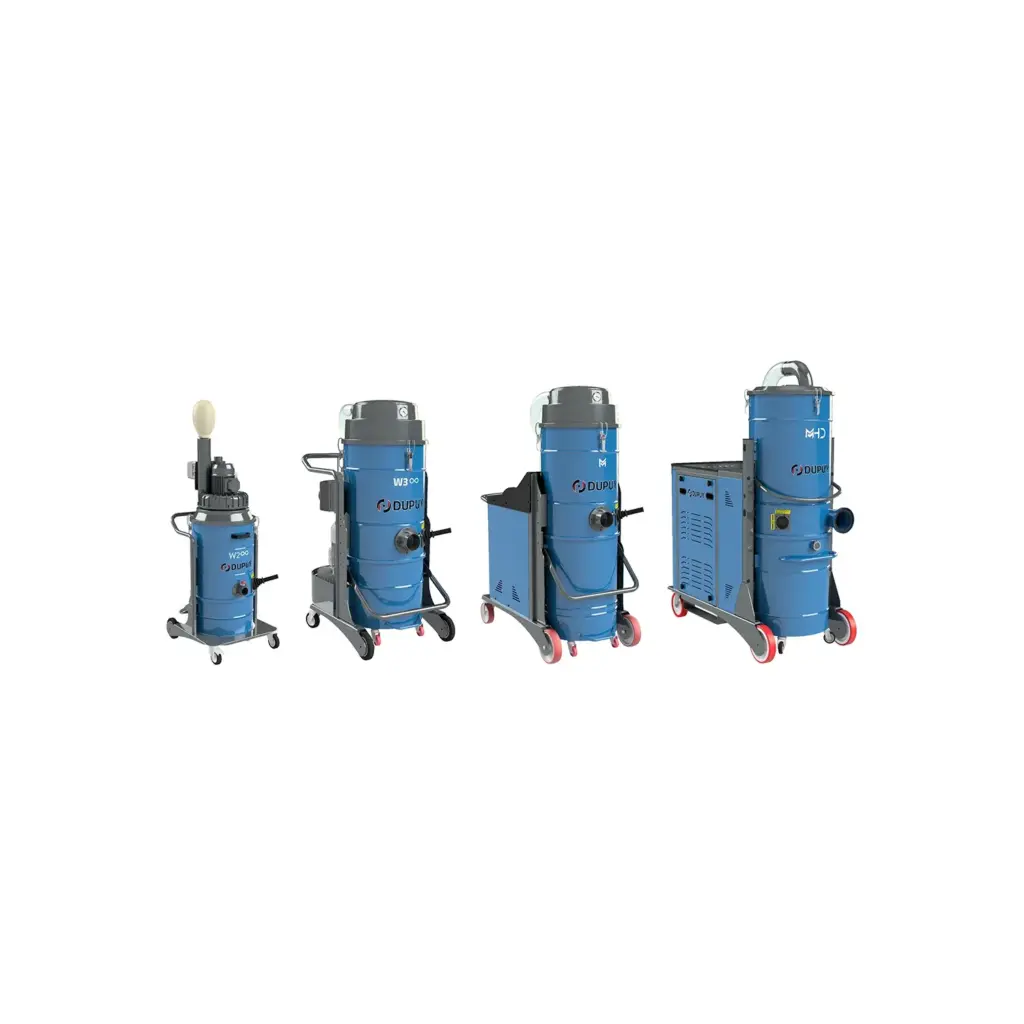
| Three-phase industrial vacuums (DUPUY) | Side-channel blower; DUPUY states the impeller is attached directly to the motor shaft on models such as M 70 and M90 | Direct drive means blower speed follows supply frequency | A 60 Hz version or rating, with airflow, vacuum and current at 60 Hz |
| Single-phase vacuums (DUPUY) | By-pass motors; DUPUY describes carbon-brush by-pass motors on models such as the PROVAC 702 WD | Brush (commutator) motors are much less sensitive to frequency than induction motors, so voltage is the main question; datasheets are still published at 230 V, 50 Hz | Whether the model offered is approved by the maker for your voltage and 60 Hz |
| Dust collectors and central vacuum units | Fans and power units | Fan laws apply directly | Fan curve and motor rating at 60 Hz; protection settings |
| Dry steam generators (TECNOVAP) | Heating elements, plus pumps or vacuum motors on combined models | Heating is mainly voltage-dependent; pumps and vacuum motors are frequency-dependent | Rated voltage and frequency for the whole unit, not only the boiler |
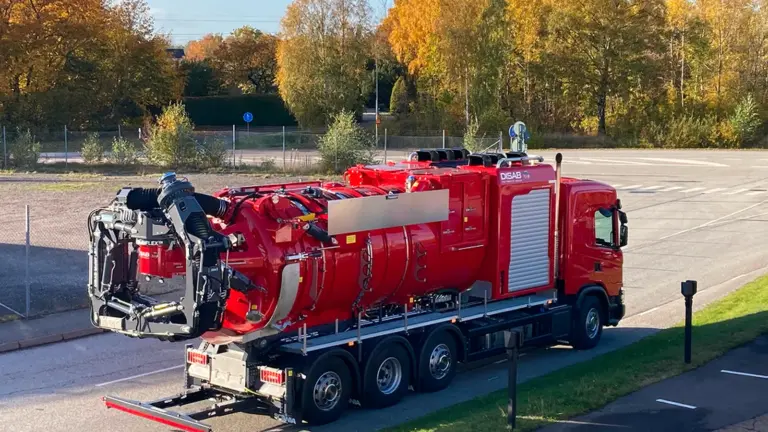
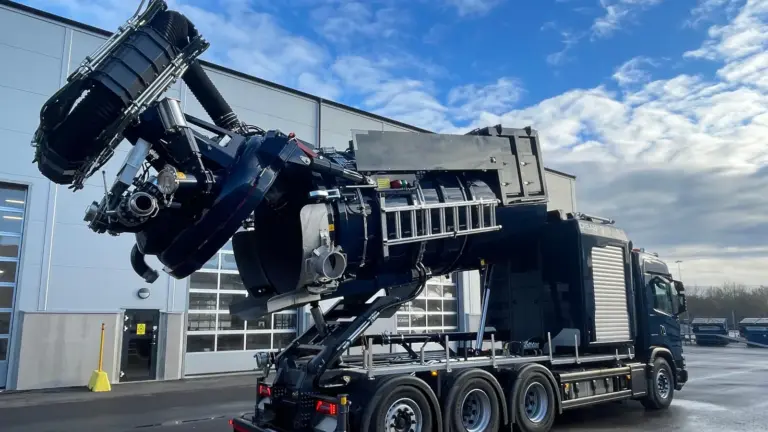
| Vacuum trucks (DISAB) | AFE describes the trucks as typically diesel-powered | Grid frequency is not the issue for an engine-driven truck | For DISAB’s electric stationary units (for example PES-6, which DISAB lists at 25-33 kW), the same 60 Hz questions |
DUPUY publishes its datasheets with the supply stated, for example 400 V three-phase 50 Hz for the M 70 and M90. That is useful: it tells you exactly what to ask for when the destination is a 60 Hz plant. The guide to single-phase versus three-phase industrial vacuums covers the other electrical choices that sit alongside frequency.
What should you ask the supplier before ordering?
Ask for the electrical rating of the exact model at your frequency and voltage, in writing, before the order is placed. A useful checklist:
- Rated frequency and voltage of the model offered, as shown on the nameplate it will ship with. If a motor nameplate carries separate 50 Hz and 60 Hz lines, read the 60 Hz line: rated voltage, current and speed can differ between them.
- Performance at 60 Hz: airflow, vacuum or pressure, and absorbed current, not only the 50 Hz catalogue figures.
- Motor and protection data: rated current and recommended protection settings for your supply.
- Plug and socket type for the points of use, and whether the cable is supplied fitted or loose.
- Conformity documents needed for import and for your site’s own approval, including any ATEX certificate where the area is classified.
- Spares at the same rating: replacement motors and blowers must match the 60 Hz build, so confirm part numbers.
Put these points into the RFQ itself. The guide to what an industrial vacuum RFQ should include shows where they fit, and industrial vacuums in Saudi Arabia covers the wider Saudi specification, including GSO IEC 62784 for combustible dust.
How do you confirm the site supply before the machine arrives?
Confirm it with the site’s electrical engineer, at the points where the machine will actually be plugged in. A short sequence avoids surprises at delivery:
Checking supply before ordering
- Map points of use
- Read site supply
- Get 60 Hz rating
- Match plugs, protection
- Commission with electrician
- Map the points of use. List where the machine will run: production halls, silos, loading bays, workshops.
- Read the supply. The site electrician records nominal voltage, frequency and phases at each point, and notes any generator-fed areas.
- Compare with the offer. Check the supplier’s 60 Hz rating against those readings, including the voltage at the furthest point.
- Match plugs and protection. Agree socket type, cable length and protection settings before dispatch.
- Commission together. At first start, the electrician checks rotation, current draw and protection with the supplier’s data in hand.
For plants in Jordan and Iraq the steps are the same; only the first reading may give a different answer. Groups that run plants in more than one of the three countries should treat each site as its own specification.
How AFE helps you specify for a 60 Hz or 50 Hz site
AFE supplies DUPUY industrial vacuums and dust collectors, TECNOVAP dry steam generators and DISAB vacuum trucks to plants in Jordan, Saudi Arabia and Iraq, working from its Aqaba regional hub. When you send your site’s supply data with the enquiry, the request to the manufacturer can name the frequency and voltage from the start rather than after delivery.
Where the electrical question is part of a wider system choice, for example a central vacuum network or equipment for a classified area, AFE’s engineering and consulting team can help structure the specification. Matching spare parts and consumables should be ordered at the same rating as the machine.
Al Faisaliah Enterprises · Aqaba
Order equipment rated for your supply
Send the voltage, frequency and phases at each point of use, with the equipment you are considering. AFE will request the matching rating and performance data from the manufacturer before you order.
Frequently asked questions
Can I run a 50 Hz industrial vacuum on a 60 Hz supply in Saudi Arabia?
Do not assume so. An induction motor runs about 20% faster at 60 Hz, and a blower's power demand rises steeply with speed, so the motor may overload, trip or run outside the maker's limits. Ask the manufacturer whether that exact model is rated for 60 Hz at your voltage, and get the 60 Hz performance and current figures in writing before you order.
Does a 60 Hz machine give more suction than the 50 Hz version?
It may move more air because the motor turns faster, but only if the motor and blower are designed for it. A version built for 60 Hz should be designed so that the motor is not overloaded at the higher speed, so its published performance can differ from the 50 Hz catalogue. Compare the figures the manufacturer gives for the version you will actually receive.
Are Jordan and Iraq on 50 Hz?
They are commonly listed at 50 Hz, but we could not confirm this on a regulator's page, so treat it as something to verify. Ask the site electrical engineer to read voltage, frequency and phases at the points where the equipment will be used, and check the nameplates of motors already running on site. Generator-fed areas should be checked separately.
Do dry steam generators care about grid frequency?
The heating side of an electric steam generator depends mainly on voltage, but many units also have pumps, fans or a built-in vacuum motor, and those depend on frequency. Ask for the rated voltage and frequency of the complete unit, as shown on its nameplate, rather than only the boiler power, and check that your supply matches.
Who should connect and commission imported equipment?
The site's qualified electrical engineer, using the manufacturer's documentation for the exact model. The supplier provides the rating, wiring and protection data; the electrician checks the supply, sets the protection and confirms rotation and current at first start. AFE supplies the equipment and documentation but does not carry out electrical work.
Sources and references
- Our existing network · GCC Interconnection Authority
- SASO 2203:2015 Plugs and socket-outlets for household and similar purposes (TBT notification document) · Saudi Standards, Metrology and Quality Organization (SASO)
- Improving Motor and Drive System Performance: A Sourcebook for Industry · US Department of Energy
- Improving Fan System Performance: A Sourcebook for Industry · US Department of Energy
- NEPCO Annual Report 2024 · National Electric Power Company (Jordan)
- M90 industrial vacuum cleaner · DUPUY
This article is general technical guidance. Equipment suitability, ATEX conformity and hygiene performance must be confirmed for each site and application.
Written for plant, maintenance, HSE and quality teams in Jordan, Saudi Arabia and Iraq.