The short answer
A steam sanitization claim needs evidence from your own surfaces, not a boiler temperature. That means a cleaning step first, a fixed procedure (model, accessory, distance, speed, passes), measured surface temperature and time, and microbiological results against your target organisms, repeated until they are consistent. Routine verification then shows the validated procedure is still followed.
Key takeaways
- Cleaning removes soil; sanitizing and disinfection reduce microorganisms; sterilization is a separate validated process. Keep the terms separate in procedures.
- A generator's steam temperature does not prove what the equipment surface reached, or for how long.
- TECNOVAP's AFNOR NF T72-110 results cover three named models, two accessories and laboratory conditions, not your production line.
- Fix model, accessory, stand-off, speed and passes, then test real surfaces with microbiology, not ATP alone.
- AFE can supply TECNOVAP equipment or deliver steam cleaning; the validated hygiene claim remains your food safety team's decision.
Dry steam is attractive in food plants. It reaches into equipment, uses little water, and TECNOVAP claims “considerable water and detergent savings” in food applications. The risk lies in the wording: once “sanitized” appears on a cleaning record, an auditor will expect evidence that the step reduced microorganisms on those surfaces, under those conditions, every time it is done.
This process guide is for quality managers who want to use dry steam sanitization for food equipment as a documented step. It separates the hygiene terms, explains why a boiler reading is not proof, shows what TECNOVAP’s published laboratory testing does and does not cover, and sets out the evidence a sanitization claim needs before anyone writes it into a procedure.
What is the difference between cleaning, sanitizing, disinfection and sterilization?
Cleaning removes soil; sanitizing and disinfection reduce microorganisms to a defined level; sterilization is a separate, validated process that steam cleaning of food equipment does not achieve or claim. Use the terms exactly, because each sets a different standard of proof.
| Term | Definition and source | What it means for a steam step |
|---|---|---|
| Cleaning | “The removal of soil, food residues, dirt, grease, or other objectionable matter” (Codex CXC 1-1969) | Verified visually and with residue checks |
| Disinfection | Reduction “in the number of viable microorganisms on surfaces, in water or air to a level that does not compromise food safety and/or suitability” (Codex) | Needs microbiological evidence |
| Sanitization (US) | Heat or chemicals applied to cleaned food-contact surfaces that, evaluated for efficacy, yield “a reduction of 5 logs, which is equal to a 99.999% reduction” of representative disease microorganisms (US FDA Food Code 2026) | Needs efficacy evidence against a defined reduction |
| Sterilization | “Validated process used to render a product free of all forms of viable microorganisms” (US CDC) | Not a claim to make for steam cleaning of food equipment |
EU food law points the same way. Regulation (EC) No 852/2004 requires equipment to “be effectively cleaned and, where necessary, disinfected,” at a frequency sufficient to avoid contamination, within procedures “based on the HACCP principles.” Both the US FDA definition and the EU wording put cleaning first: a step meant to reduce microorganisms works on surfaces that are already clean.
Why is boiler temperature not evidence of sanitization?
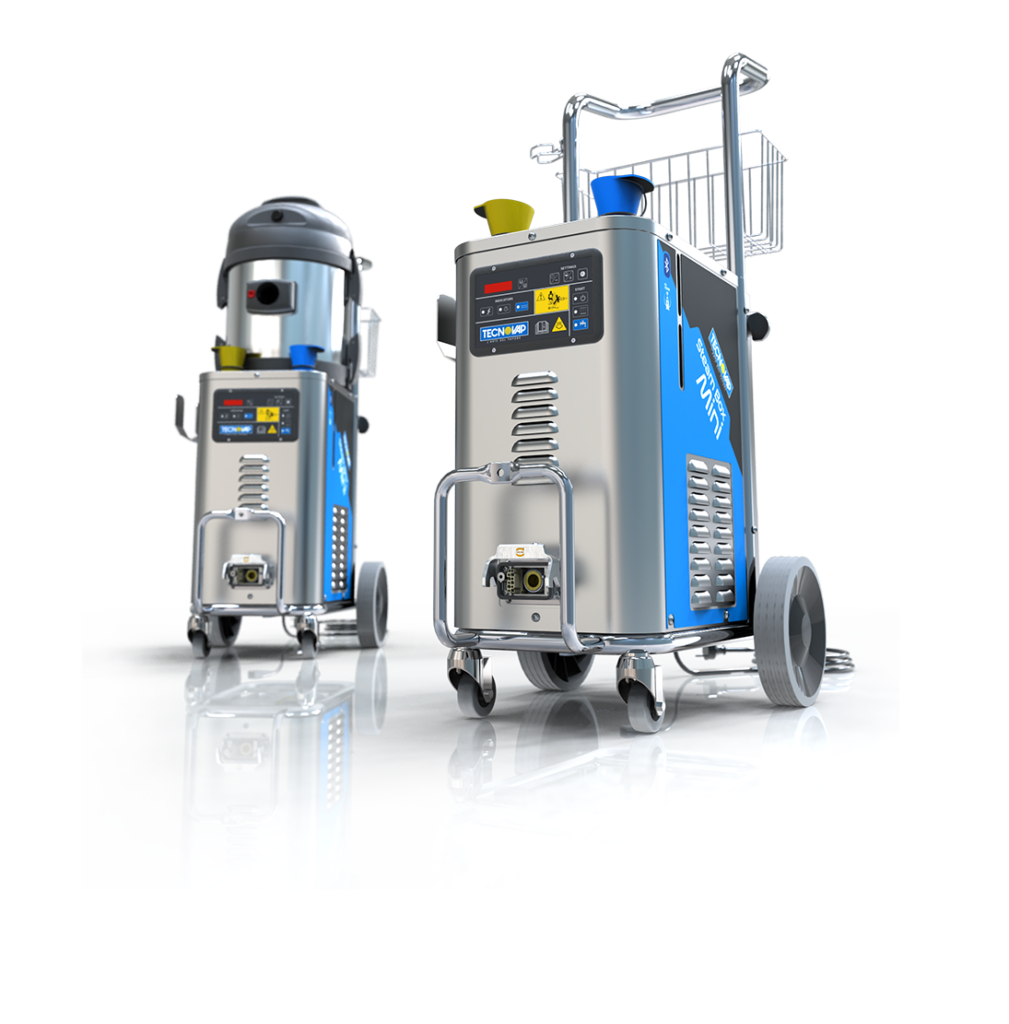
Boiler temperature describes the generator, not the surface. TECNOVAP publishes generator-side figures, for example “dry saturated steam at 183° C” for the Steam Power Plus, but those figures do not give the temperature at the nozzle or on the food equipment.
Between generator and surface, temperature falls with distance, travel speed, hose length and the heat absorbed by cold, heavy stainless steel. Any microbial effect depends on the temperature actually reached at the surface and how long it lasts, so that is what the evidence has to measure.
What does TECNOVAP’s AFNOR NF T72-110 testing show?
It shows laboratory efficacy for three named models and two accessories under fixed conditions; it does not show performance on your equipment. TECNOVAP states that the Evo 304, Evo Blu and Evo Sanitizer comply with the French standard AFNOR NF T72-110, with tests conducted at the VirHealth microbiology laboratory.
According to TECNOVAP, two accessories were tested: the Steam Mop in a contact test at 10 cm/s, and the July lance in a non-contact test held 1.5 cm from the surface at 10 cm/s. The reported reductions were at least 5 log10 for S. aureus, P. aeruginosa and E. coli; at least 4 log10 for C. albicans, A. brasiliensis, human adenovirus 5, murine norovirus and L. lactis phages P001/P008; and at least 3 log10 for B. subtilis. TECNOVAP gives the classification as “S.D.D. (Steam Disinfection Devices).”
Three limits follow. The results do not transfer to other TECNOVAP models or accessories. They were obtained at a fixed speed and distance that hand-held work on a production line may not match. And laboratory test surfaces are not gaskets, welds, conveyor mesh or soiled corners. Use the data to design your trial, not to replace it.
What evidence does a steam sanitization claim need?
A claim needs a chain of evidence that runs from machine capability to microbiology on your own surfaces, plus routine records showing the procedure is still followed. Each level answers a different question.
| Evidence | What it shows | What it does not show |
|---|---|---|
| Generator datasheet | Steam temperature and pressure at the generator | Surface temperature or any microbial effect |
| Laboratory test to a standard | Efficacy of a named device and accessory under laboratory conditions | Performance on your surfaces and soils |
| Surface temperature and time measurements | Heat delivered to your equipment under your procedure | Microbial reduction on its own |
| ATP swabs | Residual organic soil, a fast cleaning check | A log reduction of specific organisms |
| Before-and-after microbiological swabs | Reduction achieved on real surfaces, including worst-case points | Results on surfaces you did not test |
| Routine verification records | The validated procedure is being followed | The effect of later changes to equipment, surfaces or soils |
From steam cleaning to a supported claim
How do you build a verified dry steam hygiene procedure?
Build it in a fixed order, from claim and scope through to routine verification, so that each step produces a record the next one relies on.
- Define the claim and scope. List the equipment and surfaces, separate food-contact from non-contact surfaces, and state whether the step is cleaning or a microbial reduction step in your HACCP plan.
- Check compatibility. Confirm with the equipment maker that surfaces, seals, plastics and electrics tolerate heat and moisture; protect or exclude what does not.
- Clean first. Remove visible soil and residues before any step intended to reduce microorganisms.
- Fix the parameters. Record generator model, accessory, stand-off distance, travel speed, number of passes and order of work, so every operator works the same way.
- Measure the surface. Log temperature and time at representative and worst-case points with a method suited to stainless steel; infrared readings on polished metal can be unreliable.
- Test the microbiology. Take before-and-after swabs at the hardest-to-reach points, use an accredited laboratory, and repeat across runs and operators.
- Document and train. Turn the validated settings into a work instruction with photos, and train each operator against it.
- Verify and revalidate. Run routine checks, and repeat validation when the model, accessory, surface, soil or results change.

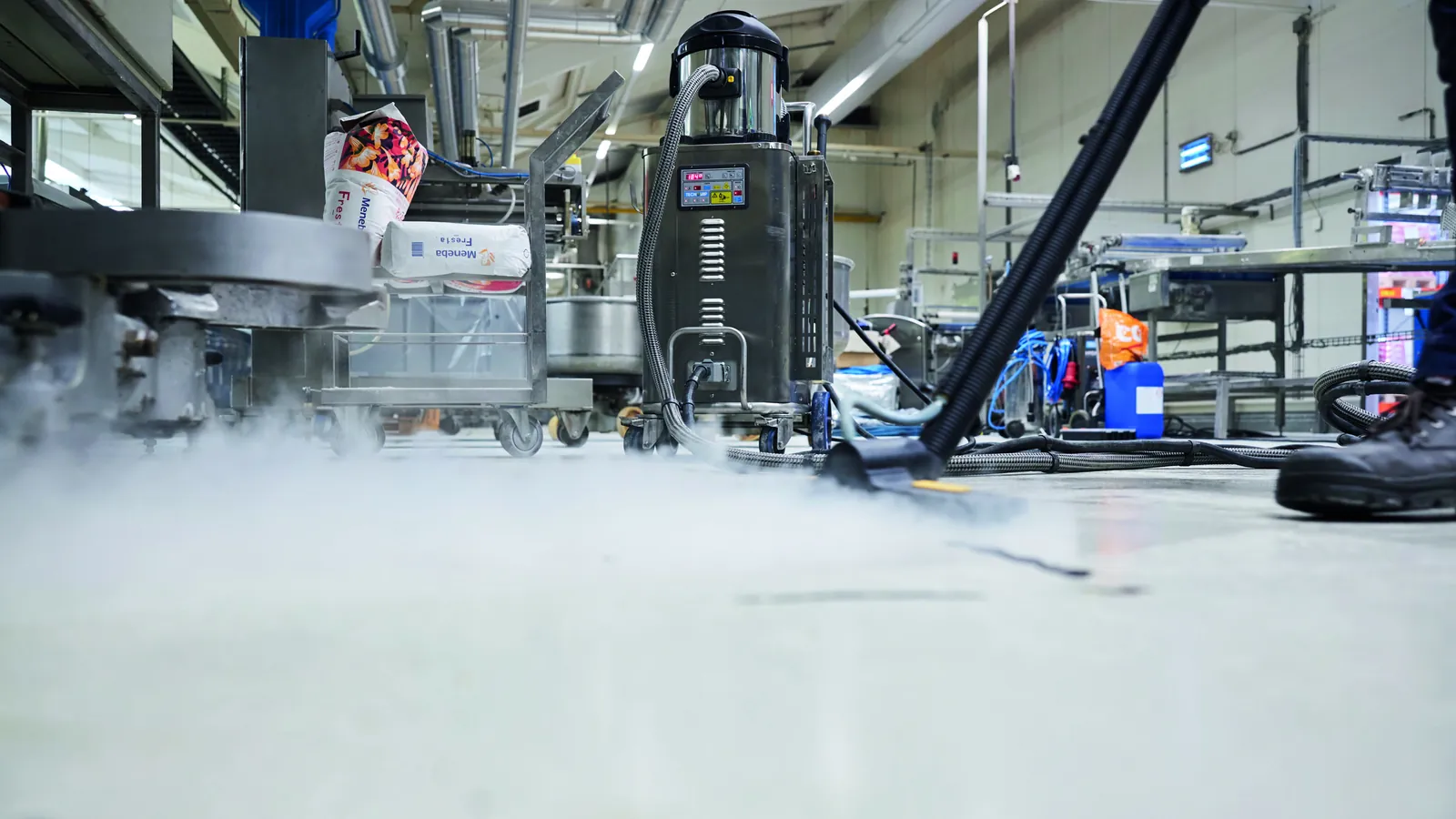
The title uses the manufacturer’s own word, “sanitizing.” Watch it as a demonstration of technique on racks, benches and production equipment, and note how distance and pace would need to be fixed in your procedure; it is not validation evidence for your site.
Where does dry steam fit in a food plant hygiene program?
Dry steam fits best where water is a problem, where surfaces are hard to reach and where the method can be held consistent. TECNOVAP states on its food industry page that dry saturated steam is “the ideal solution for sanitizing many types of metal surfaces in the food industry,” working by “eliminating microorganisms through thermal shock.” Treat that as the manufacturer’s claim to test on your equipment, not as a conclusion.
- Dry production areas. The Codex principles note that dry cleaning may be needed where water increases the likelihood of microbiological contamination, a common situation in bakery, flour and sugar areas.
- Conveyors and repeatable tasks. Automated steam and vacuum belt cleaning holds speed and distance constant, which can make parameters easier to control than hand-held lance work.
- Caution points. Condensate left in crevices that do not dry, heat-sensitive seals and plastics, and electrical components. Allergen removal needs its own validation.

Watch how the automatic steam and vacuum system treats a moving conveyor belt, and compare that consistency with hand-held work when you design your trial.
What mistakes undermine a steam hygiene claim?
Most failed claims come from wording that runs ahead of the evidence. Avoid these:
- Writing “sanitized” or “disinfected” on records before the procedure is validated.
- Quoting the generator temperature as proof of an effect on the surface.
- Extending laboratory results to a different model, accessory or travel speed.
- Skipping the cleaning step and steaming over soil.
- Testing only easy, flat surfaces, or relying on ATP swabs alone.
- Changing nozzle, technique or equipment without revalidating.
- Describing steam as sterilization in procedures, sales material or audit answers.
How does AFE support a dry steam hygiene procedure?
AFE supplies TECNOVAP dry steam generators and accessories, delivers on-site industrial steam cleaning, and can help plan a site trial that records the parameters your validation needs. Its consulting team supports process analysis, and you can ask about equipment rental for trials.
Microbiological testing belongs with an accredited laboratory, and the hygiene claim itself stays with your food safety team. For the healthcare version of this question, see how verified sanitization differs from visible cleaning; for maintenance use of the same technology, see dry steam degreasing during machine maintenance. Browse more food and beverage guides.
Al Faisaliah Enterprises · Aqaba
Plan a steam trial that produces usable evidence
Tell AFE which equipment and surfaces you want to treat and how your hygiene team will test them. We will propose a trial set-up with fixed, recorded parameters for your validation.
Frequently asked questions
Can we write 'sanitized' on our cleaning record after steam cleaning?
Only when the procedure has been validated for that outcome on those surfaces. Until then, record the step as steam cleaned, with the model, accessory and parameters used. In a US context, the FDA Food Code defines sanitization as a 5-log reduction of representative disease microorganisms on cleaned food-contact surfaces, so the record should be backed by efficacy evidence of that kind.
Does dry steam remove the need for chemical sanitizers?
Not automatically. TECNOVAP says dry saturated steam is ideal for sanitizing many metal surfaces in the food industry and claims water and detergent savings, but that is the manufacturer's position. Whether steam can replace an approved chemical step on your equipment is a decision for your HACCP team, based on site test results. Some surfaces may still need an approved chemical.
Which microorganisms should our validation test for?
Test for the organisms your hazard analysis identifies, plus any indicator groups your laboratory and auditors expect, agreed with an accredited laboratory. TECNOVAP's published laboratory results list organisms such as S. aureus, P. aeruginosa and E. coli, which can help frame the discussion, but they are not a substitute for targets chosen for your products and process.
Is ATP testing enough to prove a steam step works?
No. ATP swabs give a fast reading of residual organic soil, which makes them useful for checking cleaning on a routine basis. They do not measure the reduction of specific microorganisms. During validation, pair them with before-and-after microbiological swabs at worst-case points, and use ATP afterwards as one of your routine verification checks.
When does a validated steam procedure need to be repeated?
Revalidate whenever something that affects the result changes: the generator model, accessory, stand-off distance or travel speed, the surfaces or equipment treated, the type of soil, or the operators' technique. Also revalidate when routine verification results drift. Set a fixed review interval in your food safety system so the procedure is reviewed even when nothing seems to have changed.
Sources and references
- General Principles of Food Hygiene, CXC 1-1969 (rev. 2022) · FAO/WHO Codex Alimentarius
- Food Code 2026 · US Food and Drug Administration
- Guideline for Disinfection and Sterilization in Healthcare Facilities: glossary · US Centers for Disease Control and Prevention
- Regulation (EC) No 852/2004 on the hygiene of foodstuffs · European Union (EUR-Lex)
- AFNOR NF T72-110 test results · TECNOVAP
- Food industry applications · TECNOVAP
- Steam Power Plus · TECNOVAP
This article is general technical guidance. Equipment suitability, ATEX conformity and hygiene performance must be confirmed for each site and application.
Written for plant, maintenance, HSE and quality teams in Jordan, Saudi Arabia and Iraq.