The short answer
Granulation dust cleaning between batches should remove bulk residue first, then vacuum from high to low before product-contact parts are washed, using a vacuum dedicated to that suite. Fluid bed dryer filters are handled to the maker's procedure. Equipment is then inspected, old batch labels removed and status recorded, as EU GMP and US cGMP expect.
Key takeaways
- Map dust points room by room: charging, wet mass discharge, dryer container, filter housing, mill, sieve and perimeter surfaces.
- Clean from bulk to fine and from high to low, before washing product-contact parts.
- Dedicate one vacuum, hose set and filter to each granulation suite or product family.
- Match filtration to the powder's exposure limit and confirm the exact model's dust class.
- Zoned rooms need an ATEX-certified model with its certificate; ATEX is never a brand-wide property.
A granulation suite releases dust at almost every step of a batch: charging powders into the high-shear granulator, discharging the wet mass, loading and unloading the fluid bed dryer, shaking or changing its filter bags, then milling, sieving and transferring the dried granule to bins. Between batches, that dust sits on the machines, on the floor around them and on ledges, cable trays and pipework nearby. Granulation dust cleaning is the part of the changeover that removes it without carrying it into the next batch or the next room.
This guide follows the changeover itself: where dust collects around granulators and fluid bed dryers, how the cleanup is sequenced, why the vacuum should belong to the area, and what to check before buying DUPUY equipment for the job. Extraction design at the process is covered in our pharmaceutical process dust extraction scoping guide; this article starts once the batch has left the room.
Where does dust collect in granulation and fluid bed dryer areas?
Dust collects wherever the product is open to the room: at charging and discharge points, around the dryer container and filter housing, at mills and sieves, and on every horizontal surface downstream of them. Mapping these points room by room is the first step, because each needs a different tool and a different place in the sequence.
| Location | What typically collects | Changeover concern |
|---|---|---|
| Granulator charging port, lid and seals | Dry powder from charging | Residues of the previous product close to product-contact parts |
| Wet mass discharge and transfer to the dryer | Lumps and smears that dry into dust | Dried residue that flakes off later and is easy to miss |
| Fluid bed dryer container and its surroundings | Fine dried granule from loading and unloading | Dust spread when the container is moved or opened |
| Dryer filter housing and bag change area | The finest fraction, held by the dryer’s own filters | Highest concentration of fines; operator exposure during bag removal |
| Mill, sieve and bin docking points | Granule and fines at open transfers | Spillage on the floor, bin lids and docking collars |
| Floor edges, plinths, cable trays and pipework | Settled fines | Surfaces often left out of the changeover check |
EU GMP asks manufacturers to assess cross-contamination from “uncontrolled release of dust” and lists closed transfer systems and “controlled removal of dust close to source of the contaminant” among the technical measures (EudraLex Volume 4, Chapter 5). Good containment reduces what reaches the room, but a changeover still needs a cleanup step for what escapes.
How does granulation dust cleaning differ within a campaign and at product change?
The scope differs: within a campaign of the same product, cleanup keeps the room and equipment within the limits of your procedure; at a product change, all residues of the previous product must be removed and the result verified. Your approved cleaning procedure sets the actual scope; the table shows the usual difference.
| Changeover type | Typical dust cleanup scope | Typical check before release |
|---|---|---|
| Batch to batch, same product (campaign) | Remove loose granule and spillage, vacuum the dryer surroundings and floor, empty or change the vacuum container as the procedure says | Visual check of the areas named in the procedure; batch identification updated |
| End of campaign or product change | Full high-to-low vacuuming of the room, equipment exteriors and perimeter surfaces before washing; vacuum filter and container handled as product-contaminated | Inspection, cleaning verification as your validation requires, old batch labels removed, status label applied |
EU GMP describes campaign working followed “by a cleaning process of validated effectiveness” and suggests cleaning verification after each product campaign for higher-risk products. How a vacuum fits into a validated procedure is covered in how cleaning equipment choice affects cleaning validation.
In what order should the cleanup run?
The cleanup should run from bulk to fine and from high to low, so that nothing cleaned is dirtied again. A typical sequence for a granulation and drying suite looks like this:
- Close out the batch. Remove product containers and bins, close open ports, and keep the room’s air locks and pressure cascade working as designed.
- Collect bulk residue first. Pick up loose granule and spillage with the area’s vacuum before any wet cleaning, which would turn powder into paste.
- Handle dryer filters to the maker’s procedure. Shaking or removing the dryer’s filter bags releases the finest dust; hold the vacuum nozzle at the housing while it is opened.
- Vacuum high to low. Clean pipework, cable trays and ledges first, then machine frames and guards, then the floor and the room perimeter.
- Wash product-contact parts as validated. Vacuuming prepares the room; it does not replace the washing of granulator bowls, dryer containers or mill screens.
- Clean or bag the vacuum tools. Dismantle and clean hoses, wands and floor tools, or keep them dedicated to the room and store them as the procedure states.
- Inspect, record and label. Inspect equipment for cleanliness before use, remove the previous batch identification and apply the clean status label.
Granulation suite changeover
- Remove bulk residue
- Vacuum high to low
- Wash contact parts
- Inspect and label
The last step mirrors US cGMP. Under 21 CFR 211.67, written cleaning procedures must cover the methods and equipment used, “removal or obliteration of previous batch identification”, protection of clean equipment and “inspection of equipment for cleanliness immediately before use”, with records kept.
Why should the vacuum be dedicated to one area?
Because a mobile vacuum that moves between rooms carries product with it: in its filter, its container, its hose and its wheels. EU GMP lists among its technical measures the “dedication of selected parts which are harder to clean (e.g. filters), dedication of maintenance tools”, and a vacuum filter is a clear example. In practice, dedication means:
- One vacuum per granulation suite or product family, identified by tag or color code, never shared with tablet press or packaging rooms.
- A dedicated hose and tool set that stays in the room, with a clean storage point.
- Container emptying and filter change done in the room or a defined area, with the waste handled as the product requires.
- A status label on the vacuum itself (EU GMP suggests colors to show status, such as “clean”).
- A log of use, filter changes and cleaning of the machine, kept with the room records.
Where one vacuum must serve several products, treat the filter and container as product-contaminated at every change and include the vacuum’s own cleaning in the validated procedure.
What should the vacuum offer for granulation dust cleaning?
It should offer filtration matched to the powder’s exposure limit, construction that can itself be cleaned, emptying without exposing the operator, and ATEX certification where the room is zoned. The IEC/EN 60335-2-69 dust classes give a reference for filtration: according to the German IFA, class H covers substances with exposure limits below 0.1 mg/m³ and carcinogenic, mutagenic or reprotoxic substances, with filter penetration below 0.005%. For potent products, see what to specify in an H class vacuum for potent compounds.
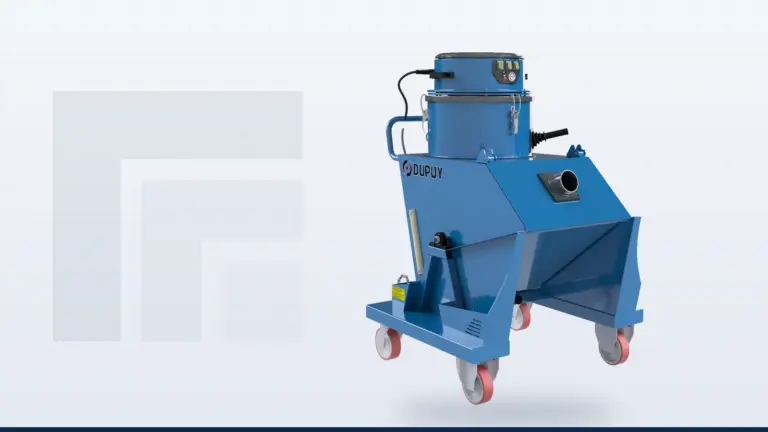
DUPUY states that its vacuums for the chemical and pharmaceutical industries include stainless steel construction as a standard feature and that ATEX-certified versions are available. Its page names no dust class, so ask for the filter class and test documents of the exact model offered.

DUPUY presents the W2 for small and medium quantities in chemical-pharmaceutical, food and milling plants. As you watch, note how the container and filter are reached, since emptying is where operators meet the collected powder.
When do solvents or explosible dust change the selection?
They change it as soon as the room is classified as a hazardous area. Some granulating fluids contain solvents, and many dried granules and their fines can be explosible; only testing of the actual material shows whether yours is. Under Directive 1999/92/EC the employer classifies zones, and “layers, deposits and heaps of combustible dust must be considered as any other source which can form an explosive atmosphere.” Equipment category then follows the zone.
DUPUY sells ATEX-certified models alongside ACD models intended for non-classified areas, so suitability belongs to a specific model and its certificate, never to the brand. The dryer’s own explosion protection is part of the dryer’s design and is outside the vacuum’s scope.
What should you send for a vacuum selection?
A complete request lets a supplier propose a dedicated unit per area instead of a general-purpose machine.
- Room list with granulators, dryers, mills and bins, and which products or product families run in each room.
- Powder data: exposure limit or potency band, particle size, and explosibility test results where available.
- Typical quantity collected per changeover and where it is generated.
- Your current changeover procedure and the steps where a vacuum is used.
- Material and finish requirements from quality, and how the vacuum itself will be cleaned.
- Zone drawings, the explosion protection document extract and the solvents used, if any.
- Power supply, storage space and how waste leaves the suite.
AFE supplies DUPUY industrial vacuums, including ATEX-certified models, and its consulting team supports process analysis and ATEX compliance checks. Spare filters and containers come through MRO and consumables, so plan stock for each dedicated unit, and a rental unit can help test a changeover routine before purchase. More guides are in our pharma insights.
Al Faisaliah Enterprises · Aqaba
Get a dedicated vacuum plan for each granulation suite
Send AFE your room list, powder data and changeover procedure. You get DUPUY vacuum options per suite and a list of any data still missing.
Frequently asked questions
Can we use the same vacuum for the granulation suite and the tablet press room?
It is better not to. A vacuum carries product in its filter, container and hose, and EU GMP names filters and maintenance tools among the parts worth dedicating. If one unit must serve several rooms, treat the filter and container as contaminated at every move, clean the vacuum to a written procedure and include that step in your cleaning validation.
Should fluid bed dryer filter bags be cleaned with an industrial vacuum?
Follow the dryer maker's procedure for the bags themselves. Shaking, removing or changing bags releases the finest dust, so a vacuum nozzle held at the filter housing while it is opened captures what escapes. Whether bags are washed, dedicated or replaced is a decision for your validated procedure and the dryer maker, not for the vacuum supplier.
Is vacuuming enough at a product change?
No. Vacuuming removes loose dust and residue from the room and equipment exteriors before washing. Product-contact parts such as bowls, containers and screens still need the washing steps in your validated procedure, followed by inspection and any cleaning verification your quality system requires. The vacuum is one step in that procedure.
What filter class does a vacuum for granulation dust need?
It depends on the powder's exposure limit and potency. As a reference, the IEC/EN 60335-2-69 dust classes set filter penetration below 1% for class L, below 0.1% for class M and below 0.005% for class H. Quality and occupational health should set the class, and the supplier should provide test documents for the exact model.
What does AFE need to propose DUPUY vacuums for our granulation rooms?
A room list with the equipment and products in each, powder data including exposure limits and explosibility, the quantities collected per changeover, your current changeover procedure, material requirements from quality, and zone drawings where solvents or explosible dust are present. AFE can then suggest DUPUY options per suite and list any data still missing.
Sources and references
- EudraLex Volume 4, EU GMP Chapter 5: Production · European Commission
- EudraLex Volume 4, EU GMP Chapter 3: Premises and Equipment · European Commission
- 21 CFR 211.67 Equipment cleaning and maintenance · US Government Publishing Office (eCFR)
- Chemical and pharmaceutical industry · DUPUY
- Testing of dust filters: dust classes L, M and H · Institute for Occupational Safety and Health of the DGUV (IFA)
- Directive 1999/92/EC on minimum requirements for improving the safety and health protection of workers potentially at risk from explosive atmospheres · EUR-Lex
This article is general technical guidance. Equipment suitability, ATEX conformity and hygiene performance must be confirmed for each site and application.
Written for plant, maintenance, HSE and quality teams in Jordan, Saudi Arabia and Iraq.