The short answer
Visible cleaning means soil is gone; verified sanitization means a defined procedure has been shown to reduce microorganisms on that surface by a stated amount. For steam in healthcare support areas, that requires test evidence for the exact model and accessory, a site method that reproduces the tested conditions, measured surface conditions and microbiological checks, not boiler temperature alone.
Key takeaways
- Clean, sanitized, disinfected and sterile are different claims, and each needs different evidence.
- Laboratory results apply only to the tested model, accessory, travel speed and distance, under laboratory conditions.
- Boiler temperature does not show what a surface reached; measure at the surface and control travel speed.
- Site verification needs microbiological sampling by a qualified laboratory, not only visual or ATP checks.
- Keep steam claims to non-clinical support areas; surface steam treatment is not sterilization and is not for medical devices.
A surface that looks clean after steam treatment has passed one test: there is no visible soil. Saying it has been sanitized is a different and much bigger statement, about microorganisms nobody can see. When a hygiene lead is asked to approve steam sanitization in healthcare support areas such as central kitchens, trolley bays, stores and staff facilities, the question that decides the answer is simple: what evidence stands behind the claim?
This guide separates the terms, explains what a manufacturer’s laboratory evidence does and does not cover, and sets out the site checks, including surface temperature, contact time and microbiological sampling, that turn a visible clean into a claim you can defend at audit.
Clean, sanitized, disinfected, sterile: what is the difference?
The four words describe four different outcomes, and a steam procedure should name only the one it can prove. The definitions below come from US CDC and FDA guidance, which are widely used international references.
| Term | What it means | What supports the claim | Relevance to steam in support areas |
|---|---|---|---|
| Cleaning | CDC: removal of “adherent visible soil” | Visual inspection and residue checks | The baseline outcome of any steam procedure |
| Sanitizing | CDC: a sanitizer reduces bacterial contaminants “to safe levels as judged by public health requirements”; FDA Food Code: a 5-log (99.999%) reduction on cleaned food-contact surfaces | Efficacy data for the method, plus site verification | A possible claim, only with application-specific evidence |
| Disinfection | CDC: “thermal or chemical destruction of pathogenic and other types of microorganisms”; less lethal than sterilization and may not eliminate bacterial spores | Standardized efficacy tests for the defined device and method, plus site verification | A possible claim, only for the tested configuration |
| Sterilization | CDC: a “validated process used to render a product free of all forms of viable microorganisms” | A validated sterilization process | Not a claim for surface steam treatment, and never for medical devices in this context |
Two rules follow. First, cleaning comes before any microbial claim: EU GMP Annex 1, written for sterile medicines manufacture, states that “for disinfection to be effective, prior cleaning to remove surface contamination should be performed” and that the disinfection process “should be validated.” Second, a claim travels only as far as its evidence: a result from one device, accessory and surface does not transfer to another.
What does manufacturer test evidence for steam cover?
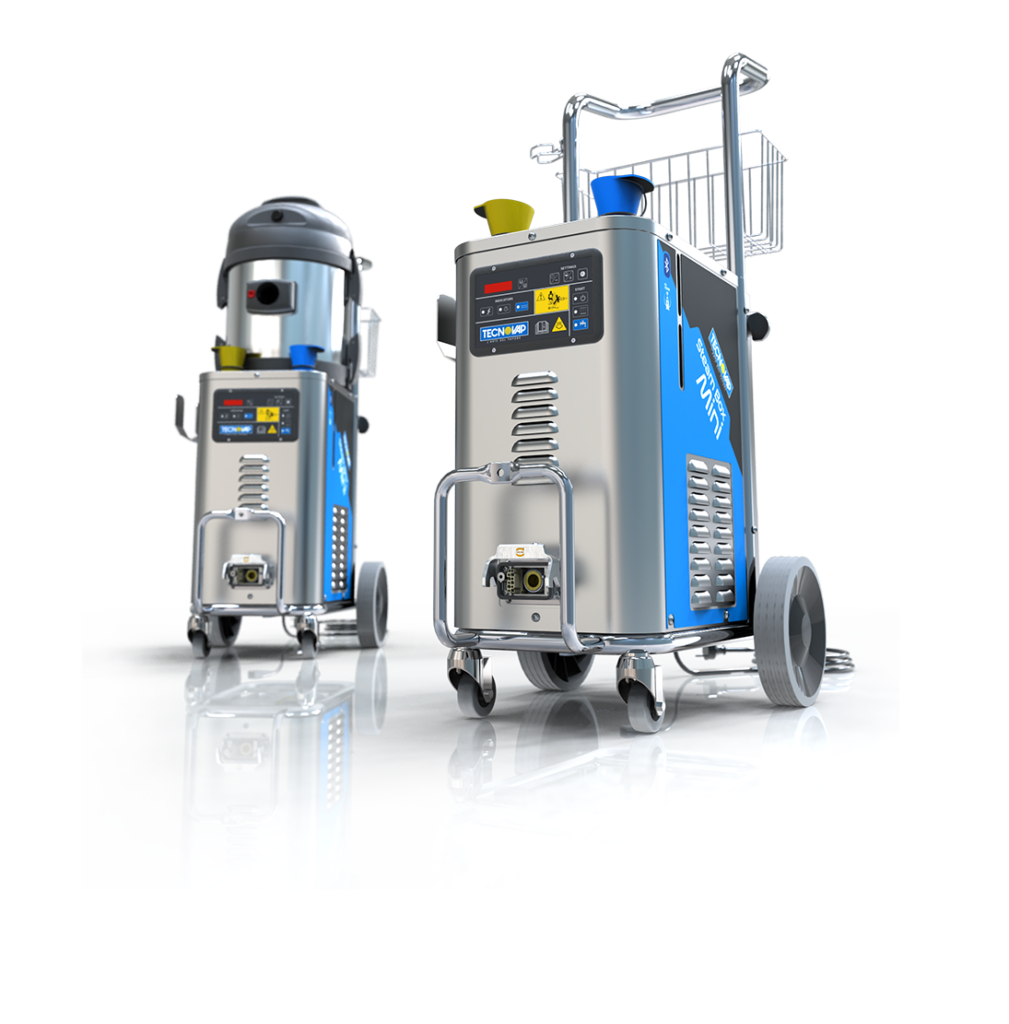
A manufacturer’s efficacy evidence covers exactly what was tested: the named models, accessories and method, under laboratory conditions. TECNOVAP is a useful example because it publishes the scope of its testing to the French standard AFNOR NF T72-110, “Methods of disinfection surfaces by steam with or without contact,” which covers bactericidal, fungicidal, yeasticidal, sporicidal and virucidal activity. Note that it is a disinfection test method; TECNOVAP classifies the compliant units as steam disinfection devices.
On its NF T72-110 page, TECNOVAP states that:
- The compliant models are “Evo 304, Evo Blu and Evo Sanitizer.”
- The tests were conducted at the VirHealth microbiology laboratory.
- Two accessories were tested: the Steam Mop in contact at 10 cm/s, and the July lance without contact, held 1.5 cm from the surface at 10 cm/s.
- Reported reductions were at least 5 log10 for S. aureus, P. aeruginosa and E. coli; at least 4 log10 for C. albicans, A. brasiliensis, human adenovirus 5, murine norovirus and L. lactis phages; and at least 3 log10 for B. subtilis.
Read those results with their limits. They apply to three models and two accessories at a defined speed and distance, under laboratory conditions. They do not extend to other TECNOVAP models, other accessories, faster passes, greater distances or worn, porous or soiled surfaces. TECNOVAP’s healthcare page states that high temperature steam “allows the elimination of microorganisms such as bacteria and viruses” but gives no test data there, so ask for the underlying test report rather than relying on the page.
Why doesn’t boiler temperature prove sanitization?
Boiler temperature does not prove sanitization because it describes the steam inside the generator, not what the surface reaches or for how long. TECNOVAP publishes generator-side figures such as 174 °C for the EVO and 183 °C for its Steam Power Plus; no published figure we have seen gives a nozzle or surface temperature for these models.
Between the boiler and the microorganisms, heat is lost in the hose, in the air as steam leaves the nozzle and into the surface itself. A thick, cold stainless table absorbs heat differently from a thin panel, and a fast pass or a lance held further away delivers less. That is why the laboratory results above are tied to a travel speed and a stand-off distance: the same machine used differently is a different procedure.
What should you measure on site?
On site, measure the conditions that the tested method depends on, because those are what turn a laboratory number into a site claim. The checklist below sets out the variables to control and record:
- Surface temperature during treatment, measured at the surface on representative materials, not read from the generator display. Infrared thermometers can misread shiny stainless steel, so contact probes or indicator labels are often more reliable.
- Contact time, controlled through travel speed and the number of passes. At 10 cm/s, the tested speed, a one-meter stroke takes ten seconds, so time a few practice strokes before trusting the method.
- Stand-off distance for non-contact lances, and the condition of the cover on contact mops.
- Pre-cleaning, so that soil is removed before the sanitizing pass; residue left on a surface shields what lies beneath it.
- Surface type and condition: smooth, intact, non-porous surfaces behave very differently from grout, worn seals or cracked plastics.
- Model and accessory on site, checked against the nameplate and the test report.
What does field evidence add to laboratory results?
Field evidence shows what happens when a method meets real surfaces, real operators and real soil. In a peer-reviewed study in occupied rooms of a long-term-care wing, Sexton and colleagues reported that a portable saturated steam vapor system “reduced bacterial levels by >90%” on six high-touch surfaces in each of eight rooms (American Journal of Infection Control, 2011).
A reduction of more than 90% is at least 1 log10. The study and the NF T72-110 tests are not directly comparable, since they used different devices, organisms and conditions, and the study was small, used a single device and gives no evidence on spores. Together they show the gap a site verification has to close: neither tells you what your own procedure achieves on your own surfaces.
How do you verify steam sanitization in healthcare support areas?
Verify the procedure on site in stages, starting with a written method that mirrors the tested conditions and ending with routine monitoring.
- Define the claim and the area. State which surfaces in which support areas, and whether the goal is cleaning only or a sanitizing outcome. Exclude patient-care items and medical devices.
- Assemble the evidence file. Obtain the test report, the model and accessory list and the test method from the manufacturer, and check them against the equipment on site.
- Write the procedure. Specify pre-cleaning, accessory, travel speed, passes, stand-off distance and who operates the equipment.
- Measure surface conditions. Record surface temperatures on representative surfaces during trial passes.
- Sample before and after. Have a qualified laboratory take and analyze microbiological samples, using a sampling plan agreed with infection prevention that includes untreated comparison surfaces.
- Approve or adjust. Infection prevention reviews the results and either approves the procedure for named surfaces or sends it back for changes.
- Monitor routinely. Keep operator logs, repeat sampling at agreed intervals and re-verify after any change of equipment, accessory, surface or operator team.
From visible clean to verified claim
- Define the claim
- Check test evidence
- Write the procedure
- Measure and sample
- Approve and monitor
ATP swabs can help in routine checks of cleaning quality because they indicate organic residue, but they do not count viable microorganisms and should not be the only evidence behind a sanitization claim.
| Evidence item | What to check | Red flag |
|---|---|---|
| Test report | Standard, laboratory, date, model, accessory and method parameters | A summary sheet only, or a report for a different model or a whole range |
| Organisms and results | Which organisms were tested and the log10 reductions reported | Claims for organisms that were never tested |
| Method parameters | Travel speed, stand-off distance, contact or non-contact use | A site method that is faster or further away than the test |
| Equipment on site | Nameplate model and accessory match the report | A different accessory, or a modified unit |
| Site results | Surface temperature records, microbiological results, operator logs | Visual checks only |
Where does steam fit in a support-area hygiene program?
In most support areas, steam earns its place first as a cleaning and degreasing method, removing soil from trolleys, racks, tiles, drains and kitchen equipment with limited water, and only then, where evidence supports it, as part of a sanitizing step. The guide to dry steam in hospital central kitchens shows where it fits in a kitchen cleaning plan, and building a verified dry steam hygiene procedure applies the same evidence logic to food production.

TECNOVAP’s one-minute explainer introduces how dry saturated steam is used for cleaning. Watch it for the principle; its cleaning and sanitizing claims are the manufacturer’s and are no substitute for site evidence.
How AFE can support an evidence-based steam program
AFE’s role is to supply suitable equipment, deliver steam cleaning to a written procedure and help assemble the evidence, while the hospital’s infection prevention team keeps the decision. In practice that means:
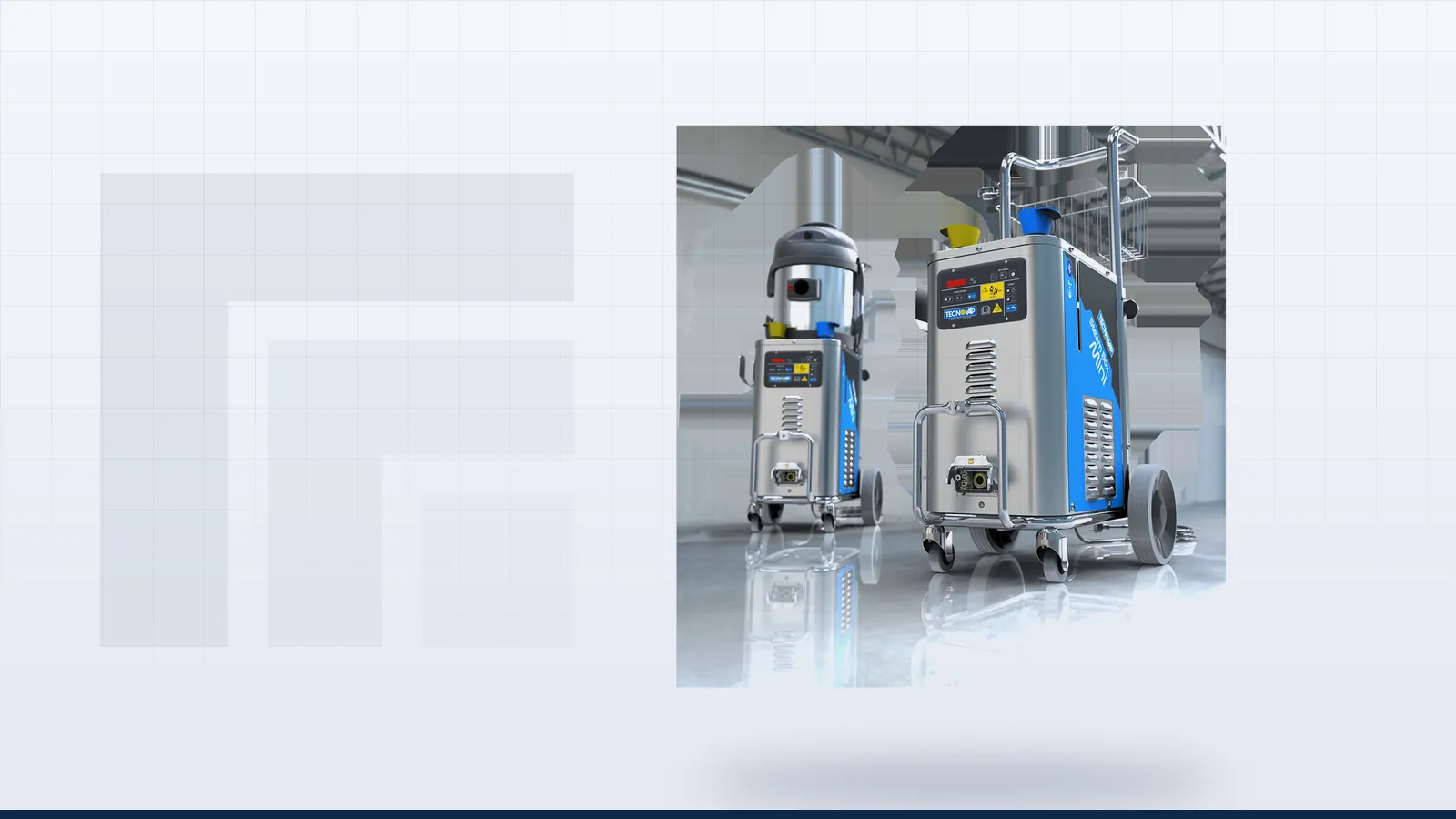
- Supplying TECNOVAP dry steam generators and requesting the manufacturer’s test reports and model documentation for your evidence file.
- Providing equipment for trials through short-term rental, so that a procedure can be tested before purchase.
- Delivering steam cleaning on site to the hospital’s approved procedure, with records of area, method and operator.
- Supporting procedure design through process analysis and consulting, while microbiological sampling and analysis are carried out by a qualified laboratory chosen with the hospital.
More guides for hospital support areas are collected in the healthcare insights.
Al Faisaliah Enterprises · Aqaba
Build a steam procedure you can defend at audit
Tell us which support-area surfaces you want to treat and the outcome you need to claim. AFE can help define the procedure, equipment and evidence file for your infection prevention team.
Frequently asked questions
Is a surface automatically sanitized after steam cleaning?
No. Steam cleaning reliably removes soil and grease when it is done well, but sanitized is a claim about a measured reduction in microorganisms. That claim needs efficacy evidence for the exact model, accessory and method, a site procedure that reproduces those conditions and microbiological verification on your own surfaces. Until then, describe the outcome as cleaned and keep the sanitizing step your hygiene plan already specifies.
Can a hospital rely on TECNOVAP's NF T72-110 results?
Only as starting evidence, and only for the configuration tested. TECNOVAP states that the compliant models are the Evo 304, Evo Blu and Evo Sanitizer, tested with the Steam Mop and the July lance at 10 cm/s, the lance at 1.5 cm from the surface, in a laboratory. Ask for the full test report, match it to the equipment on site, then verify the procedure on your own surfaces.
What surface temperature does steam need to reach to sanitize?
There is no single number to quote. Microbial reduction depends on the organism, the temperature actually reached at the surface, the time it is held and the condition of the surface, and generator figures do not tell you any of those. The tested method defines the conditions; your site trial should record the surface temperatures your procedure achieves and confirm the outcome with microbiological sampling.
Does a passing ATP test prove that a surface has been sanitized?
No. ATP tests indicate organic residue on a surface, which makes them useful for checking cleaning quality quickly and consistently. They do not count viable microorganisms, so they cannot show that a sanitizing or disinfection outcome was achieved. Use them alongside microbiological sampling by a qualified laboratory, not instead of it, and agree with infection prevention which test supports which claim.
Can steam be used on medical devices or in clinical areas?
This guide covers non-clinical support areas only. Medical devices must be reprocessed according to their manufacturers' instructions and the hospital's approved methods, and surface steam treatment is not sterilization. Any use of steam in clinical areas is a decision for the hospital's infection prevention team, based on its own policies and evidence, and is outside the scope of this guide.
Sources and references
- Guideline for Disinfection and Sterilization in Healthcare Facilities (2008): Glossary · US Centers for Disease Control and Prevention
- FDA Food Code 2026 · US Food and Drug Administration
- AFNOR NF T72-110 compliance · TECNOVAP
- NF T72-110: Methods of disinfection surfaces by steam with or without contact · AFNOR
- Reduction in the microbial load on high-touch surfaces in hospital rooms by treatment with a portable saturated steam vapor disinfection system (Am J Infect Control 2011) · PubMed, US National Library of Medicine
- EudraLex Volume 4, Annex 1: Manufacture of Sterile Medicinal Products · European Commission
- Steam cleaning for healthcare · TECNOVAP
This article is general technical guidance. Equipment suitability, ATEX conformity and hygiene performance must be confirmed for each site and application.
Written for plant, maintenance, HSE and quality teams in Jordan, Saudi Arabia and Iraq.