The short answer
A practical ATEX compliance check reviews each vacuum, filter, hose, tool and high-reach accessory against the site's documented zone classification and the equipment's own certificates and marking, then records what matches, what does not and what is unconfirmed. Zoning, dust testing and permits stay with the site; the check is not a certification or legal sign-off.
Key takeaways
- The check compares equipment with the site's documented zones and the manufacturer's certificates; it never classifies zones itself.
- Category 3 equipment may be used only in zone 22; zone 21 needs category 1 or 2.
- ATEX suitability belongs to an exact model and configuration: DUPUY sells both ATEX and non-ATEX (ACD) models.
- Hoses, filters, poles, cameras and spare parts are checked too, because one wrong part breaks the certified chain.
- GSO IEC 62784:2021 adopts the combustible-dust vacuum standard for the GCC, a useful reference for Saudi sites.
Most plants that handle combustible powders end up with a mixed fleet: vacuums bought for a classified mill room, older units moved between buildings, a rental machine brought in for a shutdown, high-reach poles added later. Over time nobody is quite sure which machine may stand where. An ATEX compliance check answers that question for the vacuum and cleaning equipment you actually use, against the zones your site has actually documented.
This explainer sets out what such a check should cover, what evidence it relies on and where its limits are. In short, it is a review of equipment against your own zone classification and the equipment’s certificates. It is not a certification, a legal sign-off or a promise that an explosion cannot happen, and the zone classification stays the site’s responsibility.
What is an ATEX compliance check for vacuum equipment?
An ATEX compliance check is a structured review of each vacuum, filter, hose, tool and high-reach accessory against two sets of documents: the site’s hazardous-area classification and the manufacturer’s certificates and marking for that exact equipment. Its output is a register showing which items match the zones where they are used, which do not, and which cannot be confirmed yet.
Be precise about what the check is and is not, because the word “compliance” is easily read as a guarantee.
| A practical check does | A practical check does not |
|---|---|
| Compare each item’s certificate and marking with the zones where it stands, collects and is emptied | Classify zones or replace the site’s explosion protection document |
| Record model, serial number, configuration and condition | Certify equipment or issue an ATEX approval |
| Flag filters, hoses, tools and spare parts that break the certified configuration | Give a legal sign-off or an authority approval |
| List missing evidence and the options to close each gap | Promise that fire or explosion risk has been removed |
| Recommend a re-check after changes to process, layout or fleet | Test the dust; laboratory testing stays with the site |
What must the site have in place before the check?
The site needs a documented zone classification, because the check measures equipment against it. Under the EU workplace directive, Directive 1999/92/EC, “the employer shall classify places where explosive atmospheres may occur into zones,” and an explosion protection document must be drawn up before work starts and kept up to date. The directive also says that layers, deposits and heaps of combustible dust must be considered as any other source that can form an explosive atmosphere, which matters for equipment whose job is to disturb them.
EU directives are not law in Jordan, Saudi Arabia or Iraq, but they are the framework ATEX-marked equipment is certified against, and sites that adopt ATEX as their internal reference apply the same logic. For Saudi Arabia and other GCC states there is a confirmed regional link: IEC 62784, the standard for vacuum cleaners and dust extractors that collect combustible dust, has been adopted as GSO IEC 62784:2021.
Before the check, gather:
- Zone drawings for every area where vacuums stand, collect dust or are emptied, outdoor areas included.
- The explosion protection document or equivalent risk assessment, with its revision date.
- Laboratory data on the dust where it exists: whether it is explosible and how easily it ignites.
- A list of vacuums, dust extractors, high-reach kits and electrical accessories, with model and serial numbers.
- Certificates, declarations of conformity and operating manuals already on file.
- Maintenance records, especially filter and hose replacements.
How are zones matched to equipment categories?
Each zone sets a minimum equipment category, and the check confirms that every item meets it. Directive 1999/92/EC defines the dust zones and, in its Annex II, the categories under the equipment directive, Directive 2014/34/EU, that may be used in each.
| Dust zone | When a dust cloud is expected | Minimum category (protection level) | Also allowed |
|---|---|---|---|
| Zone 20 | Present continuously, for long periods or frequently | Category 1 (very high) | None |
| Zone 21 | Likely to occur in normal operation occasionally | Category 2 (high) | Category 1 |
| Zone 22 | Not likely in normal operation; if it occurs, persists only briefly | Category 3 (normal) | Category 1 or 2 |
The most common mismatch is simple: category 3 equipment may be used only in zone 22. If a model is described as “ATEX 3D”, the check confirms its category on the certificate and nameplate; if it is category 3, it is limited to zone 22 areas, however similar the dust in a zone 21 room may look.
Two locations must be checked, not one: the area where the machine stands and the inside of its container, where collected dust is concentrated. DUPUY gives zone wording per model, describing its W2 EX 1/3D as “designed for use in zone 20 indoor/22 outdoor”. Do not interpret such wording from a brochure; the check reads the certificate and marking to confirm what each part of the machine is approved for.
What does the check look at on each machine?
It looks at the complete configuration in use, not only the vacuum’s nameplate, because ignition can come from any part of the chain.
| Item | What is checked | Evidence |
|---|---|---|
| Vacuum unit | Exact model and marking match the zone where it stands and the dust it collects | Certificate, declaration of conformity, nameplate |
| Motor and airflow path | How the motor is protected and whether dust-laden air passes through it | Manufacturer documentation for the model |
| Filter | The fitted filter is the type specified for the certified configuration | Filter part number against the manual |
| Hose, wands and tools | Conductive or static-dissipative parts, bonded and earthed as one path | Kit documentation, continuity check record |
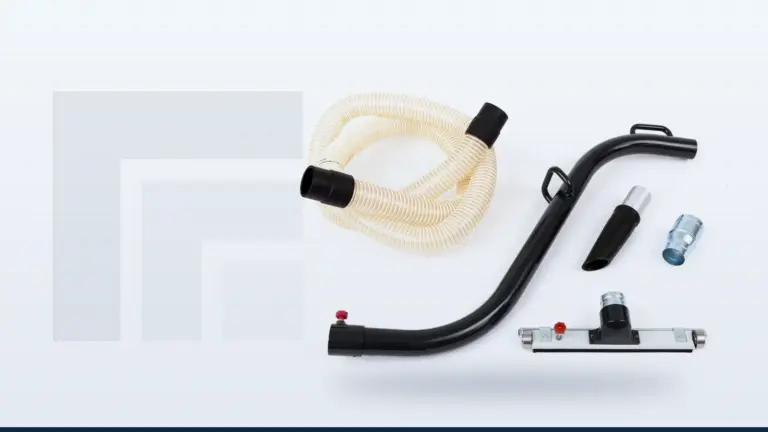
| High-reach poles and heads | Conductive kit, approved for use with the vacuum it is connected to | Pole manufacturer documentation, compatibility confirmation |
| Cameras and electrical accessories | Each electrical item taken into the zone carries its own rating | Separate certificate |
| Condition | Damage, modifications, non-original parts, missing earth connections | Inspection record and photos |
| Use and emptying | Where the unit is emptied and how collected dust is handled | Procedure and zone drawing |
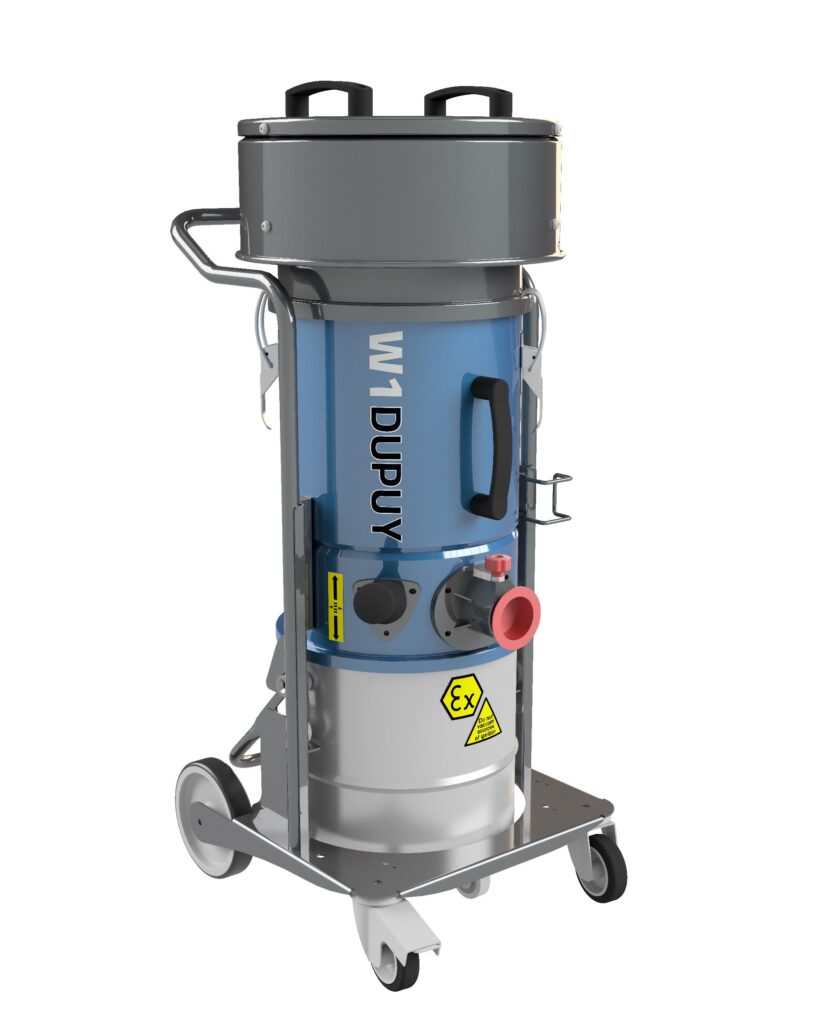
Brand alone proves nothing. DUPUY’s ATEX range page lists certified models alongside its ACD models, which it describes as not ATEX and intended for non-classified areas, so two machines of similar appearance can carry very different approvals. DUPUY states that its ATEX models use antistatic filters, motors designed to prevent overheating and conductive accessories for ground discharge, and it cites EN IEC 62784:2018. That standard covers vacuum cleaners and dust extractors at Equipment Protection Level Dc and applies in addition to IEC 60335-2-69, the safety standard for commercial and industrial vacuums.
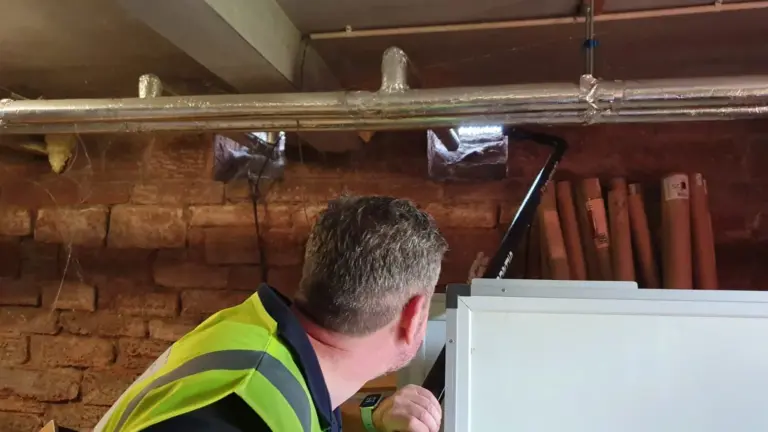
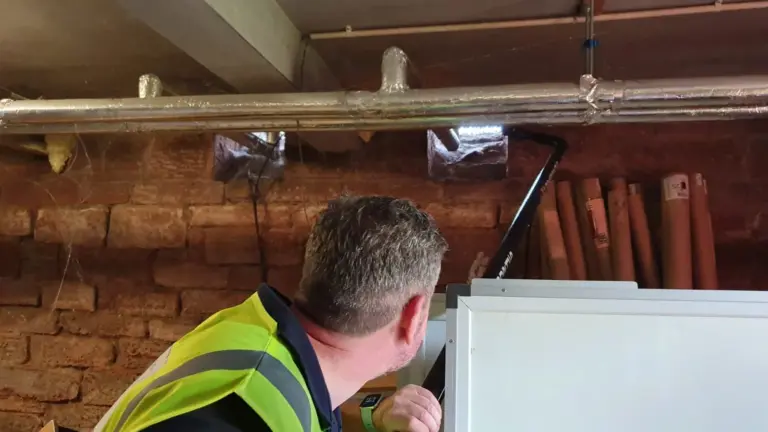
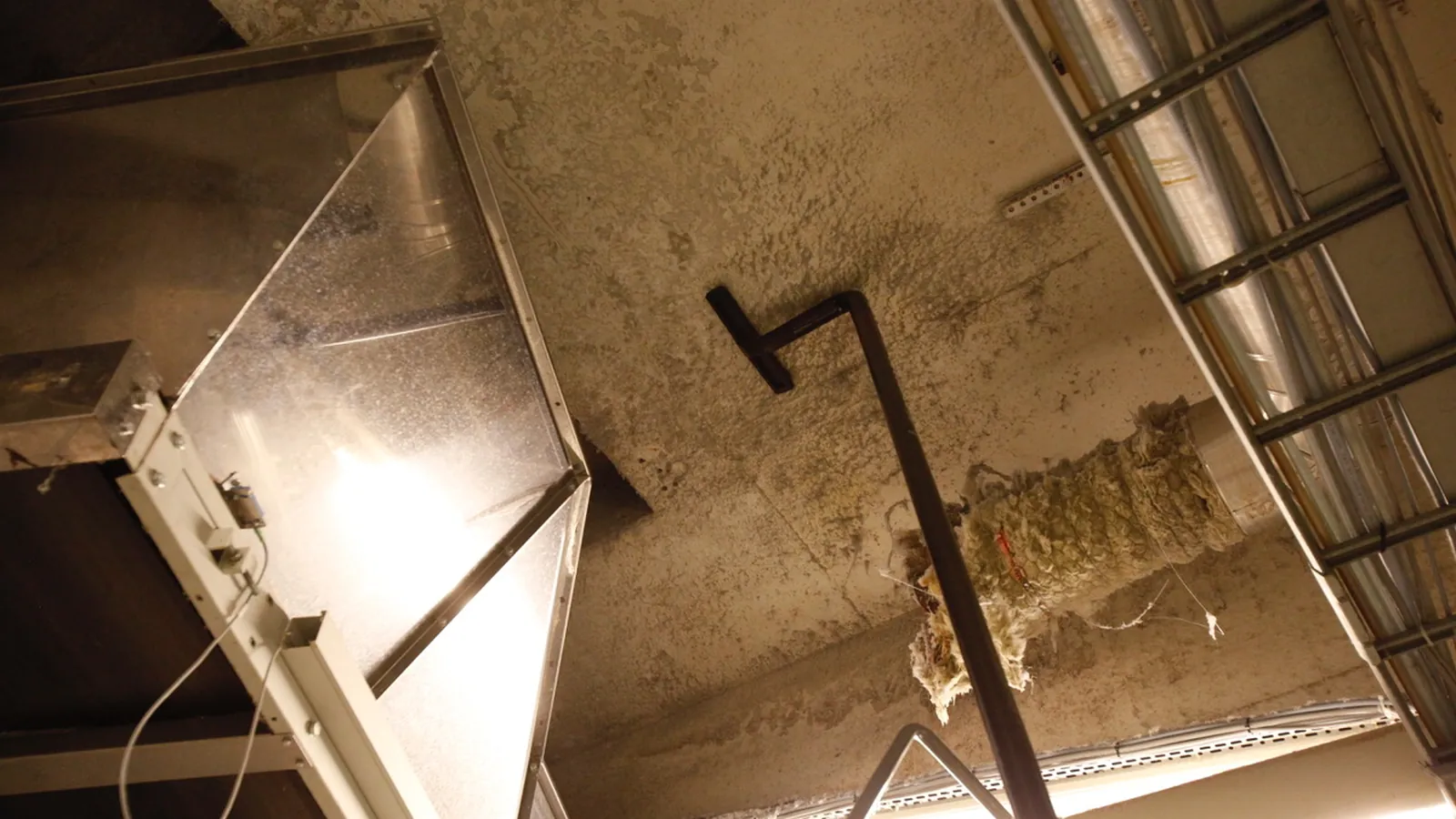
The same logic applies to high-reach systems. SpaceVac states that its ATEX pole systems “must be paired with a certified industrial vacuum suitable for the hazardous zone classification of your facility.” A conductive pole kit on a non-ATEX vacuum is not a certified system.

Watch how each pole, head and hose connection is made: in a check, those connections are part of the configuration whose conductivity and compatibility must be confirmed.
What if the area is unclassified but the dust is combustible?
The check still has value. The US OSHA combustible dust program allows portable vacuums to collect combustible dust in unclassified areas only with appropriate materials of construction, conductive or static-dissipative hoses, all conductive parts including wands and attachments bonded and grounded, and no dust-laden air passing through the fan, with motors kept out of the dust stream unless listed for Class II, Division 1 locations. It is a US reference, but a useful baseline anywhere.
Which gaps should an ATEX compliance check look for?
The gaps that matter most usually come from change rather than from the original purchase. A check should look specifically for:
- A non-ATEX unit moved into a classified area after a layout or process change.
- Replacement hoses, wands or floor tools that are not conductive or not from the certified kit.
- Generic filters fitted in place of the specified antistatic filter.
- Poles, hoses and vacuums from different kits combined without the manufacturers’ confirmation.
- Rental or used units on site without a copy of their certificate; see what to inspect before buying certified used equipment.
- Zone drawings that predate a new production line, silo or bagging point.
- Units emptied in a different zone from the one they were checked for.
How does a practical check run?
It runs as a documented sequence that starts with paperwork and ends with a register the site can keep up to date.
- Collect site documents. Zone drawings, the explosion protection document or risk assessment, dust data and the equipment list.
- Build the equipment register. Record every vacuum, extractor, high-reach kit and electrical accessory by model, serial number and area of use.
- Match zone and category. Compare each item’s certificate and marking with the zones where it stands, collects and is emptied.
- Inspect the configuration. Walk the areas, check filters, hoses, earthing and condition, and photograph nameplates.
- Report open items. Classify each item as matched, not matched or unconfirmed, with the missing evidence and options to close it.
- Re-check after change. Repeat for the affected items whenever zones, processes or the fleet change.
How an ATEX compliance check runs

Use it as a primer on ATEX fundamentals for supervisors before the check; any zone reference in a manufacturer video applies only to the specific equipment certified for it.
What stays the site’s responsibility?
Everything that defines the hazard and controls the work stays with the site. The employer classifies the zones, maintains the explosion protection document, decides whether dust testing is needed, issues permits, trains operators and keeps equipment maintained in its certified configuration. The check takes those documents as its starting point; it does not audit or rewrite them.
Its findings are therefore conditional. They hold for the zones, dust data and equipment seen at the time and lapse when any of those change. A check does not replace the site’s own competent person, the manufacturer’s instructions or the approval of any authority.
How does AFE support an ATEX compliance check?
AFE lists ATEX compliance checks under its consulting and engineering work, alongside process analysis and system design. In practice, AFE reviews your vacuum and cleaning equipment against your documented zones and the manufacturers’ certificates, and returns a register of matched, unmatched and unconfirmed items with the evidence still needed.
Where a gap needs equipment, AFE can propose specific DUPUY ATEX-certified vacuum models matched to your zones, with their documents for your HSE review; the questions behind that choice are covered in choosing an ATEX vacuum for food processing. Replacement filters, hoses and accessories can be sourced through AFE’s MRO and consumables range. For overhead dust in classified areas, the method in assessing overhead combustible dust cleaning applies, and AFE’s Internal high clean dust removal service starts from the same review. AFE coordinates this work from its Aqaba hub for sites in Jordan, Saudi Arabia and Iraq.
Al Faisaliah Enterprises · Aqaba
Review your vacuum fleet against your zones
Send AFE your zone drawings, equipment list and any certificates on file. You get a register of matched, unmatched and unconfirmed items, with the evidence still missing for each.
Frequently asked questions
Does a satisfactory ATEX compliance check mean our vacuums are certified?
No. Certification comes from the manufacturer and, where required, a notified body, and it is shown on the equipment's certificate and marking. A compliance check only confirms whether the equipment you use matches the zones your site has documented, records gaps and lists missing evidence. It is not an approval, a legal sign-off or a statement that explosion risk has been removed.
How often should the check be repeated?
There is no fixed interval. Repeat it for the affected items whenever zones are revised, a process or layout changes, new, rented or used equipment arrives, or a unit is repaired with replacement parts. Many sites also align it with the periodic review of their explosion protection document or risk assessment, so the equipment register and the zone drawings stay consistent.
Can AFE classify our hazardous zones during the check?
No. Zone classification is the employer's responsibility under the ATEX workplace directive, and sites that use ATEX as their reference keep that principle in Jordan, Saudi Arabia and Iraq. AFE works to the zones the site has documented. If no classification exists, the site needs its own competent person to classify the areas first; the equipment review follows.
Is GSO IEC 62784:2021 relevant to vacuums used in Saudi Arabia?
It is the GCC adoption of IEC 62784, the standard for vacuum cleaners and dust extractors that collect combustible dust, approved on 1 July 2021. How it applies to a particular product or site is a regulatory question to confirm with the relevant authority. A check can record whether each manufacturer's documentation references IEC 62784 or its EN version.
Can rented or used vacuums be included in the check?
Yes, and they should be. ATEX status is never assumed for a rented or used unit: the check needs a copy of its certificate, a readable nameplate and evidence that repairs kept the certified configuration, including filters, hoses and earthing. A unit that cannot show these is treated as unconfirmed and kept out of classified areas until the evidence is provided.
Sources and references
- Directive 1999/92/EC on minimum requirements for improving the safety and health protection of workers potentially at risk from explosive atmospheres · EUR-Lex
- Directive 2014/34/EU on equipment and protective systems intended for use in potentially explosive atmospheres · EUR-Lex
- GSO IEC 62784:2021 (GCC adoption of IEC 62784) · GCC Standardization Organization
- IEC 62784 preview: vacuum cleaners and dust extractors providing equipment protection level Dc · VDE Verlag / IEC
- ATEX certified industrial vacuum cleaners · DUPUY
- ATEX cleaning equipment · SpaceVac International
- Revised Combustible Dust National Emphasis Program, CPL 03-00-008 · U.S. OSHA
This article is general technical guidance. Equipment suitability, ATEX conformity and hygiene performance must be confirmed for each site and application.
Written for plant, maintenance, HSE and quality teams in Jordan, Saudi Arabia and Iraq.