The short answer
Pharmaceutical process dust extraction should be scoped from four sets of facts: how each process step releases powder; the powder's physical, potency and explosibility properties; the containment and GMP cleaning requirements set by quality; and the site's hazardous-area classification. Only then can capture devices, filter stages, discharge method and certified equipment be chosen for each point.
Key takeaways
- Source extraction controls dust where it is released; housekeeping vacuums remove what settles. Specify them as two separate jobs.
- Document each process step: how powder is released, distance to the capture point, run hours and how many points run at once.
- Powder data drives filtration: fineness, stickiness, potency and sensitizing properties decide filter stages, dust class and how filters are changed.
- Do not rely on safety data sheets for explosibility; confirm ATEX suitability per model against the site's documented zones.
- AFE supplies DUPUY extraction equipment and supports process analysis, system design and ATEX compliance checks with your engineering team.
In tablet, capsule and powder plants, the dust released during dispensing, blending, milling, compression or filling is more than a housekeeping issue. It can carry active ingredient onto neighboring equipment, expose operators and, with some powders, settle into combustible layers. Pharmaceutical process dust extraction is the engineering control that captures that dust close to where it is released, before it spreads.
The hard part is rarely choosing a collector from a catalog. It is assembling the process, powder and compliance facts a supplier needs to design capture points, filters and discharge correctly. This guide sets out what an engineering manager should document, in what order, and where projects typically go wrong.
What must pharmaceutical process dust extraction achieve?
It must stop powder spreading between products and rooms and protect operators, without becoming hard to clean itself. EU GMP guidance is direct about this: where dust is generated, for example in sampling, weighing, mixing and packaging of dry products, “specific provisions should be taken to avoid cross-contamination and facilitate cleaning” (EudraLex Volume 4, Chapter 3.14).
The EU GMP chapter on production goes further. It lists “controlled removal of dust close to source of the contaminant e.g. through localised extraction” among the measures against cross-contamination, and asks for special precautions with highly active or sensitizing materials. In practice, three tools do three different jobs, and scoping goes wrong when they are blurred together.
| Tool | What it does | What it does not do |
|---|---|---|
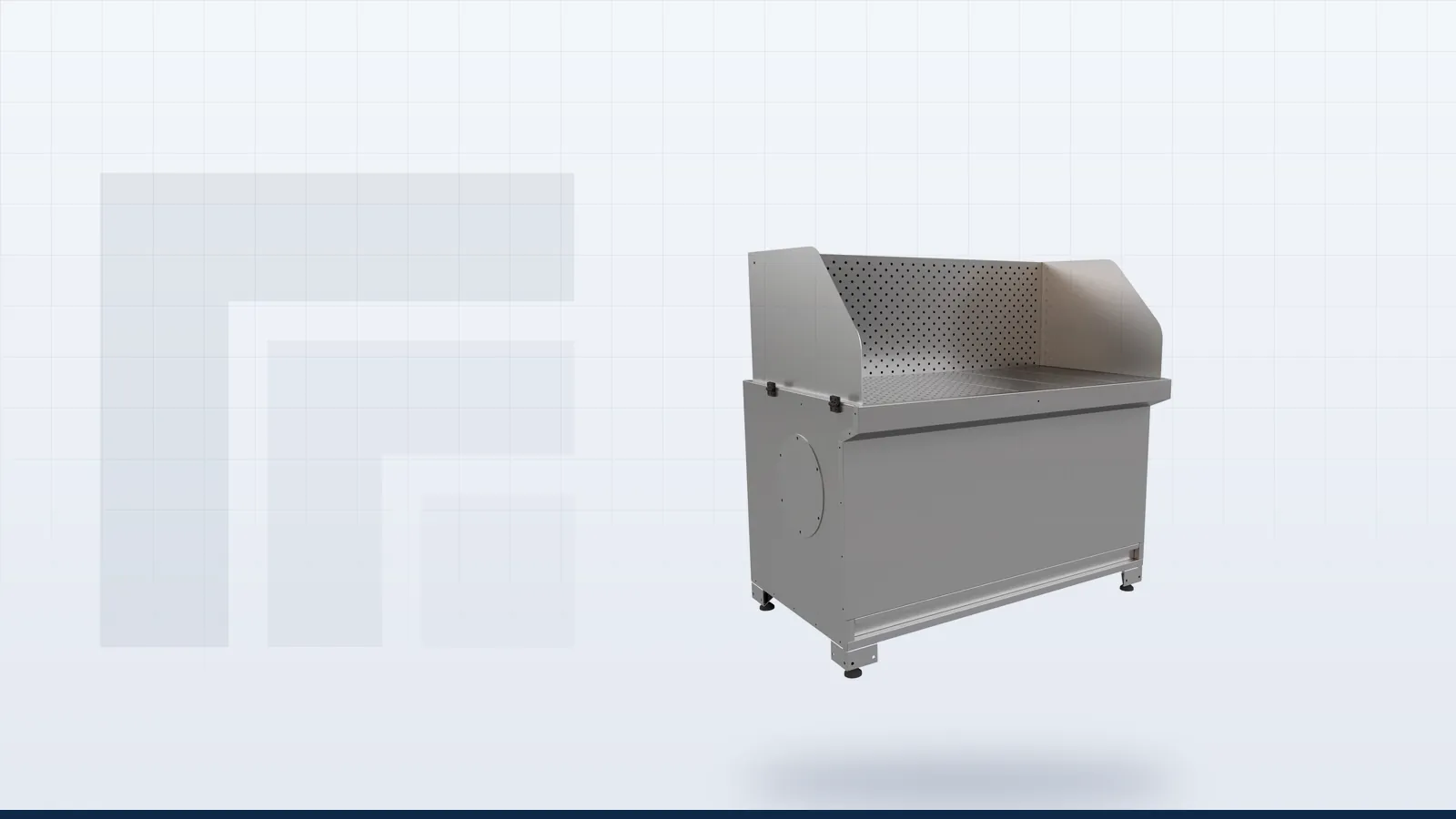
| Source extraction (hood, arm, enclosure or extraction bench connected to a dust collector) | Captures airborne dust at the point of release while the process runs | Remove dust that has already settled on floors, machines or structures |
| Housekeeping vacuum (mobile unit or central vacuum network) | Removes settled powder and spillage during and after production | Control dust while it is being generated |
| Room air handling (HVAC) | Controls room pressures, air changes and general air quality | Replace capture at source; the site designs and qualifies it separately |
Which process details shape the capture design?
The way each step releases powder decides the capture device, its position and the airflow it needs. A dispensing booth, a mill outlet and a tablet press release dust in different ways, so document them point by point rather than as one “dusty area”.
| Process step | How dust is typically released | What to record for the supplier |
|---|---|---|
| Dispensing and weighing | Short, repeated bursts as containers are opened, scooped or poured | Container sizes, frequency, operator position |
| Sieving, blending and charging | Puffs and displaced air during open transfers into bins or blenders | Open or closed transfer, port sizes, batches per shift |
| Milling and dry granulation | Continuous fine dust at inlets, outlets and seals while running | Throughput, run hours, enclosure openings |
| Discharging dried granules | Fines released as dryers or containers are emptied | Unloading method and any solvent used upstream |
| Tablet compression and capsule filling | Fine dust around the turret or dosing station and at dedusters | Machine models, extraction ports, machines running together |
| Packaging of dry product | Dust at filling heads, open-product points and during changeover cleaning | Line layout, open-product points, changeover frequency |
For every point, add four facts a supplier cannot guess: how close a hood can sit to the source, run hours per shift, how many points run at once, and how often the product changes. Simultaneous use drives the collector size; changeover frequency drives how cleanable its internals must be.
Add photos and a marked-up layout showing possible duct routes, collector positions and whether compressed air is available, since many cartridge collectors clean their filters with air pulses.
Which powder properties should be documented first?
Powder properties decide the filter media, the collector design and whether an ATEX-certified model is needed, so collect them before any equipment is discussed. Formulation, quality and EHS teams usually hold this data.
- Particle size and fines fraction. Very fine powders stay airborne longer and load filters faster.
- Bulk density and flow behavior. Cohesive powders can bridge in hoppers and build up in ducts.
- Moisture and stickiness. Hygroscopic or sticky powders can blind filter media and resist pulse cleaning.
- Potency and exposure limit. The occupational exposure limit or band sets the containment level, including how filters are changed and waste is removed.
- Sensitizing or highly active materials. These need the special precautions EU GMP describes.
- Explosibility data. Whether the dust is explosible and how easily it ignites, from tests on the actual powder.
- Solvents. Whether solvent vapor can be present with the dust, for example after wet granulation or coating.
- Changeover pattern. Single- or multi-product use, which sets how often internals are cleaned.
Do not treat a silent safety data sheet as proof that a powder is not combustible. When the US Chemical Safety Board reviewed 140 material safety data sheets for combustible powders, 41% gave no warning that the powder could explode. Test the actual material.
How do containment needs translate into filtration?
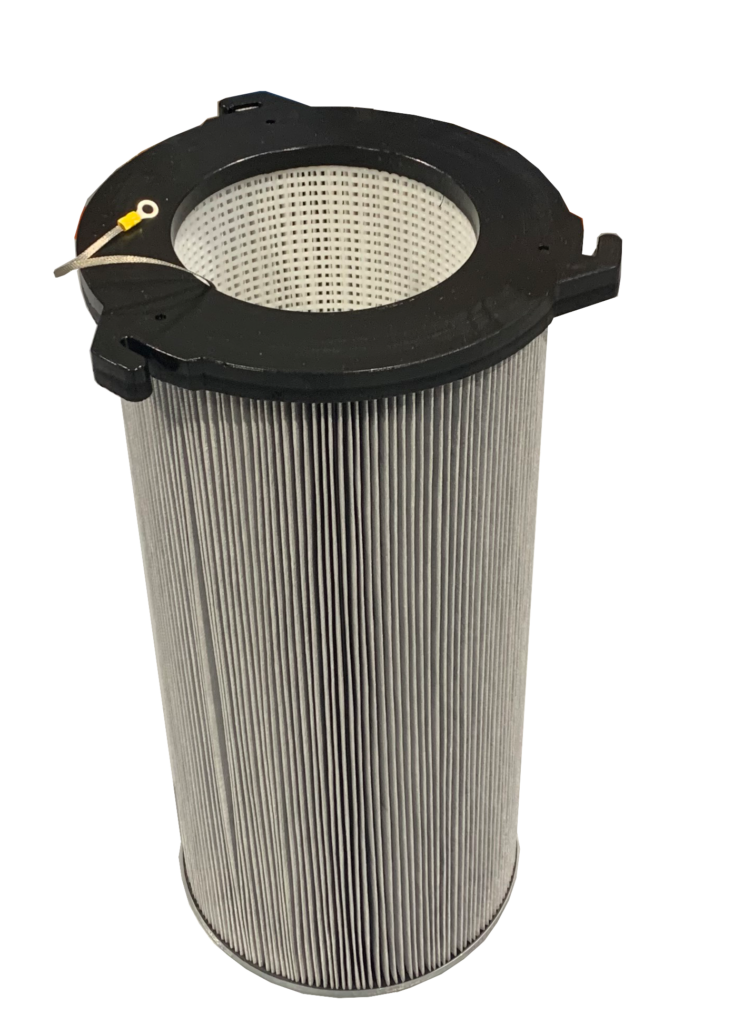
Containment requirements translate into filter stages, documented filter efficiency and, just as important, a safe way for collected powder and spent filters to leave the system. A collector that captures well but exposes an operator at every filter change has only moved the problem.
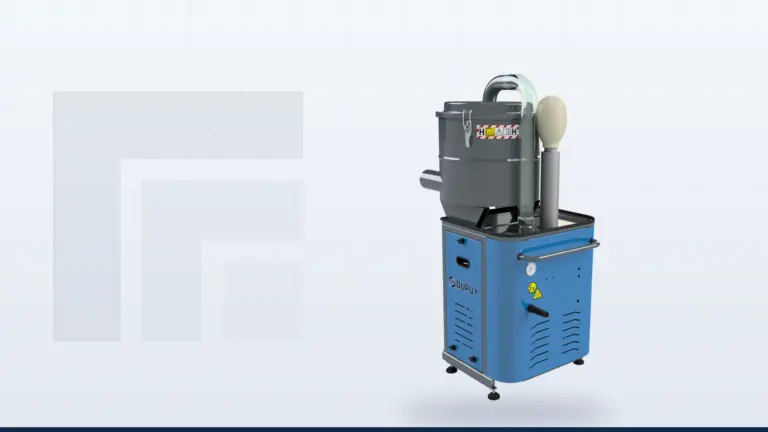
DUPUY describes its DEDUST dust collectors as combining “a stilling chamber in which the principle of gravity is applied” with “ultra-high-efficiency cartridge filters” and “an automatic filter cleaning system using compressed air.” Its product pages do not state filter classes for the range, so efficiency must be confirmed on the datasheet of the specific model and filter offered.
For mobile vacuums and dust extractors, the dust classes of IEC/EN 60335-2-69 are a useful reference. According to the German IFA’s summary, class L covers substances with exposure limits above 1 mg/m³ (filter penetration below 1%), class M limits of 0.1 mg/m³ or more (below 0.1%), and class H carcinogenic, mutagenic or reprotoxic substances and limits below 0.1 mg/m³ (below 0.005%, for both the filter material and the ready-for-use element). Where an active ingredient’s limit falls below 0.1 mg/m³, class H is the relevant benchmark.
Ask for each proposed unit:
- Which filter stages are fitted, and what efficiency is documented for each?
- How are filters cleaned, and will pulse cleaning cope with this powder’s stickiness?
- How are filters changed without opening the dirty side to the room?
- How is collected powder discharged, and how is that interface sealed?
- Does cleaned air return to the room or leave the building, and has quality accepted that?
EU GMP states that cleaning equipment “should be chosen and used in order not to be a source of contamination,” and the same applies to collectors: exhaust air, containers and outer surfaces must suit your cleaning regime.

Watch where the arm or hood sits: capture works best close to the point of release, which is why that distance belongs in your scoping data.
When does combustible dust change the specification?
It changes the specification as soon as test data shows the powder is explosible and a dust cloud can form in the room or inside the equipment. The US Chemical Safety Board lists chemical manufacturing among the sectors where dust explosions have occurred.
Under the EU ATEX workplace directive (1999/92/EC), the employer classifies hazardous areas into zones, and the directive states that “layers, deposits and heaps of combustible dust must be considered as any other source which can form an explosive atmosphere.” Equipment is then selected by category: category 1 for zone 20, category 1 or 2 for zone 21, and category 1, 2 or 3 for zone 22. These EU rules are not law in Jordan, Saudi Arabia or Iraq, but they are the internationally recognized framework that ATEX equipment is certified against.
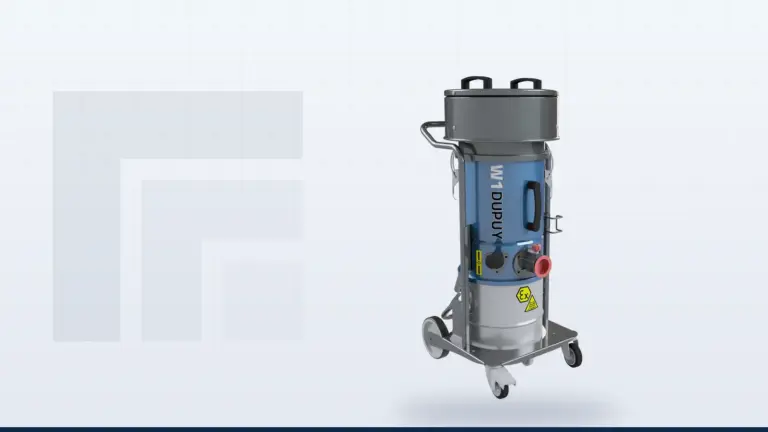
ATEX suitability belongs to a specific model with a specific certificate, never to a brand. DUPUY sells ATEX-certified vacuums alongside ACD models intended for non-classified areas, and gives zone wording model by model. It states that its ATEX models use antistatic filters, motors designed to prevent overheating and conductive accessories for ground discharge. Its dust collector page makes no ATEX statement, so any ATEX collector must be confirmed with its certificate before it is specified.
For the questions to put to a supplier of ATEX vacuums, see our checklist for selecting an ATEX vacuum.
How do source extraction and housekeeping work together?
Source extraction reduces how much powder escapes; housekeeping removes what still settles, and each must be specified so it does not become a contamination source itself. Even well-designed capture leaves deposits on floors, machine frames and structures, and EU GMP expects “effective and reproducible cleaning processes.”
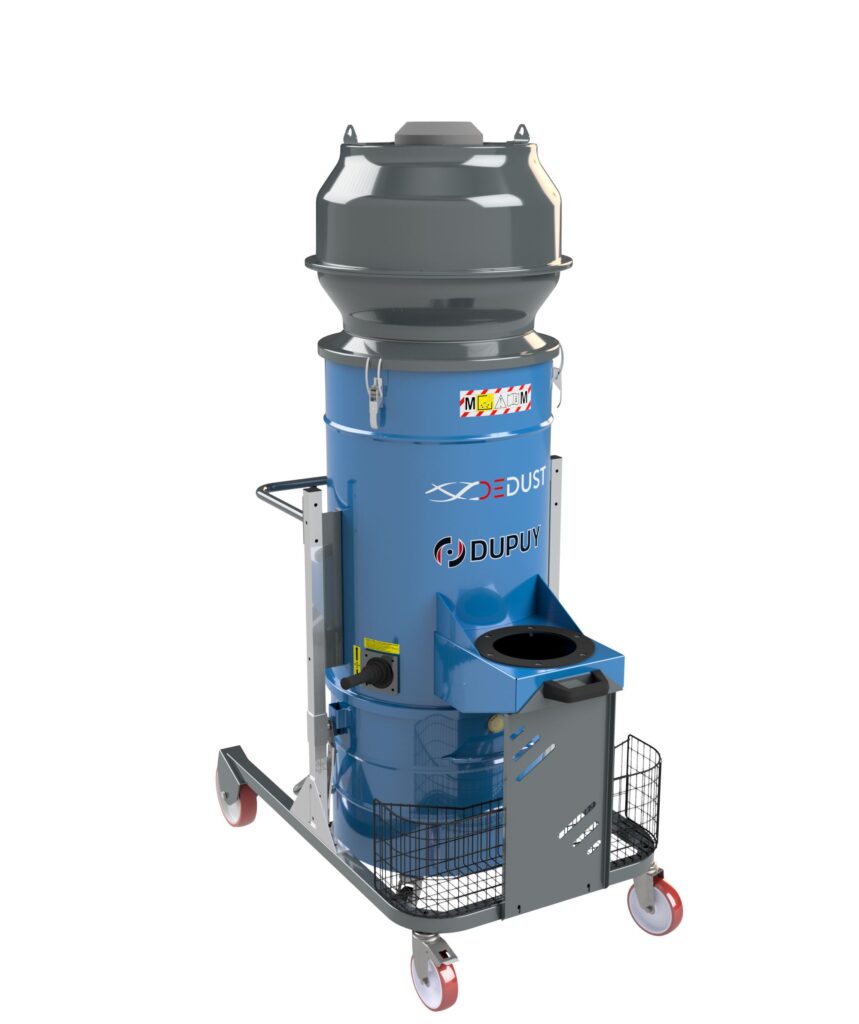
Inside production rooms, a mobile vacuum with the right dust class and, where needed, an ATEX certificate is the usual starting point. DUPUY presents its W2 industrial vacuum for small and medium quantities in chemical-pharmaceutical, food and milling applications. Where many rooms need vacuum points, a central vacuum network can replace several mobile units; what a central vacuum system specification should include covers the data it needs.

Watch how the container is emptied and the filter reached: in a pharmaceutical room, those are the moments of highest exposure and cross-contamination risk.
Dust that settles on beams, cable trays and pipework above the process is a separate task with its own risks, covered in assessing combustible dust on overhead structures.
What should a scoping package for pharmaceutical dust extraction include?
A complete package lets a supplier propose equipment for each point instead of guessing, and it shortens review cycles with quality and EHS. Build it in this order:
- Map every dust source. List process steps, rooms and machines, with photos and a layout.
- Characterize the powders. Collect fineness, density, moisture, potency band, sensitizing properties and explosibility results for each product.
- Set containment and hygiene requirements. Agree with quality the exhaust routes, cleanability, materials of construction and changeover cleaning expected.
- Attach the area classification. Provide zone drawings and the explosion protection document wherever combustible dust or solvent is present.
- Define duty and utilities. State hours per shift, points used at once, power, compressed air and space.
- List the documents you need back. Datasheets, filter efficiency data, certificates per model and the inputs your qualification team requires.
- Plan acceptance and spares. Decide how capture will be checked on site and which filters and wear parts to stock.
Scoping pharmaceutical dust extraction
- Map dust sources
- Characterize powders
- Set containment needs
- Confirm area zones
- Select certified equipment
Common mistakes that cause rework
- Sizing one large collector for a room instead of designing capture at each point.
- Treating the collector’s airflow rating as proof of capture at the hood.
- Assuming a powder is not combustible because the safety data sheet is silent.
- Specifying an “ATEX version” without naming the model, its marking and the zone it is certified for.
How AFE supports the selection
AFE supplies DUPUY dust collectors, industrial vacuums and central vacuum systems to industrial sites in Jordan, Saudi Arabia and Iraq. Its consulting team supports process analysis, system design and ATEX compliance checks of proposed equipment against your documented zones, and filters and wear parts are covered through AFE’s MRO and consumables service.
Because the equipment is made in Italy and supplied through AFE’s Aqaba gateway, agree spare-filter stock and delivery planning at the selection stage rather than after commissioning.
Al Faisaliah Enterprises · Aqaba
Get DUPUY extraction options for each capture point
Send AFE your process list, powder data and zone drawings. You get DUPUY dust collector and vacuum options per point, plus a list of any data still missing.
Frequently asked questions
Can one central dust collector serve several pharmaceutical rooms?
It can, but only if the design addresses cross-contamination between rooms and products, the airflow each capture point needs, and how shared ducting will be cleaned at changeover. Dedicated or room-level collectors are often easier to justify for potent or multi-product areas. Make the decision in the scoping package with quality involved, not on equipment cost alone.
Is a HEPA filter always required for pharmaceutical dust extraction?
Not always. The required efficiency follows from the powder's exposure limit, whether cleaned air returns to the room, and quality's containment requirements. For mobile vacuums, the L, M and H dust classes are a recognized reference; class H, for example, limits filter penetration to below 0.005%. Whatever is specified, ask for the documented efficiency of the exact filter element offered.
Does an ATEX-certified dust collector make the area safe?
No. ATEX certification shows that a specific model is designed for a defined category of hazardous area. Safety still depends on correct zoning by the employer, matching every component to those zones, earthing, maintenance, housekeeping and procedures. No equipment removes explosion risk by itself, which is why the explosion protection document should come before the equipment choice.
What information should we send AFE to get a first proposal?
A list of process steps and machines, photos of each dust source, a layout showing possible collector positions, powder data such as fineness, density, potency band and explosibility results, zone drawings if combustible dust is present, and duty details such as hours per shift and points used at once. With that, AFE can suggest DUPUY options per point and list any data still missing.
Can a mobile vacuum replace fixed extraction at a tablet press or mill?
Generally not. A mobile vacuum is designed to collect settled powder and spillage, while source extraction has to run continuously while the machine releases dust. Some vacuum units are designed to be mounted on board machines, but whether one suits a specific press or mill depends on its airflow, filtration, certification and the machine maker's connection points.
Sources and references
- EudraLex Volume 4, EU GMP Chapter 3: Premises and Equipment — European Commission
- EudraLex Volume 4, EU GMP Chapter 5: Production — European Commission
- Industrial dust collectors for fine suspended dusts — DUPUY
- ATEX certified industrial vacuum cleaners — DUPUY
- Testing of dust filters: dust classes L, M and H — Institute for Occupational Safety and Health of the DGUV (IFA)
- Directive 1999/92/EC on minimum requirements for improving the safety and health protection of workers potentially at risk from explosive atmospheres — EUR-Lex
- CSB Combustible Dust Hazard Study news release (November 2006) — U.S. Chemical Safety and Hazard Investigation Board
This article is general technical guidance. Equipment suitability, ATEX conformity and hygiene performance must be confirmed for each site and application.
Written for plant, maintenance, HSE and quality teams in Jordan, Saudi Arabia and Iraq.