The short answer
Paper dust control means capturing dust at slitters, saws and trim points, then vacuuming what still settles before it builds up. UK HSE guidance treats paper dust as a very high fire risk, worse in tissue mills, and asks for vacuum cleaning rather than blowing. In classified areas, use vacuums certified for that zone.
Key takeaways
- HSE describes paper dust as a very high fire risk that may be explosive, especially in tissue mills.
- Dust settles on beams, trays and lights overhead, where secondary dust clouds can form and product can be contaminated.
- Capture dust at slitters, saws and trim points first; vacuum the rest instead of blowing it down.
- Tissue dust is light: set cleaning triggers from your own dust data, not from a rule for dense dusts.
- In classified areas, select a vacuum model certified for that zone and pair ATEX poles with it.
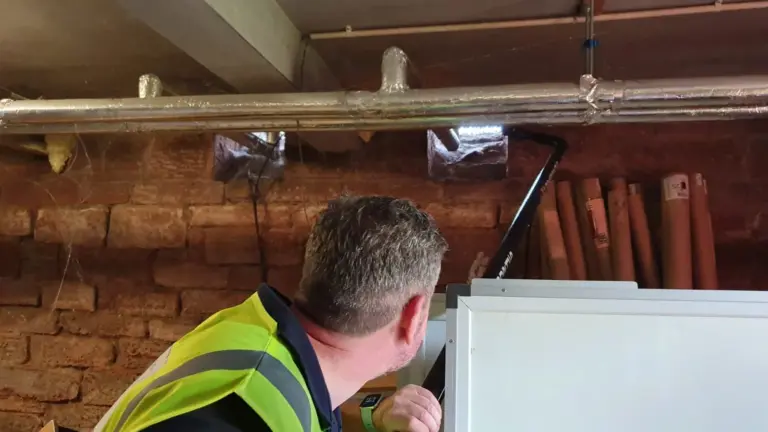
Every paper, tissue and corrugated converting line makes dust. Webs running over rollers, slitters and saws cutting through the sheet, sheets hitting stops and trim being blown away all release fine fibers. Most of it does not stay on the floor: it rides the air and settles on beams, cable trays, light fittings, duct exteriors and the tops of machines, where nobody sees it until a fire or an audit finds it.
Paper dust control is therefore two jobs at once: capturing dust where it is made, and removing what still settles before it becomes fuel or falls on product. This guide explains why paper and tissue dust is treated as a fire hazard, where it collects, and what to specify when you choose vacuum equipment to keep it under control.
Why is paper and tissue dust a fire hazard?
Paper and tissue dust is a fire hazard because it is a finely divided, readily ignitable fuel that spreads over large areas. The UK Health and Safety Executive’s guidance Paper mills: Guidance on fire risk states that in paper mills “there is always paper and paper dust,” and that both are readily ignitable fuels. It goes further: paper dust “presents a very high risk of fire and may, under certain conditions, be explosive,” and the problems “are likely to be more extensive in tissue mills.”
The US OSHA combustible dust program lists paper among the organic dusts it covers. That matters because a dust fire rarely stays where it starts. The US Chemical Safety Board notes that most fatalities and serious injuries in its dust investigations were caused by secondary explosions, when a first event shakes accumulated dust off surfaces into a cloud. Settled dust on overhead steel is exactly that kind of fuel.
The same HSE guidance lists “build-up of dust or paper causing overheating” among the circumstances that contribute to mill fires. Dust on motors, bearings, light fittings and hot surfaces is a fire risk even where no explosion is credible.
Is tissue dust treated like other combustible dusts?
Not by the same layer thickness. Tissue dust is very light, and the often-quoted 1/32-inch trigger assumes a dense dust. A 2015 OSHA interpretation letter explains that the 1/32-inch level rests on a bulk density of 75 lb/ft³ and notes that tissue dust may not create a deflagration hazard “even at an accumulation level of ¼ inch.” That is not permission to let tissue dust build up: HSE still treats it as a serious fire hazard. It means your housekeeping trigger should come from your own dust data and fire risk assessment, not from a number written for a different material. The guide on how often to clean settled combustible dust layers explains how plants set those intervals.
Why is paper dust also a hygiene and quality issue?
Paper dust is a quality issue because whatever settles overhead eventually comes down. Vibration, air movement, maintenance work and cleaning itself dislodge it onto reels, logs, cut sheets, packaging lines and finished cases. For tissue that ends up in consumer hygiene products, loose fibers and dirt on the product or its packaging are a visible defect, and dusty overhead areas are a common observation in customer and certification audits.
Dust also degrades the line itself. It loads sensors and photo-eyes, coats drives and electrical cabinets and adds to the heat on motors. Good dust control protects product, machines and the fire strategy at the same time.
Where does paper dust collect in converting plants?
Paper dust collects close to where the web is cut or handled and then wherever the air carries it. The table below is a starting point for a walk-through; your own survey should confirm the actual locations and quantities.
| Area | What makes the dust | Control at source | Housekeeping method |
|---|---|---|---|
| Rewinders and slitters | Web running over rollers, slitting knives | Local exhaust at the slitter section | Vacuum capture around frames and under the machine, line stopped |
| Log saws and cutting stations (tissue) | Cutting through logs and rolls | Enclosure and extraction at the saw | Vacuum of saw surrounds and floor, with the saw isolated |
| Corrugators, die-cutters and slotters | Trim, edge dust, sheets hitting stops | Trim extraction and collection | Vacuum around feeders, stackers and under conveyors |
| Overhead steel, cable trays, lights, duct exteriors | Fine dust carried by air movement | Reduce release below; minimise ledges | Ground-based high-reach vacuum poles or planned high-level cleaning |
| Dust collectors and their surroundings | Collected dust, leaks, emptying | Design by a competent specialist | Vacuum of spills at discharge points; no blowing |
HSE’s paper mill guidance names the same generators: “webs going over rollers, or being slit or cut, or sheets hitting stops.” It asks for dust to be collected “as near to its source as practicable,” with local exhaust ventilation wherever substantial quantities are created.
How should paper dust control work in practice?
Paper dust control works best as a fixed sequence that starts at the source and ends with records, not as a clean-up when dust becomes visible.
Paper dust control sequence
- Map dust sources
- Capture at source
- Vacuum settled dust
- Clean overhead zones
- Record and review
- Map the sources. Walk each line and mark where dust is released and where it lands, including above head height. Photographs and rough depth readings give you a baseline.
- Capture at the source. Extraction at slitters, saws and trim points reduces how much dust reaches the building. HSE describes collector design as “highly specialised” and asks for advice from a competent supplier or consultant.
- Vacuum, do not blow. HSE states that paper dust “should be cleaned up with a vacuum cleaner except where it is not physically possible.” Compressed air is only for coagulated material, and only after loose dust has been vacuumed.
- Clean overhead zones on a schedule. Dust on ledges and beams, HSE says, “should be regularly removed with vacuum equipment.” Plan it zone by zone so dust does not fall onto running lines.
- Record and review. Log what was removed, where and when. If the same areas fill up quickly, fix the source rather than cleaning more often.
What should the vacuum equipment for paper dust include?
The vacuum equipment for paper dust should match the dust, the area classification and the reach you need, and every part of that match must be documented. Start with three questions: is the area classified for combustible dust, how high are the deposits, and how much material is collected per shift?
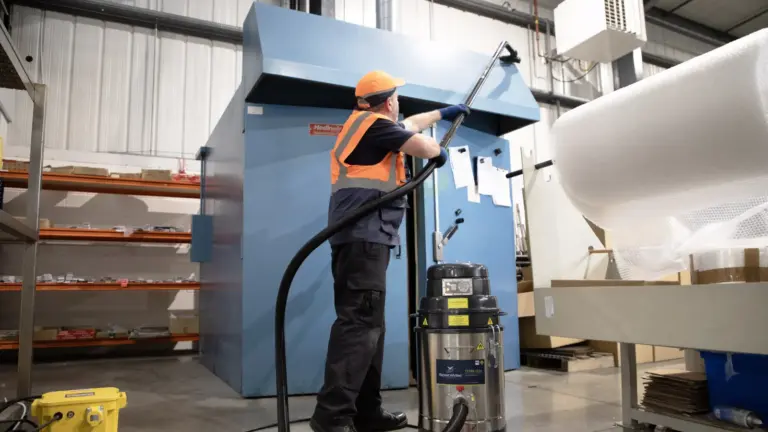
Where your explosion risk assessment classifies an area, for example as Zone 22, the vacuum must be a model certified for that zone. DUPUY lists paper mills among the industries it serves and publishes ATEX-certified models zone by zone, while its ACD models are stated as not ATEX and intended for non-classified areas. ATEX suitability belongs to a specific model with its certificate, never to a brand. The guide on antistatic hoses and grounding covers the static side of the same decision.
Where no area is classified, the US OSHA program still sets conditions for portable vacuums that collect combustible dust: suitable materials, conductive or static-dissipative hoses, bonded and grounded conductive parts, and no dust-laden air passing through the fan or an unlisted motor.
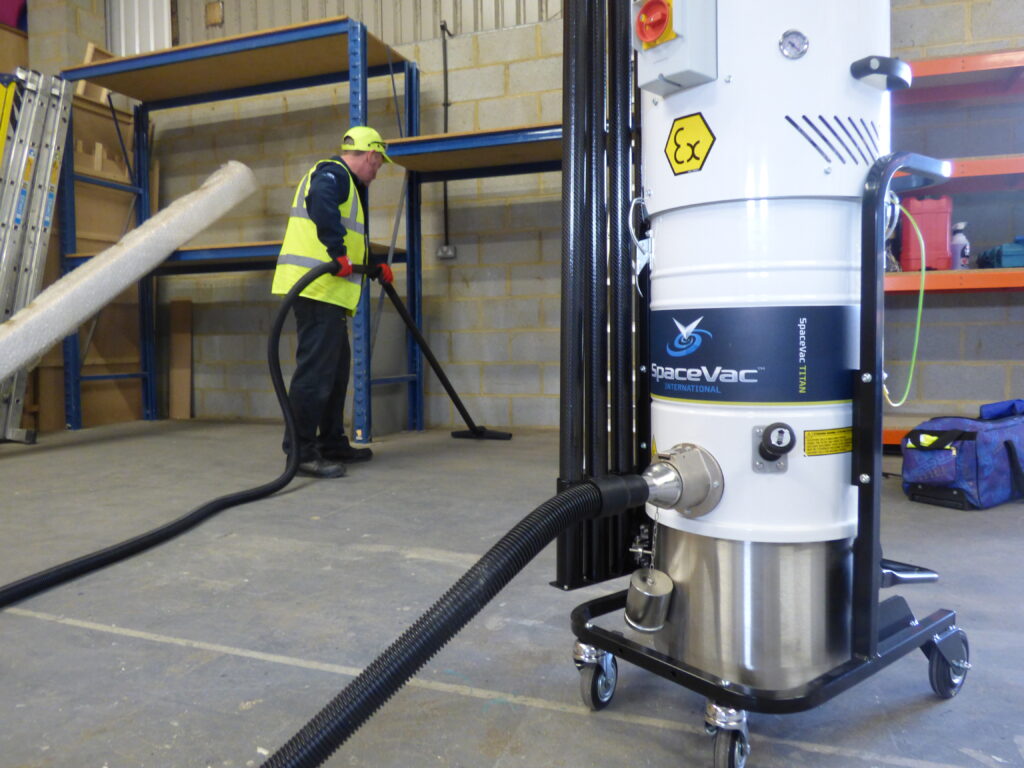
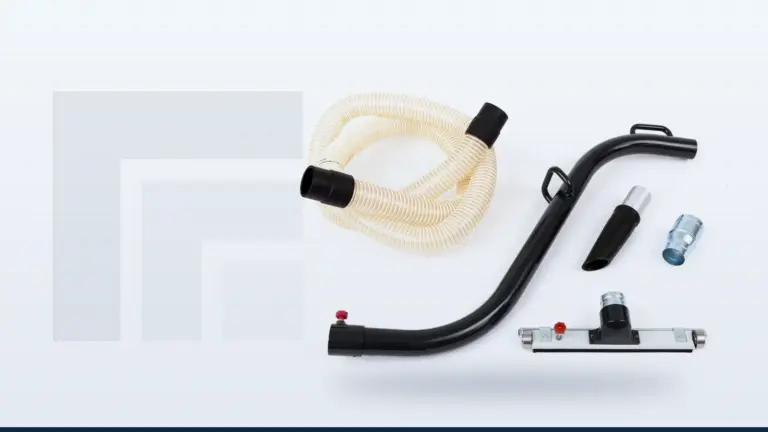
For overhead deposits, ground-based pole systems avoid lifting equipment over running lines. SpaceVac offers ATEX pole kits but states that they “must be paired with a certified industrial vacuum suitable for the hazardous zone classification of your facility.” The pole and the vacuum are selected together.
- Area classification drawing and the zones where the vacuum and poles will be used
- Dust type per line (paper, tissue, corrugated board, starch from adhesives) and any test data you hold
- Highest deposit height and the obstacles between floor and deposit
- Approximate quantity collected per shift and how the container will be emptied
- Power available at each line, and whether fixed pipework or mobile units suit the layout
- Filter documentation and conductive accessories for each proposed model
How do you keep overhead paper dust under control?
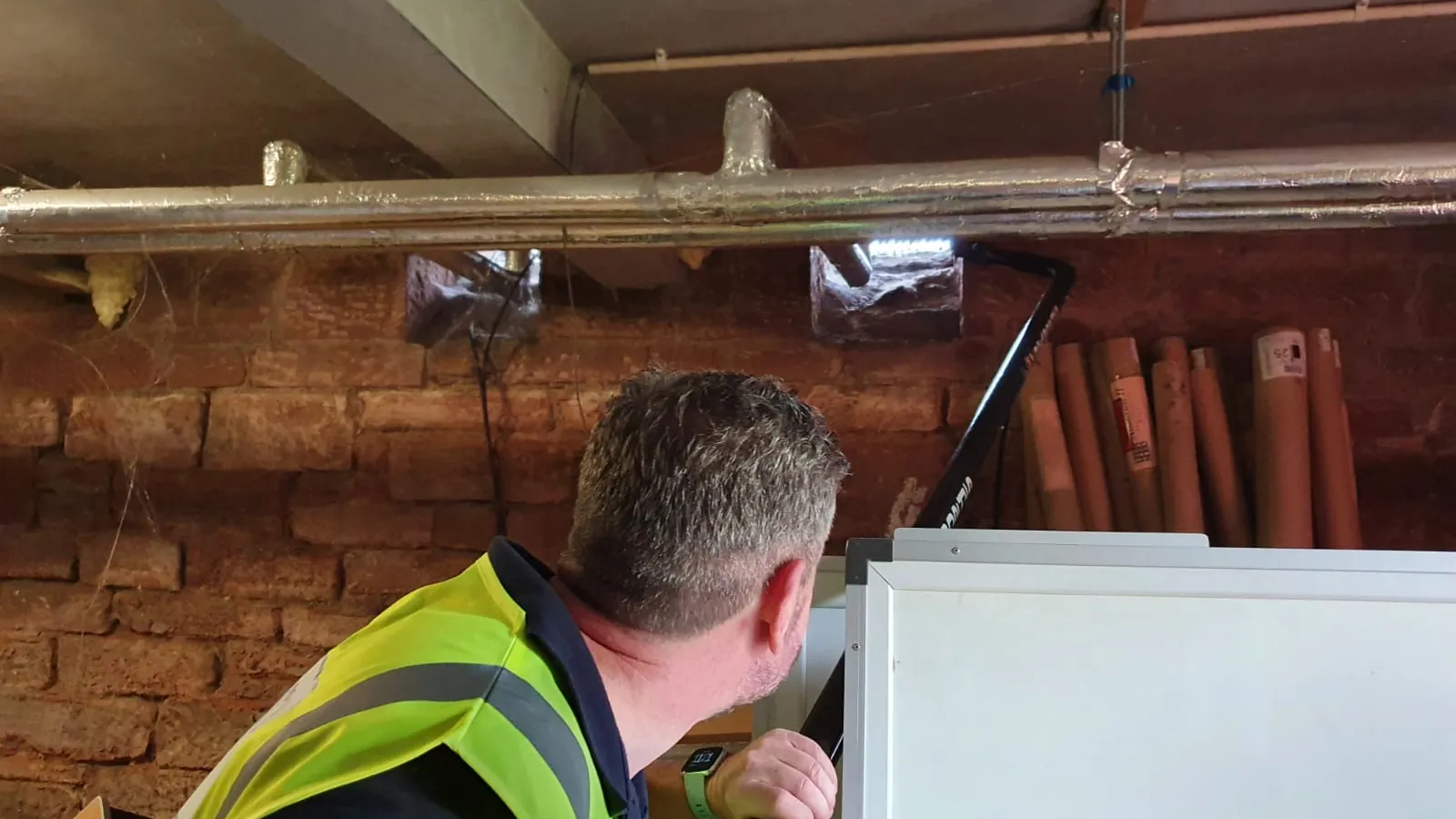
Overhead paper dust stays under control when cleaning is planned around production and repeated at an interval your records justify. Agree which zones can be cleaned while lines run below and which need a stop, and clean from the highest level downward so dust is not dropped onto surfaces already done.

Watch how the brush head stays in contact with the beam while the dust is drawn into the hose rather than knocked off; that is the behaviour to look for in any overhead method.
Many plants combine their own equipment for routine cleaning with periodic specialist visits for the highest or most congested areas. AFE supplies DUPUY vacuums and SpaceVac pole systems through its industrial vacuum range, can supply rental units for shutdown trials, and offers Internal high clean dust removal as a separate service. For classified areas, an ATEX compliance check of the proposed equipment is a sensible step before purchase.
Which mistakes make paper dust control fail?
Paper dust control usually fails for organisational reasons, not for lack of equipment. The most common patterns are:
- Cleaning only what is visible. Floors look clean while beams and cable trays carry the real load.
- Using a standard vacuum in a classified area. A vacuum that is not certified for the zone can introduce the ignition source the zoning was meant to exclude.
- Copying a layer-depth rule. A threshold written for dense dusts does not describe tissue, and vice versa.
- Ignoring the collector. Leaks and spills at the dust collector refill the area quickly.
- No feedback loop. Without records, nobody notices that one slitter is producing most of the dust.
If you are comparing capture at the machine with cleaning afterwards, the article on dust collectors versus industrial vacuums sets out where each fits. Fix the source, vacuum what remains, and let your records set the cleaning interval.
Al Faisaliah Enterprises · Aqaba
Choose vacuum equipment for your paper dust
Send your zone drawing, dust types per line, deposit heights and photos. AFE can propose DUPUY vacuum and SpaceVac pole options with the certificates for each area.
Frequently asked questions
Can we use a normal workshop vacuum for paper dust?
Only in areas that are not classified for combustible dust, and even then the vacuum should meet the basic conditions the US OSHA program sets for combustible dust: conductive or static-dissipative hoses, bonded and grounded parts, and no dust-laden air passing through the fan or motor. In any area your risk assessment classifies, use a model certified for that zone, with its certificate.
Is tissue dust explosive?
HSE guidance says paper dust may be explosive under certain conditions and that the problems are likely to be more extensive in tissue mills. Whether a given area can form an explosive cloud depends on the dust, its quantity and how it can be dispersed. Your explosion risk assessment and dust data decide this, not a general rule.
How often should overhead paper dust be cleaned?
No single interval fits every plant. Start from a survey that records where dust settles and how fast, set an interval that prevents substantial accumulations, and adjust it from your records. Areas above slitters, saws and trim systems usually need the shortest intervals. HSE expects cleaning frequent enough to prevent any build-up.
Should we buy equipment or use a cleaning service?
Many converting plants do both: their own vacuums for daily and weekly cleaning at machine level, and periodic specialist work for high or congested overhead areas. Renting equipment for a shutdown is a practical way to test a method before buying. The right mix depends on the heights, zones and labour you have.
What information should we send for equipment selection?
Send the area classification drawing, the dust types on each line, photographs of the worst deposits, the highest deposit height, an estimate of the quantity collected per shift and the power available. With that, a supplier can propose specific models with their certificates rather than a generic catalogue answer.
Sources and references
- Paper mills: Guidance on fire risk (WEB08) · UK Health and Safety Executive / Paper and Board Industry Advisory Committee
- Revised National Emphasis Program: Combustible Dust (CPL 03-00-008) · US Occupational Safety and Health Administration
- Evaluating Hazardous Levels of Accumulation Depth for Combustible Dusts · US Occupational Safety and Health Administration
- Drivers of Critical Chemical Safety Change: Combustible Dust (fact sheet) · US Chemical Safety and Hazard Investigation Board
- ATEX certified industrial vacuum cleaners · DUPUY
- ATEX cleaning equipment · SpaceVac International
This article is general technical guidance. Equipment suitability, ATEX conformity and hygiene performance must be confirmed for each site and application.
Written for plant, maintenance, HSE and quality teams in Jordan, Saudi Arabia and Iraq.