The short answer
An injection moulding shop stays clean and safe when granule spills are vacuumed as they happen into labelled containers, machine areas are cleaned at every changeover and shift end, and granulator dust is contained and vacuumed under lockout, never blown down. Drain covers stop granules leaving the site, and records show where spills keep starting.
Key takeaways
- Loose granules give minimal traction; OSHA names slips and falls a major cause of plastics industry accidents.
- Vacuum spills immediately into labelled containers per material, so clean granules can be reused.
- Granulator dust can burn: contain it, vacuum it under lockout and never use compressed air.
- Drain covers and prompt clean-up prevent pellet loss, as set out in EU Regulation 2025/2365.
- Combine mobile vacuums, on-machine capture and central systems or dust collectors to suit shop size.
In an injection moulding shop, the mess is small but constant. Granules escape when octabins and bags are tipped, when hopper loaders are refilled or changed over, around dryers and at the feed throat of every press. Purgings and sprues drop beside the machines, and the granulator adds fine regrind dust that settles on everything nearby.
Good injection moulding cleaning is less about deep cleans than about a routine that stops granules and dust from building up in the first place. This guide explains why granule spills are a safety problem, where material collects, what makes granulator dust different, how to collect spills so material can be reused, and which DUPUY vacuum equipment fits a moulding shop.
Why is injection moulding cleaning a safety issue, not just tidiness?
It is a safety issue because loose granules on a smooth floor behave like ball bearings. U.S. OSHA states that “slips and falls are one of the major causes of plastics industry accidents” and that “walking surfaces that have spilled resin pellets or beads provide minimal traction”. Operators carrying moulds, tools or bins across such a floor are at real risk.
There are three further reasons. Fine plastic dust from granulators can burn and, if dispersed, explode; OSHA’s combustible dust programme lists “plastics and resins” among the dusts it covers. Mixed or contaminated granules cause quality problems when they find their way back into a hopper. And granules swept into floor drains or yard gutters leave the site: the EU now regulates this through Regulation (EU) 2025/2365 on preventing plastic pellet losses. It is EU law, not Jordanian, Saudi or Iraqi law, but its clean-up measures are a useful benchmark and matter to moulders supplying EU customers.
Where do granules and dust collect in a moulding shop?
They collect wherever material is transferred, changed over or reduced in size. Mapping these points shows where routine cleaning, and prevention, should focus.
| Area | What collects | Main risk | Usual approach |
|---|---|---|---|
| Material receiving, octabin and bag tipping | Granules spilled during tipping and lance changes | Slips; granules carried into the yard | Vacuum at once into a labelled container; catch trays under tipping points |
| Conveying lines, hopper loaders and changeovers | Granules from emptied loaders and disconnected hoses | Mixed materials and colours | Dedicated vacuum and container per material family during changeover |
| Dryers and dryer hoppers | Granules and fines around hopper lids, drains and filters | Slips; hot surfaces nearby | Vacuum around the base after the dryer is safe to approach |
| Press feed throat and machine surround | Dropped granules, purgings, sprues and runners | Slips at the operator position; debris under guards | Shift-end vacuum of the floor; on-machine capture where practical |
| Granulators and regrind storage | Fine regrind dust on surfaces, beams and machines | Combustible dust, noise and moving knives | Contain at source, vacuum settled dust, never blow down |
| Floor drains and outdoor areas | Granules washed or kicked into drains and gutters | Pellet loss to the environment | Drain covers, regular inspection and vacuum recovery |
What makes granulator and regrind dust different?
Granulator dust is finer, travels further and comes from a machine with heavy knives on a fast rotor, so cleaning it combines dust, fire and machinery risks. New Zealand’s work safety regulator, WorkSafe, lists dust, fire and explosion, noise and slips among the hazards of plastics granulators.
Its guidance is direct: “CLEAN plastic dust from surfaces where it lands. Blowing dust with compressed air is NOT acceptable”, “CONTAIN plastics dust as much as possible during granulation”, and plastics dust not contained “could cause fire and explosion”. It also warns that granulator rotors are “somewhat sluggish, revolving for several seconds after power is turned off”, and requires lockout of all power before maintenance, cleaning and repairs. Noise is a further reason granulators are often placed in separate rooms: the UK HSE gives an example level of around 100 dB for granulators.
For the static and grounding details behind that advice, see antistatic vacuum hoses and grounding, and for assessing whether your regrind dust is a combustible dust hazard, see combustible dust hazard analysis.
How should spilled granules be collected?
Spilled granules should be collected promptly with a vacuum into a dedicated, covered container, kept separate by material type so they can be reused where quality allows. Brooms scatter round granules and push them under machines and into drains.
The EU pellet regulation’s Annex I sets out what good practice looks like. Its mandatory equipment includes “vacuum cleaners with sufficient capacity for internal and external usage” and “plastic pellet retaining drain covers or suitable alternatives to protect underground drainage systems”; its recommended equipment includes “industrial vacuum cleaners; dedicated containers for recovered plastic pellets that are covered, labelled and secured”; and spills are to be cleaned up “as soon as possible, and at the latest at the end of the operation”.
- Vacuum spills when they happen, not only at shift end.
- Use one container per material family and label it; do not mix virgin, regrind and floor sweepings.
- Let quality decide what can return to the hopper; contaminated material goes to your licensed waste contractor.
- Fit and inspect drain covers inside and outside the building.
- Repair the source: leaking loader seals, overfilled hoppers, damaged bags.
Which DUPUY equipment fits an injection moulding shop?
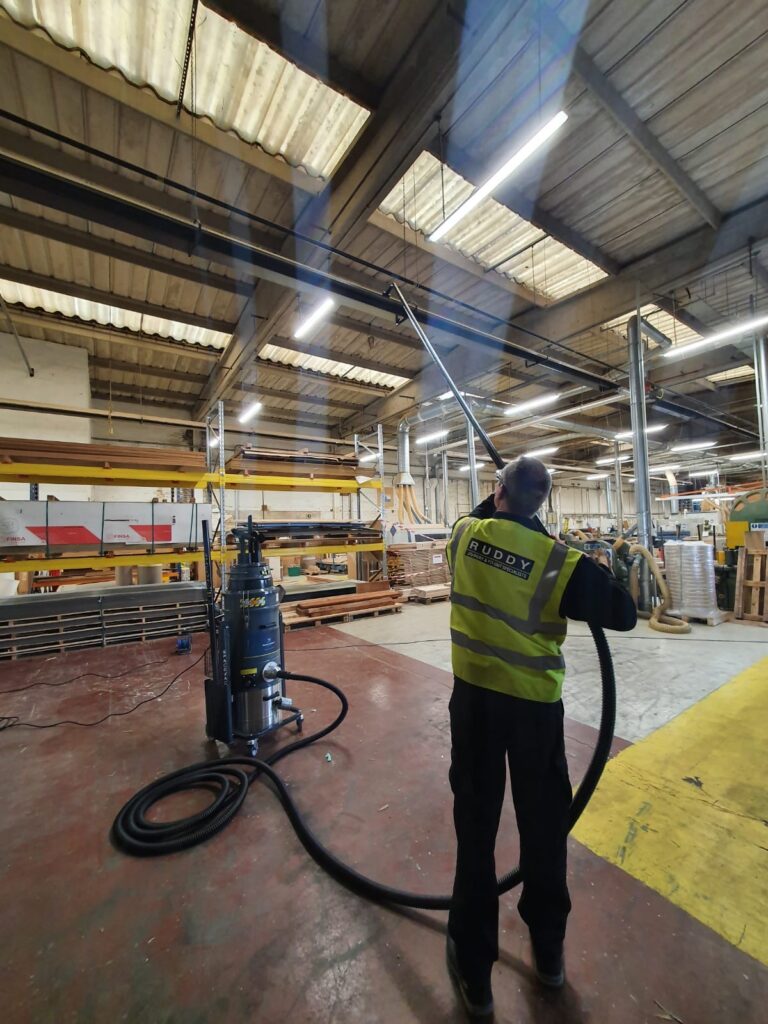
Most moulding shops need a mix: mobile vacuums for spills, capture at the machine for repetitive debris, and either a central system or a dust collector for granulator areas. DUPUY makes all of these, and the choice depends on shop size, number of presses and material.
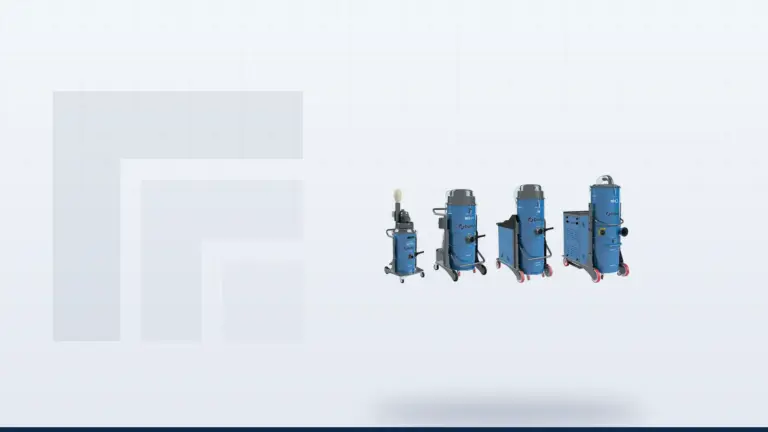
DUPUY notes that the plastics sector generates “a considerable amount of by-products” such as chips, fine dust and off-cuts. Its range includes single-phase and three-phase industrial vacuums for routine spill collection; stationary vacuum units “on-board machine” that DUPUY describes as “ideal for removing residues directly at the source”; central vacuum systems that move material “through a series of fixed pipes” to a discharge point, with the suction unit “up to hundreds of meters” from the pick-up points; and DEDUST dust collectors with “an automatic filter cleaning system using compressed air” for capturing fine dust. DUPUY also offers ATEX-certified models, but ATEX suitability is model-specific and must match the zone your assessment defines.
A central system suits larger shops where many presses and a granulator room are cleaned every shift; central vacuum system specification explains how to size one.

This film shows a separate machine-area task: dry steam removing oil and grime from an injection moulding machine during maintenance. AFE offers it through its steam cleaning and degreasing service; granule and dust collection stays a vacuum job.
What does a practical housekeeping routine look like?
A practical routine has three layers: immediate spill collection, a shift-end clean of machine areas and a periodic clean of granulator rooms and overhead surfaces. Writing it down makes it auditable.
- At the spill. Vacuum granules immediately at tipping points, loaders and dryers into the labelled container for that material.
- At changeover. Empty and vacuum loaders, hoses and hopper areas before the next material arrives.
- At shift end. Vacuum the floor around each press and remove purgings and sprues to their bins.
- Weekly. Lock out the granulator, clean settled dust in the granulator room, and inspect drain covers.
- Periodically. Remove dust from beams, ducts and machine tops before it builds up, and review the cleaning records for recurring sources.
Moulding shop housekeeping routine
- Vacuum spills at once
- Clean at changeover
- Shift-end machine areas
- Weekly granulator room
What should you send AFE for equipment advice?
A short description of the shop lets AFE propose the right mix of mobile, on-machine and central equipment instead of a single machine that suits nobody.
- Number and size of presses, and a layout sketch with the granulator room and material store.
- Materials processed and whether regrind dust is fine and dry.
- How granules are delivered and conveyed: bags, octabins, silos, loaders.
- Current cleaning method, frequency and the areas that cause most trouble.
- Any zone classification or dust hazard assessment for the granulator area.
- Power supply, and whether you would like a trial or rental unit first.
AFE supplies DUPUY equipment through its industrial vacuum range, provides filters, hoses and spare parts through its MRO and consumables service, and can review a central system layout through its engineering and consulting team. More guides for manufacturing plants are in the industrial insights hub.
Al Faisaliah Enterprises · Aqaba
Keep your moulding shop floor clear
Tell us your press count, materials, granulator layout and current routine. AFE will propose the DUPUY mobile, on-machine or central vacuum equipment to match.
Frequently asked questions
Can spilled granules go back into the hopper?
Sometimes, if they were collected straight away into a clean, labelled container for that material and your quality team accepts them. Granules swept from the floor, mixed with other materials or contaminated with dust, oil or debris should not go back. Vacuuming spills promptly by material type is what keeps the reusable share as large as possible.
Is a normal workshop vacuum good enough for granulator dust?
Often not. Fine, dry regrind dust can be combustible, so the vacuum should have conductive or static-dissipative hoses, bonded and grounded parts, and a design where dust-laden air does not pass through the motor. If your dust hazard assessment classifies the area, an ATEX-certified model for that zone is needed. AFE helps match the model to the assessment.
Should we install a central vacuum system or use mobile units?
Mobile units suit smaller shops and occasional spills. A central system with fixed pipes and hose points suits larger shops where many presses and a granulator room are cleaned every shift, because operators connect a hose instead of moving a machine. Many plants combine both. AFE compares the options once it knows your layout and routine.
Does the EU pellet regulation apply to moulders in Jordan, Saudi Arabia or Iraq?
Regulation (EU) 2025/2365 is EU law and applies within the EU from 17 December 2027, with some provisions earlier or later. It does not bind plants in Jordan, Saudi Arabia or Iraq, but its clean-up measures are a sensible benchmark, and EU customers may ask suppliers about pellet handling.
Sources and references
- Plastics Industry: Hazards and Solutions · U.S. Occupational Safety and Health Administration
- Plastics granulator · WorkSafe New Zealand
- Regulation (EU) 2025/2365 on preventing plastic pellet losses to reduce microplastic pollution · European Union (EUR-Lex)
- Plastic products: noise good practice · UK Health and Safety Executive
- Revised Combustible Dust National Emphasis Program, CPL 03-00-008 · U.S. Occupational Safety and Health Administration
- Wood and plastic industry · DUPUY
This article is general technical guidance. Equipment suitability, ATEX conformity and hygiene performance must be confirmed for each site and application.
Written for plant, maintenance, HSE and quality teams in Jordan, Saudi Arabia and Iraq.