The short answer
Plants recover fastest from sand and dust ingress by assessing first, then cleaning top-down: overhead structures with vacuum poles from the ground, then equipment and racking, then floors with sweepers and vacuums, then yards. Avoid compressed air and dry sweeping of fine dust, and reduce future ingress through doors, envelope gaps, intake filters and a regular cleaning interval.
Key takeaways
- Assess and prioritize before cleaning: product, safety and critical equipment come first.
- Clean top-down and inside-out so each step does not dirty the last one.
- Vacuum fine dust and overhead deposits; compressed air and dry sweeping spread them.
- Use sweepers for large floors and yards, vacuums for fine dust, corners and machines.
- Reduce ingress with closed doors, sealed gaps, checked intake filters and a clean baseline.
After a sand or dust storm, a factory does not only have a dirty yard. Fine material is pushed through dock doors, roof vents, louvres, air intakes and gaps in cladding, and it settles on roof steel, cable trays, machine tops, control panels, racking and floors. Then forklifts, fans and people stir it up again, and the cleaning starts over.
Good sand and dust control in factories across Jordan, Saudi Arabia and Iraq therefore has two parts: recovering quickly and in the right order after each event, and reducing how much gets in and settles in the first place. This practical guide covers both, with the equipment and service choices AFE can offer for each step.
Where does desert dust get into a factory, and where does it settle?
Desert dust gets in wherever air moves into the building, and it settles wherever that air slows down: on horizontal surfaces, in corners and on top of equipment. Knowing both ends of the path tells you where to clean first and where to stop the next ingress.
| Location | What you typically find | Why it matters | Usual tool |
|---|---|---|---|
| Roof steel, purlins, cable trays, pipe and duct exteriors | Even layers of fine dust and sand | Falls back onto product, equipment and people for weeks | High-reach vacuum poles worked from the ground |
| Machine tops, guards, motors and panel roofs | Fine dust in corners and on flat tops | Re-suspended by vibration and cooling fans | Industrial vacuum with hand tools |
| Racking, shelving and stored goods | Dust on beams, packaging and pallet tops | Contaminates goods and dispatch areas | Industrial vacuum, high-reach poles for upper levels |
| Floors, aisles and loading docks | Drifts near doors, fine dust across open floors | Tracked through the building by traffic | Sweeper for large areas, vacuum for fine dust and corners |
| Yards, roads and car parks | Sand drifts and loose material | Carried back inside by vehicles and wind | Ride-on or road sweeper |
Two places deserve special care. Inside electrical panels and drives, dust removal is a job for the site’s electricians under their isolation procedure. Air intake and ventilation filters are checked and changed by the site’s maintenance or HVAC team. A cleaning crew should report what it sees there but not open either.
What should happen in the first hours after a storm?
The first hours are for assessment and priorities, not for brooms and compressed-air lines. A quick, structured walk-round decides what has to be cleaned before production restarts and what can wait for a planned clean.
- Check safety first: blocked exits, slippery drifts on stairs and walkways, damaged doors or roof sheets.
- Identify product, packaging and food or pharma contact areas that may have been exposed.
- Ask the electrical and HVAC teams to check panels, drives and intake filters under their own procedures.
- Photograph overhead surfaces, machines and floors in each area, with a scale reference for the layer.
- Rank areas by consequence: what affects product, safety or critical equipment goes first.
- Tell staff not to blow down surfaces with compressed air or dry-sweep fine dust.
The last point matters more than it seems. The UK Health and Safety Executive notes that dry sweeping “can produce high levels of dust” and that the dust settles again afterwards. Compressed air does the same on a larger scale: it moves the deposit from one surface to every surface around it, including the ones already cleaned.
In what order should sand and dust control in factories be done?
Clean from the top down and from the inside out, so that each step does not dirty what the previous step cleaned.
- Overhead structures. Roof steel, trays, pipe and duct exteriors, lighting and high ledges, with dust captured at the cleaning head.
- Equipment tops and racking. Machine guards, motors, panel roofs, conveyor frames and upper racking levels.
- Walls, ledges and low-level surfaces. Window frames, door heads, sills and fixtures.
- Floors and docks. Sweep large open floors, then vacuum fine dust, corners, pits and around machines.
- Yards and approaches. Clear outside drifts last, or at least before traffic tracks them back in.
- Record and review. Photograph each zone, note where ingress was worst and feed it into the prevention plan.
Recovering after a sand or dust storm
How do you remove sand and dust from overhead structures?
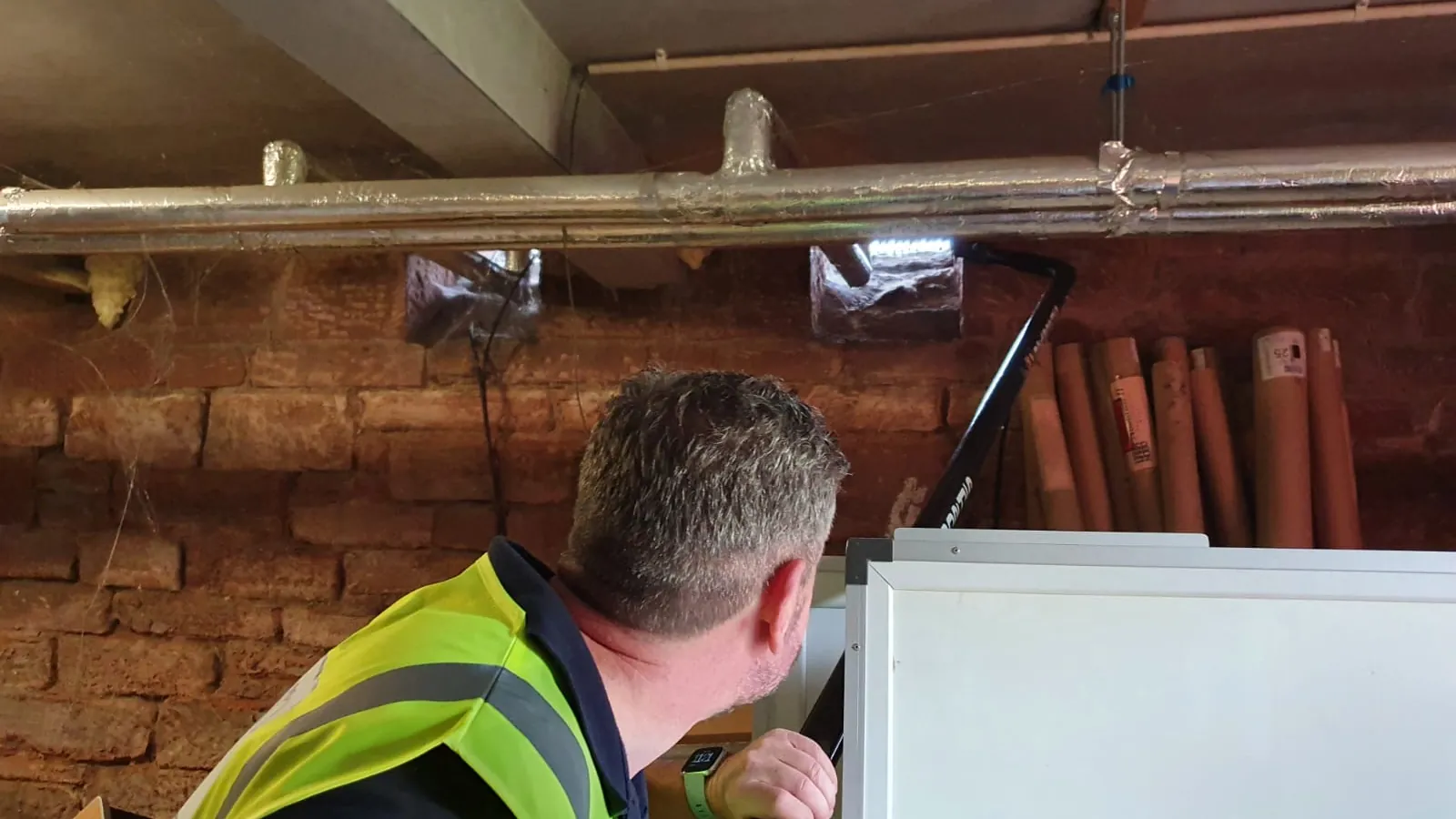
Overhead deposits are best removed with a vacuum, from the ground where heights allow, so that the material goes into a container rather than onto the floor and the people below.
SpaceVac systems use interlocking, mostly carbon-fiber poles connected to a vacuum, which lets the operator clean roof steel and services while standing on the floor. SpaceVac publishes reach figures per system, but they differ between its regional pages, so the actual configuration has to be checked against measured heights. Working from the ground also follows the hierarchy in the UK Work at Height Regulations 2005, which require employers to avoid work at height where it can reasonably be done safely another way. That is UK law, not law in Jordan, Saudi Arabia or Iraq, but it is a widely used benchmark.

This is SpaceVac’s own demonstration of wind-blown desert sand being cleared from high-level surfaces with a ground-based pole system. Watch how the head follows the steel and the material goes into the hose rather than falling to the floor.
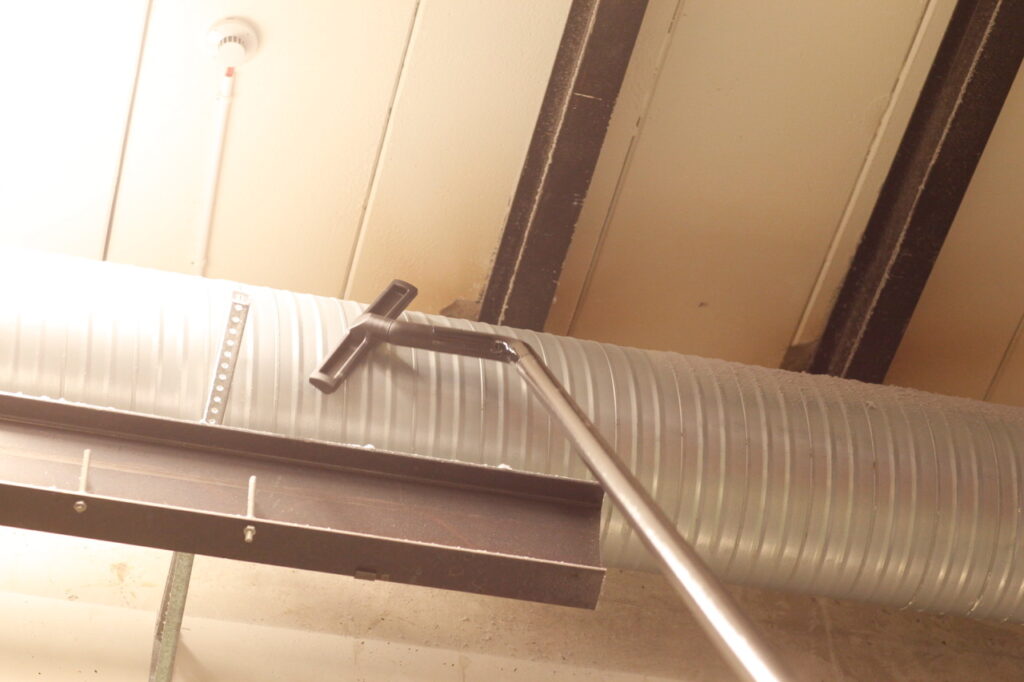
AFE delivers this as its Internal high clean dust removal service, often searched as high-level dust removal, with ground-based high-reach cleaning as the default access method. Areas beyond ground reach need a separate access decision, which the survey identifies.
Should floors and yards be swept or vacuumed?
Use a sweeper for large open floors and yards where the material is mostly sand and coarse dust, and an industrial vacuum where the dust is fine, where it sits in corners, pits and machines, or where re-suspension must be avoided. Most sites need both.
| Situation | Better fit | Reason |
|---|---|---|
| Large paved yards, roads and car parks | Ride-on or road sweeper | Covers area quickly; outdoor models can use water spray to keep dust down |
| Wide warehouse and production aisles | Ride-on or walk-behind sweeper with filtration | Collects sand and debris without manual brushing |
| Fine dust near product, clean areas or offices | Industrial vacuum with a suitable filter class | Captures fine particles instead of lifting them into the air |
| Corners, pits, gratings, machine bases | Industrial vacuum with hose and tools | Reaches where brushes cannot |
| Dust that may contain hazardous substances | M or H class vacuum, chosen from hazard data | Filter class follows the dust, not the convenience |
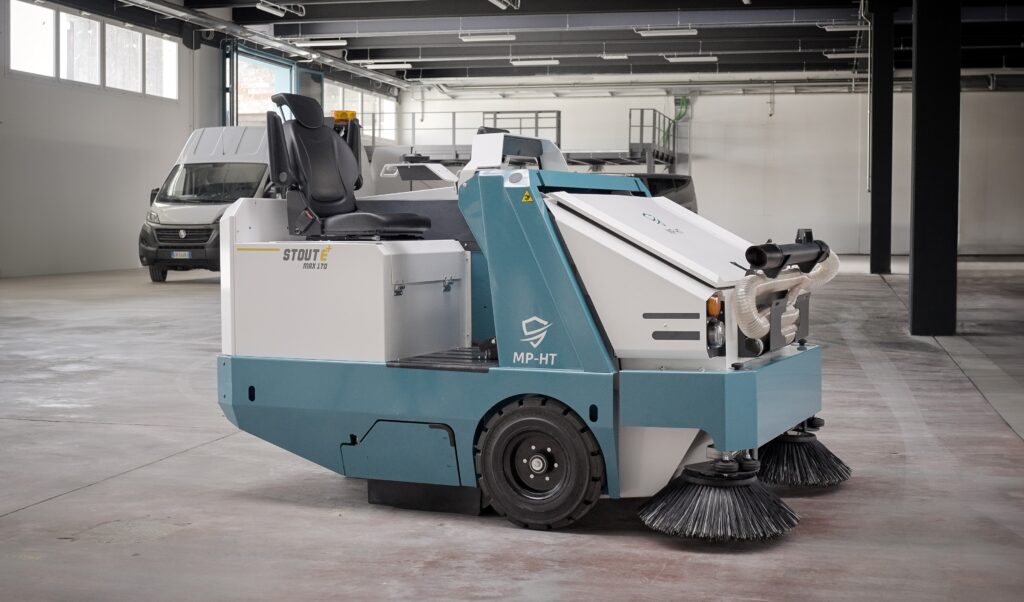
AFE states that MP-HT sweepers are used for removing fine dust, sand, gravel and residues from industrial sites, ports, logistics hubs and large paved areas, and that they combine suction, brushes and water spray dust suppression. MP-HT says its Handy Max 73 walk-behind model “bags dirt while protecting the operator from contact with dust.” For the fine dust that a sweeper leaves, DUPUY’s three-phase industrial vacuums and silo vacuums cover continuous, heavier work; see AFE’s sweeper range and industrial vacuum systems.
Choose the vacuum filter class from the dust’s hazard data. In the IFA summary of the vacuum standard, class L filters allow less than 1% penetration, class M less than 0.1% and class H less than 0.005%. If the site’s hygiene data show respirable crystalline silica in settled dust, treat it as silica dust; silica and cement dust housekeeping explains the class choice, and choosing between sweepers and vacuums goes deeper on floors.
How can a factory reduce what settles inside?
A factory reduces what settles inside by closing the paths dust uses, removing the places it collects and keeping a clean baseline, so that each storm adds to a clean building rather than to months of old dust.
- Doors and docks. Keep dock and personnel doors closed when not in use, and repair seals, shelters and damaged door leaves.
- Openings in the envelope. Record where drifts form after each event; they point to gaps in cladding, louvres and roof vents for the maintenance team to review.
- Air intakes. Ask the HVAC team to check intake filters after storms and review whether their filtration and change routine suit dusty seasons.
- Horizontal surfaces. Fewer ledges mean fewer deposits. The US OSHA combustible dust program points to minimizing horizontal surfaces such as beams and ledges where dust accumulates, and the same logic applies to storm dust.
- Protection before a forecast storm. Cover sensitive equipment and stored goods near doors when a storm is forecast.
- A regular interval. Schedule overhead and equipment cleaning on a routine, then add an inspection after each significant event.
Building, HVAC and electrical changes belong to the site’s engineers. A cleaning provider can show where the dust comes from; the site decides what to change.
Should you buy, rent or call in a service?
The right model depends on how often the problem comes back and who will do the work. Plants with frequent events and their own crews usually buy sweepers and vacuums; plants that need extra capacity after an event can rent; and overhead work that needs trained crews and planning is often better delivered as a service.
AFE sells, rents and executes, often in combination. It states that it offers short- and long-term equipment rental across Jordan, KSA and Iraq, with maintenance included, and that every intervention is shaped by “local access constraints and safety requirements specific to the region’s climate.” Renting through AFE’s equipment rental service adds sweepers or vacuums for the recovery peak without a capital commitment, while owned equipment covers the routine between events.
Al Faisaliah Enterprises · Aqaba
Plan your recovery before the next storm
Send photos of overhead surfaces, machines and floors after your last event, with approximate heights. AFE proposes a site assessment, a recovery sequence and the mix of service, rental and equipment that fits.
Frequently asked questions
Can we restart production before the overhead structures are cleaned?
Sometimes, but it is a risk decision. Dust on roof steel and trays keeps falling for days as fans, vibration and traffic disturb it, so product-exposed lines and clean areas often need overhead cleaning first. Lower-risk areas can restart after floors and equipment are done, with overhead work booked into the next suitable window.
Is compressed air acceptable for blowing sand off machines?
It is a poor choice for fine dust. Compressed air moves the deposit onto surrounding surfaces and into the air people breathe, including areas already cleaned. Where the dust may contain crystalline silica, the US OSHA silica standard, an international reference, limits compressed-air cleaning to cases with capturing ventilation or no feasible alternative. Vacuuming is the safer default.
What filter class should the vacuum have for storm dust?
Base it on the dust's hazard data rather than on habit. Ordinary nuisance dust may suit a class L machine, while dust that contains respirable crystalline silica or other hazardous substances calls for M or H. The IFA summary of the vacuum standard gives penetration limits of under 1%, 0.1% and 0.005% for L, M and H.
Can AFE help straight after a storm?
AFE offers equipment sales, short- and long-term rental across Jordan, KSA and Iraq, and on-site Internal high clean dust removal. Availability of crews and equipment for a specific date has to be confirmed at the time; sending photos and approximate heights speeds up the proposal.
How do we know where the dust is getting in?
Look at where it lands. Drifts inside dock doors, lines of dust under louvres or roof vents and heavy deposits near air intakes point to the main paths. Photograph and map them after each event, and give the record to the maintenance and HVAC teams, who decide on seals, repairs and filter changes.
Sources and references
- Sweeping and cleaning (construction dust) · UK Health and Safety Executive
- Testing of dust filters (dust classes L, M, H) · IFA, German Social Accident Insurance
- The Work at Height Regulations 2005, regulation 6 · UK legislation.gov.uk
- Revised National Emphasis Program: Combustible Dust (CPL 03-00-008) · US Occupational Safety and Health Administration
- Directive 1999/92/EC on minimum requirements for workers potentially at risk from explosive atmospheres · European Union (EUR-Lex)
- MP-HT industrial and street cleaning machines · MP-HT
- Internal high-level cleaning · SpaceVac International
This article is general technical guidance. Equipment suitability, ATEX conformity and hygiene performance must be confirmed for each site and application.
Written for plant, maintenance, HSE and quality teams in Jordan, Saudi Arabia and Iraq.