The short answer
An industrial floor sweeper is the right tool for large, open aisles, halls and yards with loose debris, sand and packaging. An industrial vacuum is needed for fine or hazardous dust, edges and under racking, liquids and product spills, and any dust the risk assessment assigns to class M or H. Most sites need both.
Key takeaways
- Sweepers are built for area: long aisles, halls, parking and paved yards with loose debris, sand and packaging.
- Dry sweeping raises fine dust; HSE recommends M or H class vacuum extraction for finer material.
- Vacuums handle edges, under racking, pits, liquids, product recovery and any dust needing class M or H.
- Choose ride-on or walk-behind by area and congestion, and battery or engine power by indoor or outdoor use.
- In classified hazardous zones every machine must suit the zone; check equipment against the documented zones first.
A distribution center with long aisles, a dispatch yard that collects sand and grit, a production hall with fine dust around the machines: each of these floors gets dirty in a different way, and one machine rarely suits them all. Choosing between an industrial floor sweeper and an industrial vacuum is really a question about the debris, the area and how much dust you can accept in the air.
This comparison explains when a sweeper is the right tool for large floors and yards, when an industrial vacuum is needed instead, and how the two work together. It draws on statements from the manufacturers MP-HT and DUPUY and on international occupational health guidance on fine dust.
What does an industrial floor sweeper do well?
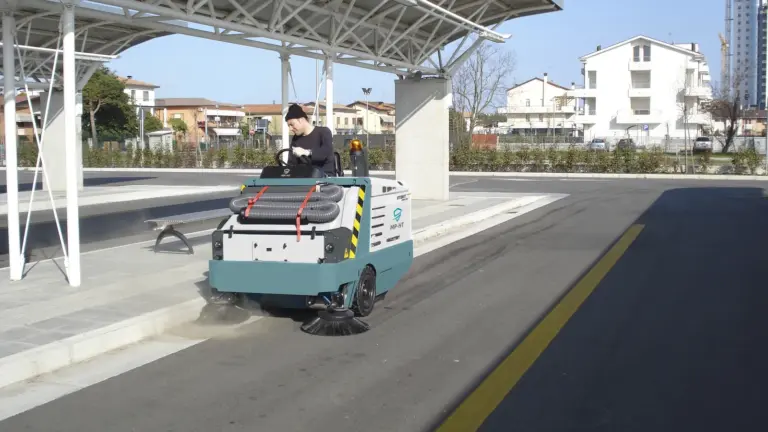
An industrial floor sweeper collects loose debris from large, open, reasonably even surfaces quickly. Brushes move material into a hopper or bag while a filter handles the dust the brushes raise, so the machine’s strength is area: long, unobstructed aisles, halls, parking areas and paved yards.
MP-HT, the Italian manufacturer whose sweepers AFE supplies, says it “designs and manufactures industrial and street cleaning machines” and describes its range as serving manufacturing, logistics, construction sites and urban spaces, including warehouses, parking and pedestrian areas. It groups the machines as industrial, street, ride-on, walk-behind, battery-powered and engine-powered.
Sweepers suit packaging fragments, pallet splinters, sand and grit tracked in through dock doors, and general aisle debris. They are not designed to recover liquids, reach under low racking beams or capture very fine hazardous dust at the source.
When is an industrial vacuum needed instead?
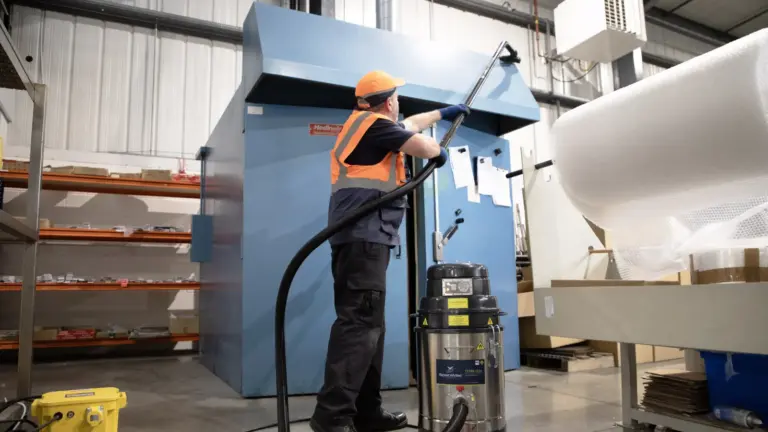
An industrial vacuum is needed when the dust is fine or hazardous, when the debris sits where a sweeper cannot go, or when liquids or spilled product must be recovered. Sweeping moves fine dust into the air as well as into the hopper. The UK Health and Safety Executive notes in its construction guidance on sweeping that dry sweeping “can produce high levels of dust,” quickly producing high peak exposures of around 1-2 mg/m³, and that the dust re-settles. For finer material it recommends vacuum attachments fitted to an H or M class extraction unit.
Those classes come from IEC/EN 60335-2-69. According to the IFA summary of the standard, class L covers substances with occupational exposure limits above 1 mg/m³ (filter penetration below 1%), class M limits of 0.1 mg/m³ or more (below 0.1%), and class H carcinogenic substances and limits below 0.1 mg/m³ (below 0.005%). They are defined for vacuum cleaners and dust extractors, so if your risk assessment calls for a class M or H machine, get written confirmation before relying on any sweeper for that dust.
For respirable crystalline silica, the US OSHA standard for general industry does not allow dry sweeping or brushing that could contribute to exposure unless wet sweeping, HEPA-filtered vacuuming or other low-exposure methods are not feasible. These are US and UK references, not law in Jordan, Saudi Arabia or Iraq, but they show the direction of good practice; why vacuuming beats sweeping for silica and cement dust covers this in detail.
Vacuums are also the practical answer for:
- Edges and confined areas: under the lowest racking beams, along walls, around dock levellers, machines and pits.
- Liquids and mixed spills: DUPUY lists wet and dry and powder-and-liquid models among its industrial vacuum families.
- Product recovery: spilled powder or granules collected cleanly into a container rather than mixed with floor debris.
- Heavy bulk spills: large quantities are better handled by a high-capacity vacuum or vacuum loader than pushed around by a sweeper.
Industrial floor sweeper vs vacuum: how do they compare?
They solve different parts of the same housekeeping problem, and the table below shows where each one fits.
| Criterion | Industrial floor sweeper | Industrial vacuum |
|---|---|---|
| Best area | Large open aisles, halls, yards and parking | Edges, under racking, around machines, pits and confined spaces |
| Typical debris | Loose debris, packaging, sand and grit | Fine dust, powders, spills; liquids with wet and dry models |
| Airborne dust | Some dust is raised; filter and dust-control features vary by model | Captured at the nozzle; filtration class can be specified |
| Fine or hazardous dust | Confirm suitability case by case | Class M or H models where the assessment requires them |
| Combustible dust | Needs a specific assessment | A model certified for the zone, or the safeguards for unclassified areas |
| Formats | Ride-on or walk-behind, battery or engine | Mobile units, central systems, high-reach kits |
| What drives output | Cleaning path, route and hopper emptying | Hose route, suction and container capacity |
Ride-on or walk-behind: which industrial floor sweeper fits?
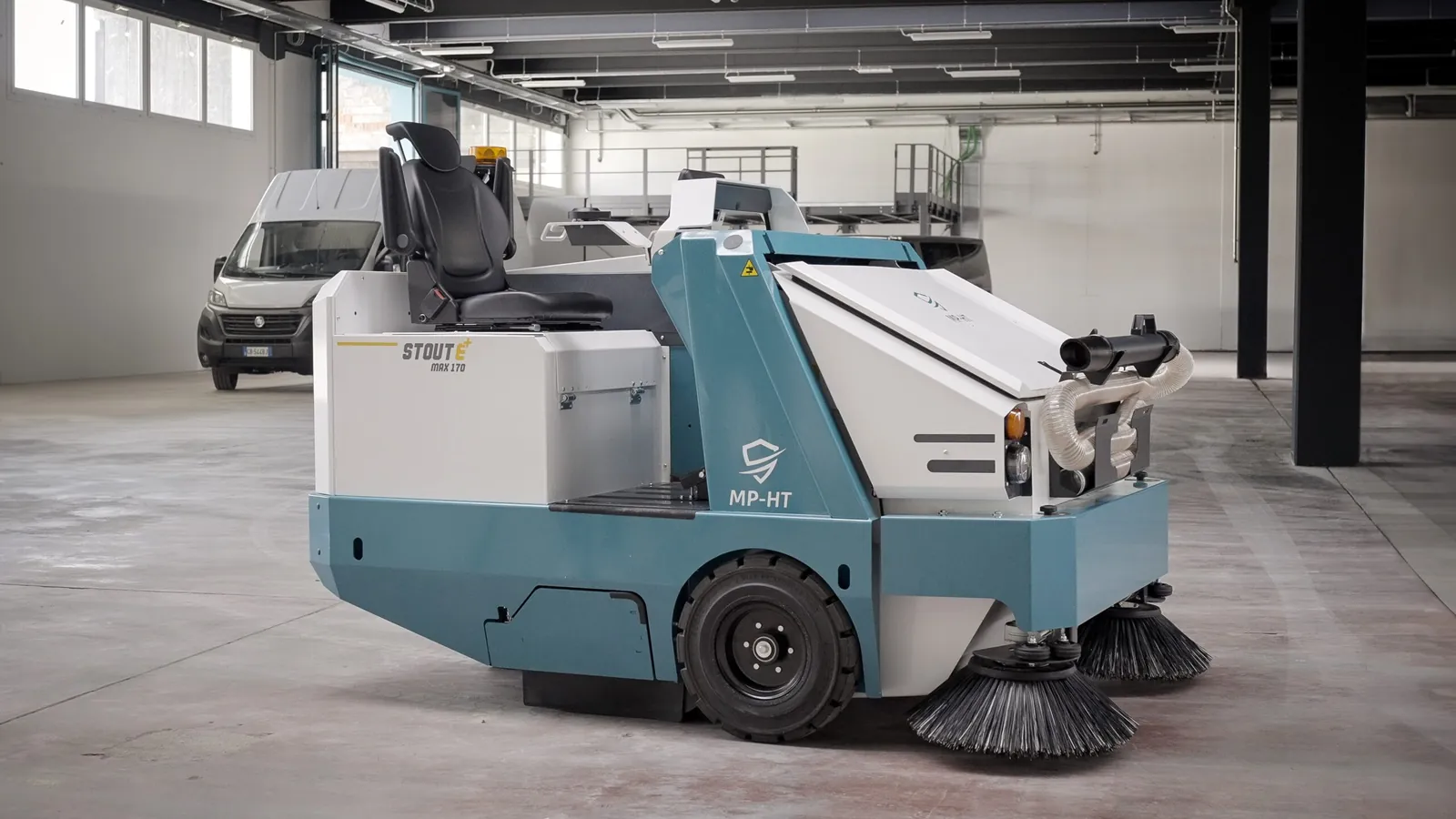
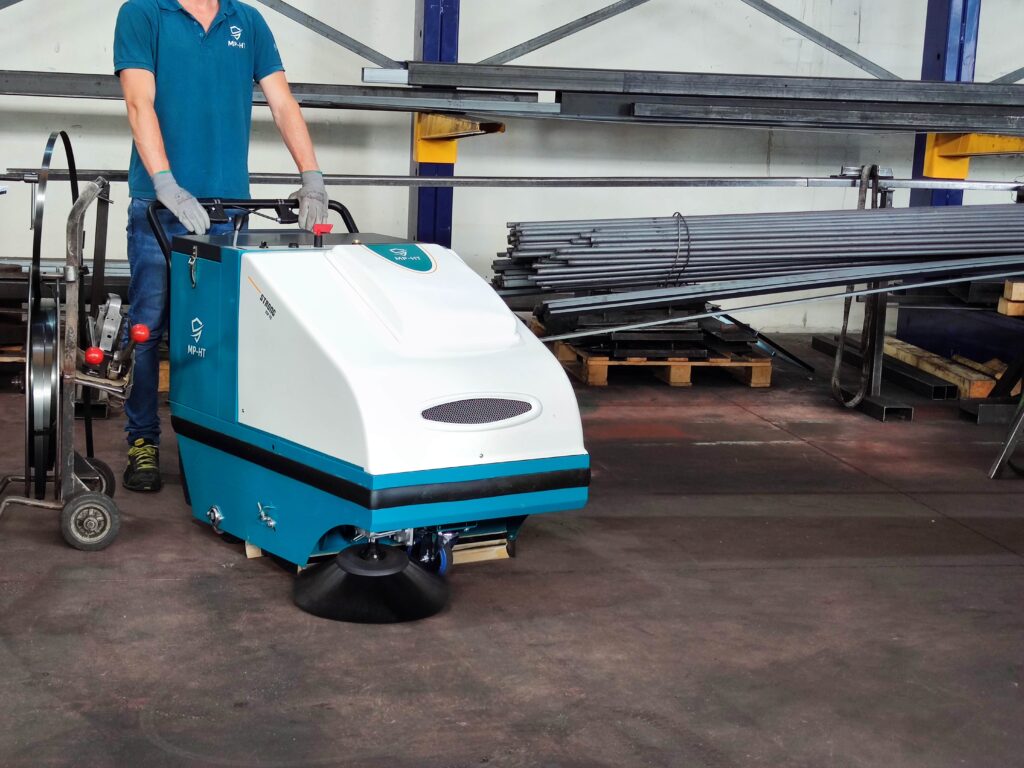
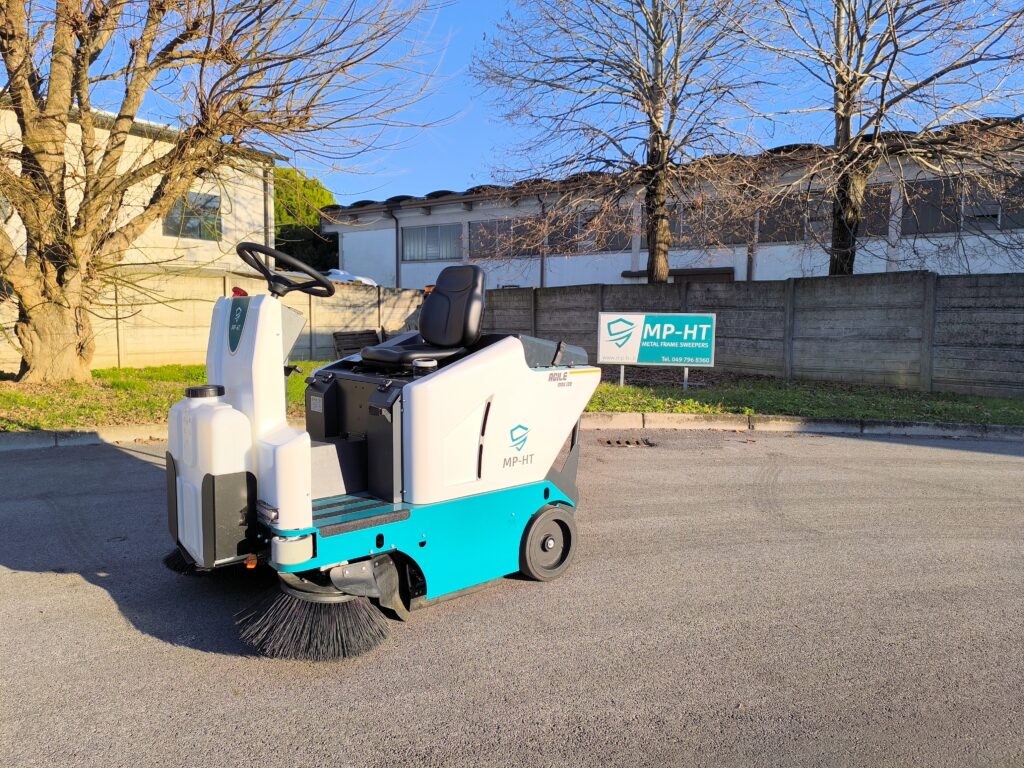
The size of the area and how congested it is decide between ride-on and walk-behind; the environment decides between battery and engine power. MP-HT lists walk-behind models such as the Handy Max 73 and the compact Max Wind street sweeper, and ride-on models such as the Stout E+, which it describes with 24 V motors, and the Wind Ant E4H street sweeper. It presents the Agile Max 107 for medium and large surfaces.
Before asking for a recommendation, describe the site:
- Measure the areas: aisle lengths and widths, yard size and the narrowest point the machine must pass.
- Note obstacles: racking uprights, dock levellers, ramps, kerbs and floor joints.
- State whether work is indoors or outdoors; enclosed buildings generally point to battery power, open yards and roads can suit engine power.
- Describe the debris: fine dust, sand, packaging, pallet fragments, spilled product or wet material.
- Give the shift pattern and when floors are free of forklifts and pedestrians.
- Explain how the hopper or bag will be emptied and where the waste goes.
- Ask about operator protection: MP-HT states that the Handy Max 73 “bags dirt while protecting the operator from contact with dust,” with bagged collection and an elevated filter.
How do sweepers and vacuums work together on one site?
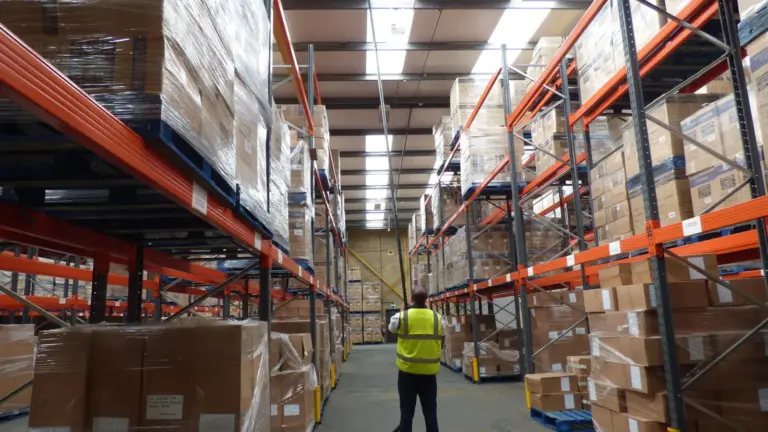
On many logistics and industrial sites the answer is a combination: a sweeper for the open floor, a vacuum for the detail and the hazardous fractions, and a separate method for dust above head height.
- Clean high areas first. When overhead cleaning is scheduled, do it before the floor routine so falling dust is not left behind; see warehouse dust removal from racking and high bays.
- Vacuum the detail. Edges, under the lowest racking beams, around docks, machines and spill points.
- Sweep the open floor. Aisles, halls and yards on a fixed route and frequency.
- Recover bulk spills separately. Collect large spills with an industrial vacuum or vacuum loader instead of sweeping them.
- Review and adjust. Note where dust returns fastest and change routes, frequencies or source control.
Choosing floor cleaning equipment

Watch for the configurable heavy-duty format: this is the kind of mobile vacuum that takes on the edge, spill and pit work a sweeper leaves behind.
Which dust hazards change the choice?
Three hazards override the convenience of sweeping: fine health-hazardous dust, combustible dust and outdoor sand loads that overwhelm the wrong filter. Fine dust is covered above; when an assessment calls for class M or H extraction, a vacuum is the default tool.
Combustible dust needs its own assessment. OSHA’s US combustible dust program accepts vacuum cleaning, sweeping and water wash-down as ways to remove accumulated layers, but the method must not lift the dust into a cloud. In any area the site has classified as a hazardous zone, every machine, sweeper or vacuum, must be suitable for that zone, and AFE’s consulting team can run an ATEX compliance check of the equipment against your documented zones.
Outdoor yards bring sand and grit in large volumes. Ask how the filter is cleaned, how often it needs attention in dusty conditions and how the hopper is emptied, because these drive daily output more than headline specifications. Brushes and filters are wear parts; plan them as consumables.
How does AFE help choose floor cleaning equipment?
AFE supplies MP-HT sweepers and DUPUY industrial vacuums as equipment, and recommends a combination from your site description rather than from a single catalogue. As AFE puts it, “We recommend the right machines for your facility, not the ones in stock.”
For a trial before purchase, AFE offers equipment rental for shutdowns, trials and temporary needs. Brushes, filters, hoses and spare parts are covered by AFE’s MRO and consumables service. Where the job is better bought as a service than as a machine, see what a vacuum-based industrial dry cleaning scope covers. AFE works with sites across Jordan, Saudi Arabia and Iraq from its Aqaba hub.
Al Faisaliah Enterprises · Aqaba
Get a sweeper and vacuum combination for your floors
Send AFE your floor areas, debris types, indoor or outdoor use and shift pattern. You get a recommended mix of MP-HT sweepers and DUPUY vacuums, with the points to confirm in a trial.
Frequently asked questions
Can a sweeper be used for fine cement or silica dust?
Not as the main method. Sweeping raises fine dust, and international guidance points the other way: HSE recommends M or H class vacuum extraction for finer material, and US OSHA's silica standard does not allow dry sweeping where HEPA vacuuming or wet methods are feasible. A sweeper can still clear coarse debris from the same floor once the fine dust has been vacuumed.
Is a battery or engine-powered sweeper better for a warehouse?
For enclosed warehouses, battery power is the usual starting point because it avoids engine exhaust indoors. Engine-powered sweepers suit open yards, roads and large outdoor areas. MP-HT offers both battery-powered and engine-powered machines, so state where each machine will work, the shift length and the charging or refuelling arrangements when asking for a recommendation.
Could we vacuum the whole warehouse floor instead of buying a sweeper?
You can, but a mobile vacuum is designed for capture at the nozzle, not for covering large open areas quickly. On long aisles and yards, a sweeper usually makes better use of operator time, while the vacuum handles edges, under the lowest racking beams, docks and spill points. Combining both normally gives cleaner floors than stretching either machine across every task.
What should we check before buying a sweeper for a sandy yard?
Ask how the filter is cleaned and how quickly it loads in dusty conditions, how the hopper is emptied and where the waste goes, and which brushes and filters wear fastest. Check the machine can handle your kerbs, ramps and surfaces. Plan brushes and filters as consumables from the start, so the machine is not idle waiting for parts.
Can we try a sweeper on site before deciding?
AFE states that it offers equipment rental for shutdowns, trials and temporary needs across Jordan, Saudi Arabia and Iraq. Whether a specific MP-HT model is available for a trial needs to be confirmed when you enquire. Running a trial on your own floors, debris and shift pattern is the most reliable way to compare a sweeper with your current method.
Sources and references
- MP-HT industrial and street cleaning machines · MP-HT
- Handy Max 73 walk-behind sweeper · MP-HT
- Sweeping and cleaning (construction dust) · UK Health and Safety Executive
- Testing of dust filters: dust classes L, M and H (DIN EN 60335-2-69 Annex AA) · IFA / DGUV
- 29 CFR 1910.1053 Respirable crystalline silica · U.S. OSHA
- Revised Combustible Dust National Emphasis Program, CPL 03-00-008 · U.S. OSHA
- DUPUY industrial vacuum cleaners · DUPUY
This article is general technical guidance. Equipment suitability, ATEX conformity and hygiene performance must be confirmed for each site and application.
Written for plant, maintenance, HSE and quality teams in Jordan, Saudi Arabia and Iraq.