The short answer
Museums and heritage buildings can remove high-level dust safely by letting the conservator decide what is cleaned, testing a small area first, and using soft brush heads that feed a filtered vacuum from the ground. Work from the top down, protect objects below, avoid feather dusters, compressed air and steam, and record the condition before and after.
Key takeaways
- Dust, especially desert dust, is abrasive; careless brushing can scratch soft stone and remove decorative finishes.
- The conservator decides what is cleaned, inspected only or excluded; the cleaning team works within that decision.
- Brush into suction with soft, dedicated brushes, adjustable suction and filtration agreed with the conservator.
- No steam, wet methods, sprays or compressed air on artefacts or decorative surfaces.
- Ground-based high-reach cleaning keeps towers and lifts away from display cases and historic floors.
Museums and heritage buildings collect dust in the places visitors rarely look: cornices, ceiling coffers, beams, high window reveals, light fittings, the tops of tall display cases and the ledges of galleries. Over time it dulls decorative ceilings, falls onto exhibits below and becomes harder to remove. Reaching it usually means towers or lifts in rooms full of irreplaceable objects.
Museum cleaning at height therefore has a double job: remove the dust, and do nothing that could harm the collection or the historic fabric. This guide explains why museum dust needs a gentle method, who approves what is cleaned, which tools are appropriate, how to plan the work around visitors and collections, and what AFE needs to plan its Internal high clean dust removal service in a museum or heritage building.
Why does museum cleaning at height need a gentler method?
It needs a gentler method because dust is abrasive and many historic surfaces are soft, fragile or decorated. The cleaning itself can cause the damage it is meant to prevent.
The U.S. National Park Service (NPS) puts it plainly in its Conserve O Gram conservation leaflets: “Dust acts as an abrasive. Each time an object is brushed, surface materials can be removed.” Its guidance on stone and interior architectural features adds that dust “blown off of a dirt road, desert, or beach is quite abrasive and can scratch objects if pressure is applied during its removal”, and that soft stones such as marble, limestone and alabaster “can be easily scratched by improper dusting procedures”. For buildings in Jordan, Saudi Arabia and Iraq, where fine desert dust enters every interior, that warning applies directly.
Method matters as much as care. The same guidance discourages feather dusters “because they send dust back into the air and do not actually remove it from the building”, and describes compressed air as “the most dangerous cleaning method”. Capturing dust in a vacuum with good filtration removes it; brushing alone moves it onto the next surface.
Who decides what can be cleaned in a museum?
The museum decides, through its conservator or the authority responsible for the building, and the cleaning team works within that decision. A cleaning contractor should never be the one judging whether a decorated ceiling or an object is stable enough to clean.
NPS guidance says that if a surface shows “signs of flaking, powdering, or otherwise loose material or attachments, or you are unsure of its condition, then the object should be examined by a conservator before dusting”, and that where decorative elements are “extensive and very delicate, cleaning should be performed by a conservator”. A clear split of responsibility, agreed before any work, avoids misunderstandings.
| Surface | Who approves | Typical method | Not done by the cleaning team |
|---|---|---|---|
| Plain building fabric: beams, plain ceilings, high walls, window reveals | Facility manager, with conservator sign-off in listed buildings | Soft brush heads into suction, from the ground | Repairs, repainting, wet cleaning |
| Decorative plaster, painted or gilded ceilings, carved cornices | Conservator, after a condition check and test area | Very soft brushes, low suction, no pressure; stop at any loose finish | Consolidation, retouching, any treatment |
| Light fittings, speakers, cameras, cable trays | Facility manager and electrician | External surfaces only, with light contact | Electrical isolation, dismantling, internal cleaning |
| Tops of tall display cases and plinths | Collections team | Case exteriors only, with the case closed | Opening cases, touching objects inside |
| Suspended or large exhibits, historic chandeliers | Conservator | Usually cleaned by or under a conservator | Any handling unless the conservator directs it |
In practice, AFE’s role is the building fabric and fixtures at height. Objects in the collection remain with the museum’s own conservation staff.
Which tools and methods are gentle enough for heritage surfaces?
Soft brushes feeding a vacuum with good filtration, adjustable suction and a top-to-bottom sequence are the core of a gentle method. NPS conservation guidance describes the same principles that a high-reach system applies at height.
- Brush into suction. NPS advises dusting with a soft brush and, “whenever possible”, brushing into a vacuum cleaner so soil is not redeposited.
- Filtration. A vacuum with a HEPA filter “will reduce exhaust material to an even greater extent”, according to NPS; agree the filter standard with the conservator.
- Adjustable suction. Low suction and fine screening for fragile surfaces; NPS warns that flaking surfaces and loose parts can be detached by the screen or vacuum.
- Clean, dedicated brushes. NPS recommends brushes kept for this purpose only, never used on floors, with the metal ferrule taped so it cannot scratch.
- Top to bottom. Always dust from the top down so dust does not fall onto cleaned surfaces.
- No sprays, feather dusters or compressed air. NPS advises against aerosol dusting sprays and feather dusters, and treats compressed air as a last resort.
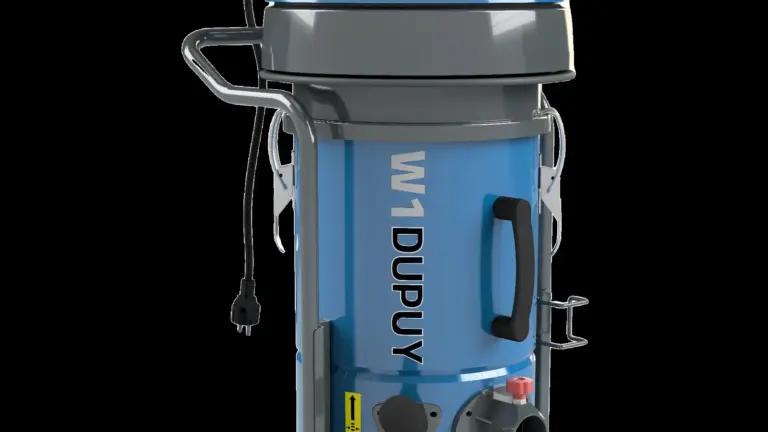
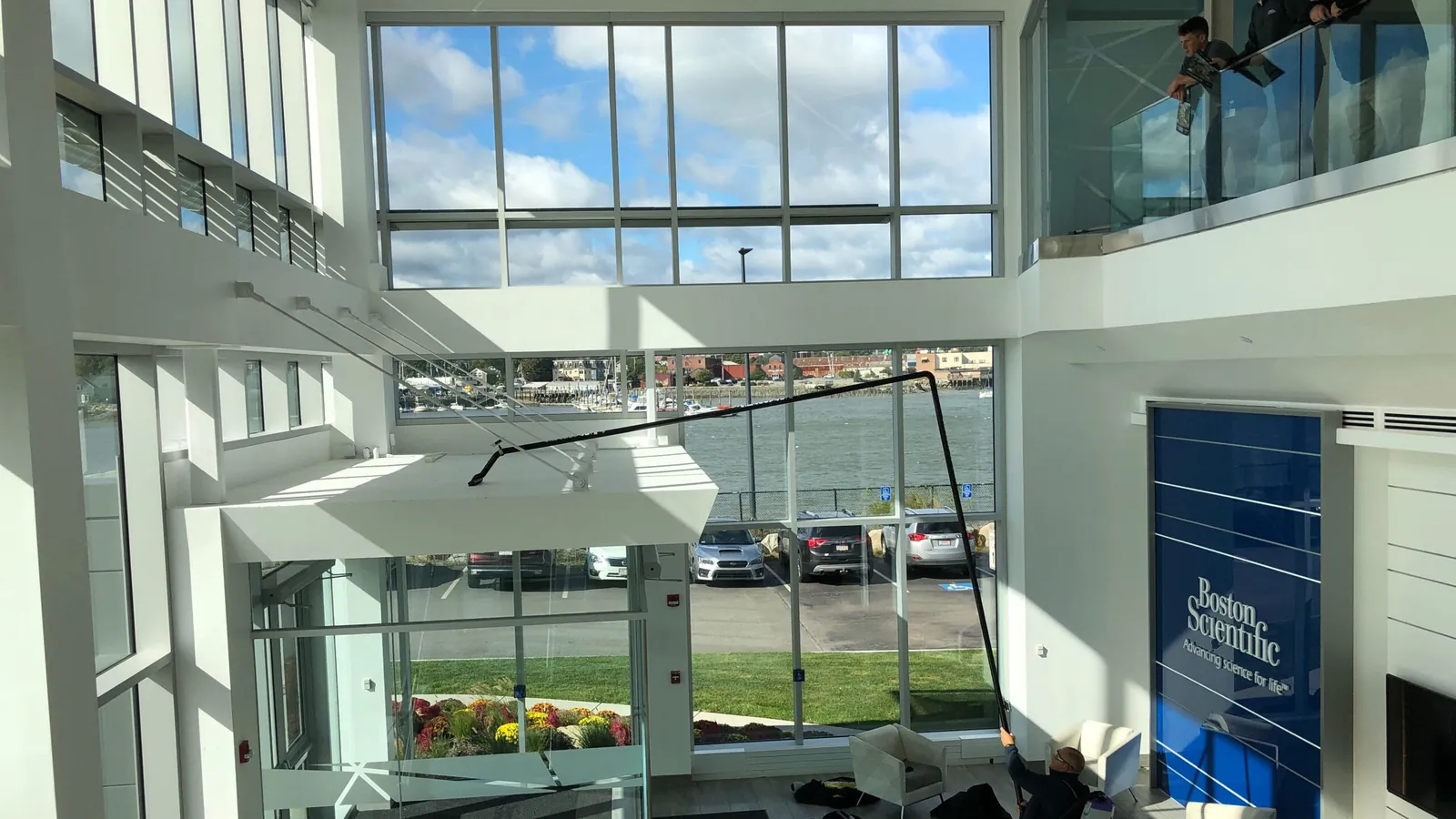
At height, SpaceVac systems carry the brush heads on interlocking, mostly carbon-fibre poles connected to a vacuum, so the operator stays on the floor. Brush heads in different shapes suit beams, ledges, pipes and round fittings. SpaceVac also lists camera and monitor systems, sold separately from its standard kits, that show the operator the surface being cleaned. AFE pairs the poles with a compatible industrial vacuum, such as a suitable DUPUY unit, whose filter documentation can be shared with the conservator.
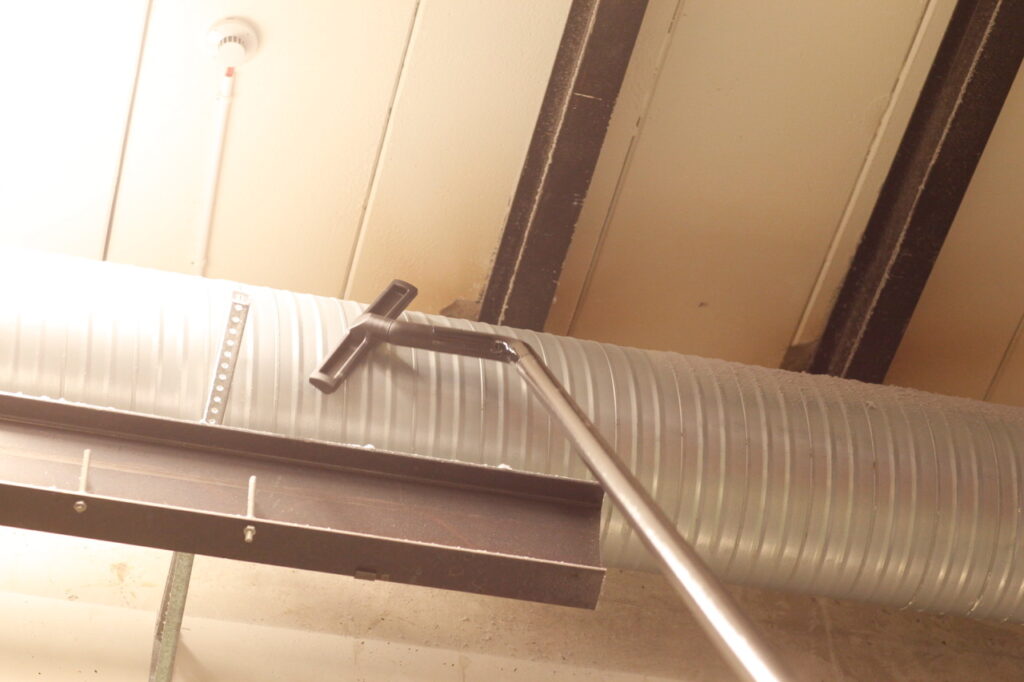

Watch how the operator controls the head from floor level and how the dust is drawn straight into the hose; in a museum the same technique is used with softer heads and lower suction.
How is a museum clean planned around visitors and collections?
It is planned room by room, outside opening hours where possible, with a condition record and a test area before the main work. The sequence below keeps every decision with the museum.
- Survey with the conservator. Walk each room, mark what is cleaned, only inspected or left untouched, and record heights and access.
- Record condition. Photograph surfaces before work so any change can be identified.
- Test a small area. Clean an agreed patch out of direct view and let the conservator approve the brush, suction and contact level.
- Protect below. The collections team covers or relocates vulnerable objects; the crew sets barriers so no visitor or staff member stands under the pole.
- Clean from the top down. Ceilings and cornices first, then fittings, then case tops and lower ledges.
- Inspect and hand back. Walk the room with the museum’s representative, compare with the photos and record what was done and anything noticed at height.
Museum high-level cleaning sequence
- Survey with conservator
- Record and test
- Protect objects below
- Clean top down
- Inspect and hand back
For occupied public buildings in general, see high-level cleaning for schools, malls, stadiums and airports. Large glazed voids are covered in atrium cleaning in malls, and decorated domes and chandeliers in mosque high level cleaning, which shares many heritage precautions.
Why clean from the ground rather than from towers or lifts?
Cleaning from the ground keeps heavy access equipment away from display cases, historic floors and doorways, and removes the need for people to work at height above the collection. It follows a recognised safety hierarchy: the UK Work at Height Regulations 2005 require employers to ensure work is not carried out at height “where it is reasonably practicable to carry out the work safely otherwise than at height”. This is UK law and does not bind Jordan, Saudi Arabia or Iraq, but it is a widely used reference and the same logic behind ground-based high-reach cleaning.
There are limits. Very high vaults, surfaces hidden behind suspended exhibits, or fragile decoration that needs close inspection may still need access equipment or a conservator working by hand. The survey should identify those areas so they are planned separately rather than forced.
What should the museum send before a survey?
A short information pack lets AFE judge feasibility and plan the right heads, vacuum and schedule before visiting.
- Photos of each room, the high surfaces and a close-up of the dust.
- Approximate heights or drawings of ceilings, vaults and galleries.
- The conservator’s list of surfaces to clean, inspect only or exclude.
- Heritage status of the building and any authority approval needed.
- Opening hours, closed days and windows when rooms can be cleared.
- Filter standard and any other equipment requirements from the conservator.
- Who handles electrical isolation, object protection and the hand-back record.
How does AFE support museum cleaning?
AFE provides Internal high clean dust removal, also searched as high-level dust removal, as an on-site service: survey, method statement, room-by-room schedule, ground-based cleaning with SpaceVac poles and a compatible vacuum, and a hand-back record. The scope covers building fabric and fixtures; objects, conservation treatment, electrical work and the inside of air-handling systems stay with the museum’s specialists.
Museums that prefer to keep cleaning in-house can obtain SpaceVac pole systems and compatible vacuums through AFE’s industrial vacuum range. Examples of the technique by application are in the execution gallery, and related planning guides are in the public buildings hub.
Al Faisaliah Enterprises · Aqaba
Plan a gentle high-level clean for your galleries
Share photos, approximate heights and your conservator's list of surfaces. AFE proposes a survey, test area and room-by-room plan for your team to approve.
Frequently asked questions
Can the cleaning team dust the exhibits as well as the ceiling?
Normally not. Objects in the collection are handled and cleaned by the museum's conservation staff or under their direct supervision. The high-level cleaning service covers building fabric and fixtures such as ceilings, cornices, beams, fittings and the outside of closed display cases. If the conservator wants a specific object cleaned, that is planned separately with them.
Is a HEPA vacuum necessary in a museum?
It is often requested, because a HEPA filter reduces the fine dust a vacuum exhausts back into the room, which NPS conservation guidance supports. The museum's conservator should set the filter standard. AFE then pairs the high-reach poles with a vacuum whose filter documentation matches that requirement.
Can the work be done while the museum is open?
Some rooms can be cleaned while others stay open, provided the work area is closed off and nobody stands under the pole. Most museums prefer early mornings, closed days or rooms already closed for rehanging. The schedule is built from the museum's opening hours and the collections team's availability.
How often should high surfaces in a museum be cleaned?
There is no fixed rule; NPS guidance notes that each building and collection will have its own dusting schedule. Set the first interval from the survey and adjust it from the records of each clean. Dust storms, nearby construction or changes to the ventilation system are good reasons to bring a clean forward.
Sources and references
- Conserve O Gram 15/2: Dusting Guidelines for Stone Objects and Interior Architectural Features · U.S. National Park Service
- Conserve O Gram 1/3: Preventive Conservation Recommendations for Organic Objects · U.S. National Park Service
- The Work at Height Regulations 2005, regulation 6 · UK legislation.gov.uk
- Internal high-level cleaning · SpaceVac International
- Resource hub: FAQs · SpaceVac International
This article is general technical guidance. Equipment suitability, ATEX conformity and hygiene performance must be confirmed for each site and application.
Written for plant, maintenance, HSE and quality teams in Jordan, Saudi Arabia and Iraq.