The short answer
A pharmaceutical site should evaluate dry steam as a cleaning method for defined, compatible equipment, not as a general hygiene solution. Define the equipment, residue and intended claim; screen surface compatibility; run a protocol-based trial; verify results against the site's own acceptance criteria; and approve the procedure through change control. Generator temperature alone proves nothing about the surface.
Key takeaways
- Start with the claim: cleaning, disinfection and sterilization are different outcomes, and the evidence must match the one intended.
- Screen every material, seal, label and electrical part for heat and moisture before any trial on real equipment.
- TECNOVAP's published temperatures are generator-side figures; they do not establish surface temperature or any microbial effect.
- Trial under a written protocol with the site's own acceptance criteria, then approve the procedure through change control.
- AFE supplies TECNOVAP generators and delivers steam cleaning services; a site assessment shows which route fits each application.
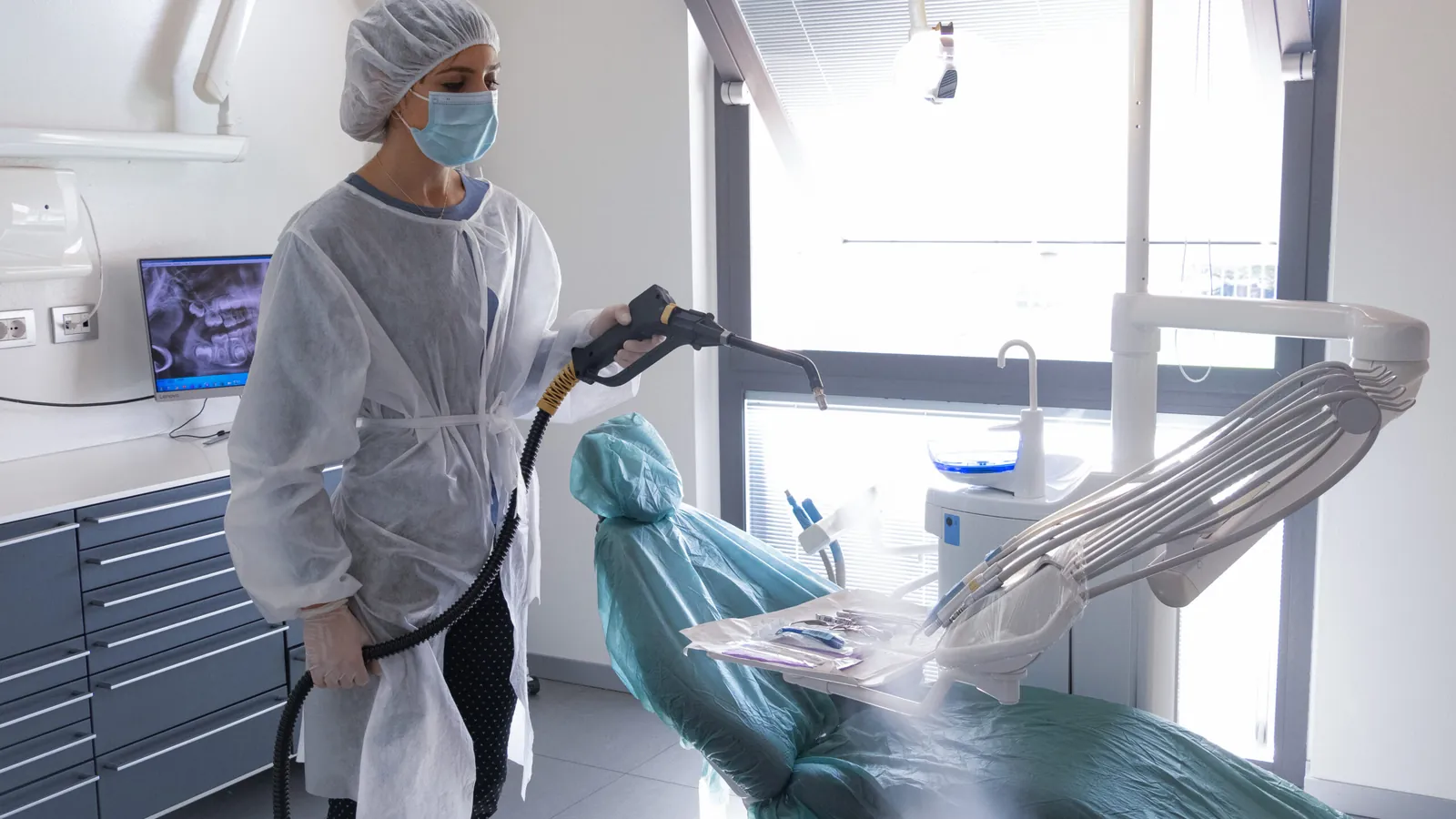
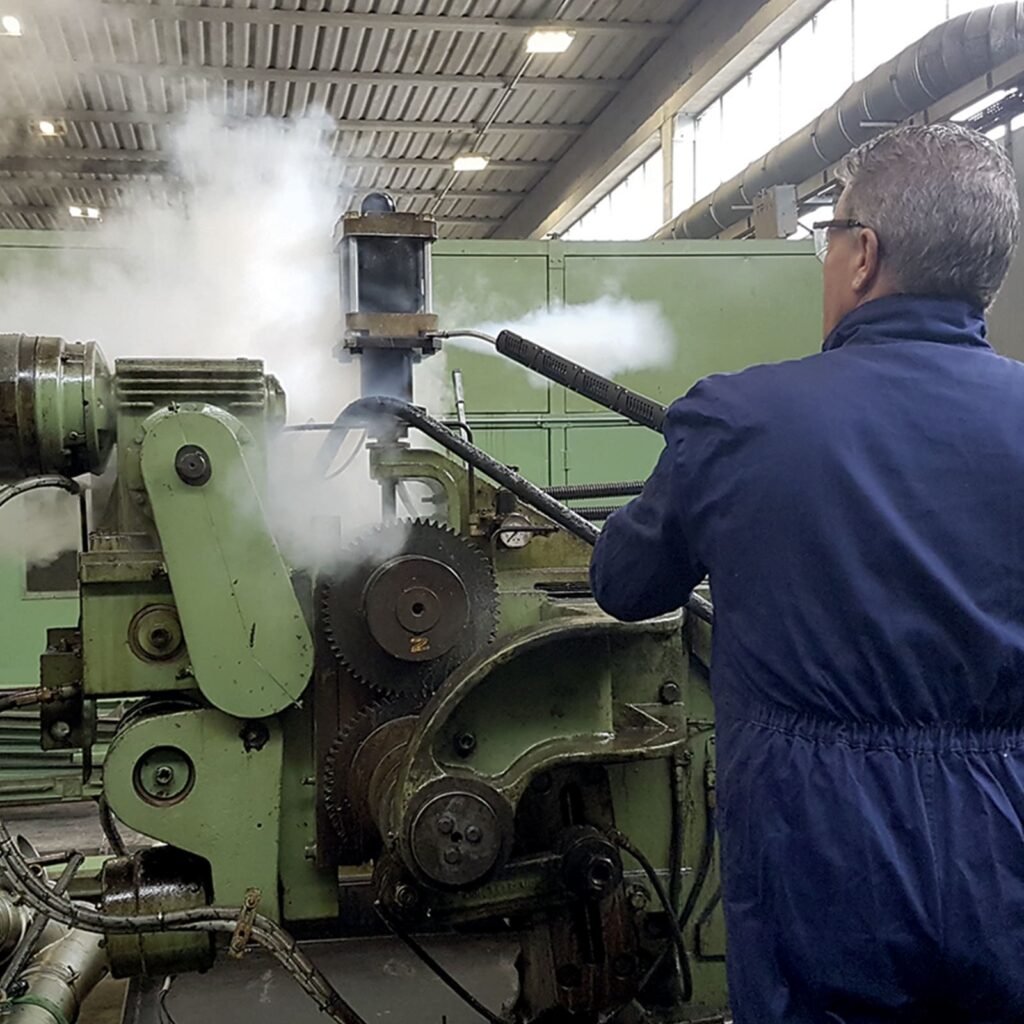
Validation and engineering teams are regularly asked whether steam could simplify the cleaning of trolleys, change parts, machine frames, workshop equipment or utility areas. The appeal is easy to see: dry saturated steam brings heat with little liquid water, and it can loosen grease and ingrained soil that is slow to remove by hand. But in a GMP environment, dry steam cleaning of pharmaceutical equipment has to be evaluated like any other change to a cleaning method.
This guide sets out how to evaluate a steam cleaning application in support areas: which questions come first, what to test, which evidence closes each question, and where steam should not be considered without a full validation case. It also distinguishes what AFE supplies as TECNOVAP equipment from what it delivers as a service.
Where can dry steam be considered on a pharmaceutical site?
Dry steam is best evaluated first in support areas, on equipment whose materials tolerate heat and moisture and where the residue is physical: grease, lubricant, adhesive or ingrained general soil. Each site defines its own support areas through its zoning and risk assessment, so the table below is a starting point for that discussion, not a classification.
| Area or equipment | Evaluation status | Main questions |
|---|---|---|
| Maintenance workshop machinery, tools and benches | Good first candidate | Lubricant type, electrical parts, condensate drainage |
| Secondary packaging line frames and guards | Candidate after screening | Plastics, labels, sensors, nearby open product |
| Trolleys, racks and change-part storage | Candidate after screening | Wheels and seals, drying time before reuse |
| Utility rooms, drains and waste areas | Candidate after screening | Run-off, splash onto nearby equipment |
| Product-contact equipment in processing areas | Only within the cleaning validation program | Residue limits, sampling method, effect on validated state |
| Sterile manufacturing areas | Not without a full validated case | Disinfection validation, condensate and particle control |
Product-contact surfaces and sterile areas are a different case because the method sits inside validated programs. EU GMP Annex 1 states that “for disinfection to be effective, prior cleaning to remove surface contamination should be performed” and that “the disinfection process should be validated.” Steam can be assessed there only as part of that program, never as a shortcut around it.
What should be defined before any trial?
Define the equipment, the residue and the intended claim before anyone switches on a generator; otherwise the trial cannot pass or fail. The claim matters most, because cleaning, disinfection and sterilization are different outcomes that need different evidence.
The CDC’s definitions are a useful anchor. Cleaning is the removal of adherent visible soil; disinfection is the thermal or chemical destruction of pathogenic and other microorganisms; sterilization is a “validated process used to render a product free of all forms of viable microorganisms.” Dry steam used on support-area equipment is a cleaning claim. A further disinfection or sanitization claim needs separate, validated evidence, as building a verified dry steam hygiene procedure explains.
Record for each candidate application:
- The equipment item, its materials of construction and any manufacturer cleaning restrictions.
- The residue: what it is, how old it is, and how it is removed today.
- The area, its classification and what is exposed nearby.
- The intended claim: cleaning only, or a further hygiene claim that will need validation.
- The current method’s time, water and chemical use, and its known problems, as the baseline.
- The acceptance criteria the site will apply: visual standard, residue limit or another test.
How should surface compatibility be screened?
Screen on paper first, then on coupons or a hidden area, and only then on the equipment itself. Heat and moisture affect materials differently, and the costly failures tend to be seals, plastics, labels and electronics rather than the stainless steel frame.
| Component | Typical concern | How to check |
|---|---|---|
| Stainless steel and other metals | Generally tolerant; check special finishes or coatings | Equipment manual; coupon test |
| Plastics, polymers and clear guards | Softening, distortion or crazing with heat | Material datasheet; hidden-area test |
| Seals, gaskets and wheels | Heat ageing, swelling or loss of fit | Manufacturer guidance; inspection after the trial |
| Labels, tags and markings | Lifting or loss of legibility, a traceability issue | Identify and protect before the trial |
| Electrical and electronic parts | Moisture ingress and condensation | IP rating; manufacturer guidance; isolation by site staff |
| Painted or coated surfaces | Blistering or loss of coating | Hidden-area test |
Also consider what steam does to the surroundings. Loosened residue and condensate can be carried onto adjacent surfaces, and EU GMP asks that cleaning equipment be “chosen and used in order not to be a source of contamination.” Recovering residue by vacuum or wiping, controlling stand-off distance and protecting nearby equipment all belong in the trial design. Ask quality which water quality may feed the generator, since whatever is in the feed water can end up on the surface as condensate.
What do manufacturer steam figures prove, and what do they not?
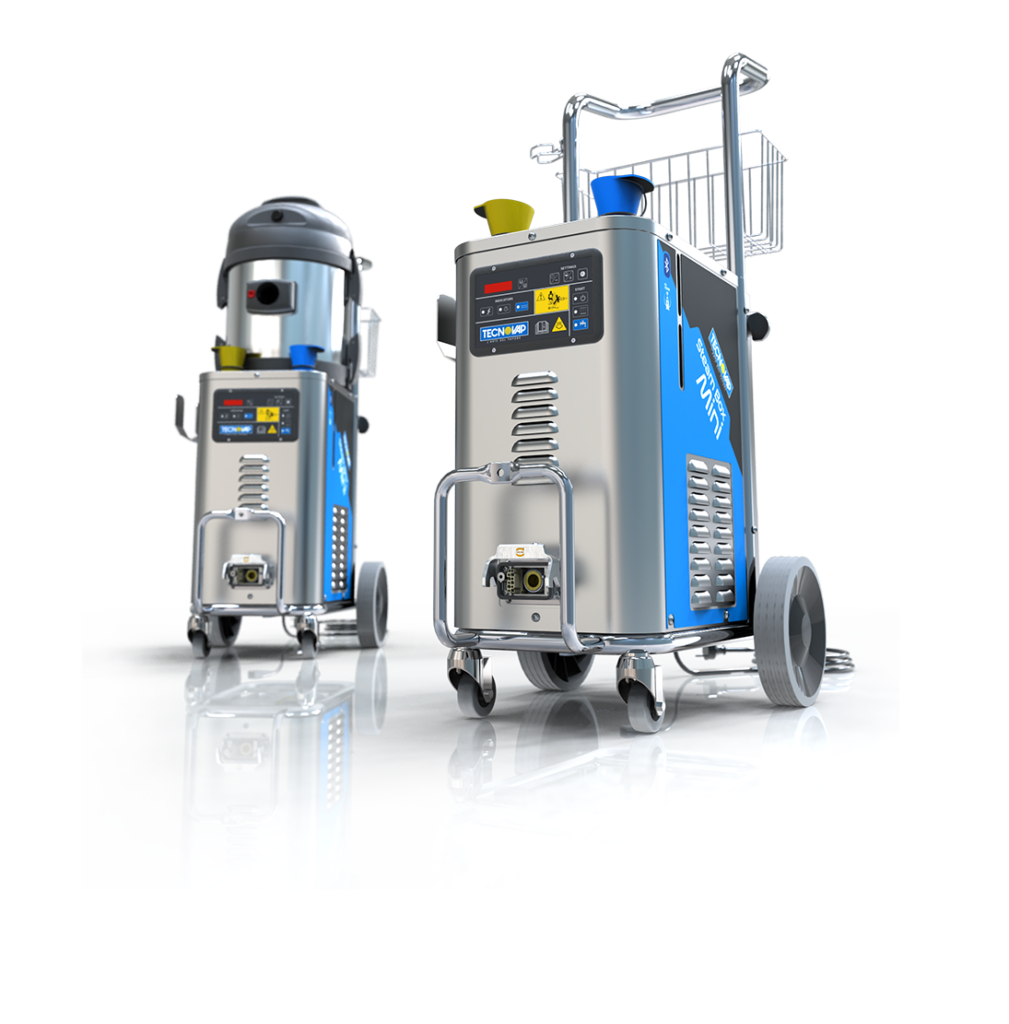
Manufacturer figures describe the generator, not the result on your surface. TECNOVAP states, for example, that its EVO model is “able to deliver dry saturated steam 174°C and detergent injection,” and that its Steam Box Vac Industrial delivers “dry saturated steam at 183° C” and includes a wet/dry vacuum cleaner. These are generator-side figures. Surface temperature depends on the accessory, distance, pass speed and the material itself, and no published figure supports a surface or nozzle temperature.
Laboratory efficacy data has similar limits. TECNOVAP reports tests to the French standard AFNOR NF T72-110 at the VirHealth laboratory, but only for its Evo 304, Evo Blu and Evo Sanitizer models, with a steam mop or a lance moved at 10 cm/s, the lance held 1.5 cm from the surface. Those results do not transfer to other models, accessories, speeds or surfaces, and they are not site validation. Evidence needed for steam sanitization claims explains how to read such data.

TECNOVAP presents this industrial range for the food, mechanical and pharmaceutical industries. Use it to see the equipment types available, not as evidence for a specific application.
How should a dry steam cleaning trial for pharmaceutical equipment be run?
Run it under a written protocol approved by quality, with acceptance criteria fixed in advance and every variable recorded. EU GMP expects “effective and reproducible cleaning processes,” and a demonstration that looks impressive but cannot be repeated is not evidence.
- Write the protocol. Name the equipment, residue, area, claim, acceptance criteria, sampling method and who signs off.
- Fix the method variables. Record the generator model, accessory, settings, stand-off distance, pass speed, any detergent and how loosened residue is recovered.
- Prepare the area. Isolate and cool the equipment, protect labels and electronics, and segregate nearby open product or clean equipment.
- Clean a defined section. Treat a marked area, time it, and record water or chemical use against the current method.
- Verify. Inspect visually, sample for residues where the criteria require it, and check surfaces and components for damage after drying.
- Repeat. Run enough repetitions, ideally with different operators, to show the result is reproducible.
- Decide and document. Accept, adjust or reject, then draft the SOP, training and change-control record.
Evaluating a dry steam application
Which evaluation mistakes should validation teams avoid?
Most failed evaluations trace back to a missing definition rather than to the equipment. Watch for these:
- Testing without a claim. A trial with no defined outcome cannot support an SOP.
- Treating generator temperature as surface data. It is not, and auditors will ask.
- Extending lab results across models. Efficacy reports apply only to the tested models, accessories and conditions.
- Ignoring the surroundings. Condensate and loosened residue can land on clean or exposed surfaces.
- Skipping the baseline. Without the current method’s time and results, no improvement can be shown.
- Forgetting drying and reuse. Define how long equipment must dry and how it is inspected before return to use.
How can AFE support the evaluation?
AFE supports both routes a pharmaceutical site may choose. As a trading partner, it supplies TECNOVAP dry saturated steam generators and accessories for in-house teams, with spare parts and consumables to keep them running. As a service provider, it delivers industrial steam cleaning on agreed scopes, which can suit periodic deep cleaning of support-area equipment or the evaluation phase itself.
In both cases, the starting point is a site assessment. AFE reviews the candidate equipment, materials and residues, proposes a trial method and records the variables your protocol needs, while the validation decision, acceptance criteria and change control stay with your quality unit. Where a trial period is useful before purchase, rental options can be discussed. More guidance for pharmaceutical plants is collected in the pharma insights hub.
Al Faisaliah Enterprises · Aqaba
Assess a dry steam application on your site
Send AFE the candidate equipment, materials, residues and your acceptance criteria. You get a screened shortlist, a proposed trial method and the variables your protocol should record.
Frequently asked questions
Can dry steam replace our validated cleaning procedure for product-contact parts?
Not by itself. A validated procedure can only be changed through change control, with new evidence that the modified method meets the same acceptance criteria. Dry steam may be assessed as one step within that program, for example to loosen residues before a validated wash, but it does not replace residue testing or a validated disinfection step where one is required.
Is dry steam suitable for cleaning near cleanrooms or controlled areas?
It depends on what the area and its quality team will accept. Steam produces condensate and can move loosened residue, so work near controlled areas needs segregation, residue recovery, and agreement on feed-water quality and drying. A practical approach is to start in maintenance or packaging support areas, where the evaluation is simpler, before considering anything closer to product.
Does TECNOVAP's AFNOR test mean the equipment disinfects surfaces on our site?
No. TECNOVAP reports AFNOR NF T72-110 results for three named models with specific accessories, at a set pass speed, under laboratory conditions. Your surfaces, soil, accessories, operator technique and environment differ. If you need a disinfection claim, it must be supported by your own validated data; the laboratory report can inform the study design but cannot replace it.
Should we buy a steam generator or use a cleaning service?
Buying suits sites with frequent, well-defined tasks and trained staff who follow an approved SOP. A service can suit periodic deep cleaning, shutdown work or the evaluation phase, before committing to equipment. Either way, the surface screening and trial evidence are the same; the choice depends on frequency, staffing and who will own the procedure.
What documents should we expect from the supplier for the evaluation?
At least the generator datasheet with the model's stated output and settings, accessory descriptions, operating and safety instructions, and maintenance requirements. For the trial, expect a record of the exact model, accessories, settings and method used, so your protocol and final SOP can reproduce it. Any hygiene claim should come with its test report and stated scope.
Sources and references
- EudraLex Volume 4, EU GMP Chapter 3: Premises and Equipment · European Commission
- EudraLex Volume 4, EU GMP Chapter 5: Production · European Commission
- EU GMP Annex 1: Manufacture of Sterile Medicinal Products · European Commission
- Guideline for Disinfection and Sterilization in Healthcare Facilities: Glossary · U.S. Centers for Disease Control and Prevention
- AFNOR NF T72-110 · TECNOVAP
- EVO 304 DET · TECNOVAP
- Steam Box Vac Industrial · TECNOVAP
This article is general technical guidance. Equipment suitability, ATEX conformity and hygiene performance must be confirmed for each site and application.
Written for plant, maintenance, HSE and quality teams in Jordan, Saudi Arabia and Iraq.